
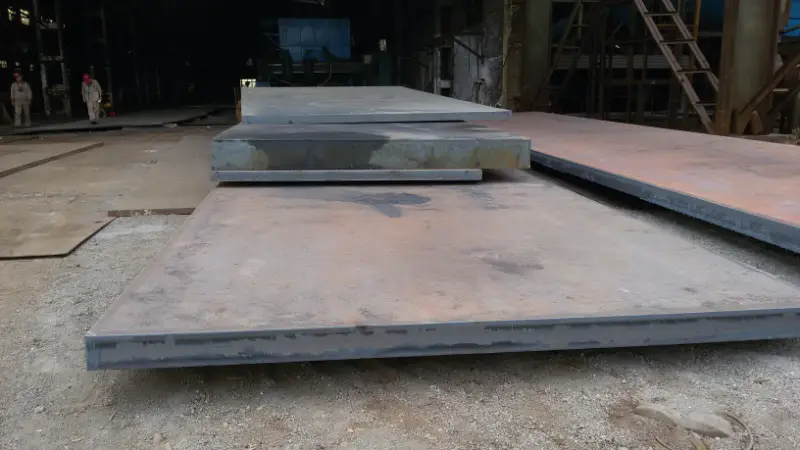
ASTM A656 Grade 80
ASTM A656 Grade 80: High-Strength Low-Alloy Steel Coil for Advanced Structural Applications
Comprehensive technical data for ASTM A656/A656M Grade 80 carbon and low-alloy high-strength steel coil, covering chemistry, mechanical and physical properties, equivalents, and applications.
Hot rolling, controlled rolling, cold forming, bending, welding, machining
- Phone : +8618037372205
- Email : [email protected]
- WhatsApp: Contact via Whtsapp
- WeChat: +8618037372205
ASTM A656 Grade 80 Introduction
ASTM A656/A656M Grade 80 is a hot-rolled, high-strength low-alloy (HSLA) structural steel coil with excellent formability. It offers a minimum yield strength of 550 MPa (80 ksi) and minimum tensile strength of 655 MPa (95 ksi) at thicknesses up to 40 mm, making it suitable for weight-critical structural components. The microalloyed chemistry (C ≤ 0.18%, Mn ≤ 1.65%) with optional Nb, V, or Ti provides grain refinement and precipitation strengthening, delivering a balanced combination of strength, toughness, and weldability. This grade is widely adopted in
- automotive frames
- crane booms
- construction machinery
- shipbuilding
where reduced weight and high load-bearing capacity are required. The steel is typically supplied in the as-rolled or controlled-rolled condition, enabling further cold forming and fabrication.
ASTM A656 Grade 80 Chemical Composition
The following limits, according to ASTM A656/A656M, apply to the heat analysis. Microalloying elements such as niobium, vanadium, titanium, or aluminum may be added singly or in combination to achieve grain refinement and precipitation hardening. The steel is fully killed and produced to a fine grain practice.
| Element | Standard Value (max, unless range) | Remarks |
|---|---|---|
| C (Carbon) | 0.18 % | Maximum |
| Mn (Manganese) | 1.65 % | Maximum |
| P (Phosphorus) | 0.025 % | Maximum |
| S (Sulfur) | 0.035 % | Maximum |
| Si (Silicon) | 0.60 % | Maximum |
| Nb, V, Ti, etc. | Not specified (optional additions) | Used for grain refinement and strengthening |
| Al (Aluminum) | ≥ 0.020 % (if used for killing) | Fine grain practice |
ASTM A656 Grade 80 Physical Properties
These physical properties are representative of carbon-manganese HSLA steels and are not part of the ASTM A656 specification. They are provided for engineering calculations and design purposes. Properties are valid at ambient temperature unless otherwise noted.
| Property | Typical Value | Unit | Test Condition |
|---|---|---|---|
| Density (ρ) | 7.85 | g/cm³ | Ambient |
| Modulus of Elasticity (E) | 200 | GPa | Ambient |
| Shear Modulus (G) | 80 | GPa | Calculated (E, ν) |
| Poisson's Ratio (ν) | 0.30 | - | Ambient |
| Thermal Expansion (α) | 12.2 | µm/m·°C | 20–100 °C |
| Thermal Expansion (α) | 13.8 | µm/m·°C | 20–400 °C |
| Thermal Conductivity (λ) | 50 | W/m·K | Ambient |
| Specific Heat Capacity | 460 | J/kg·K | Ambient |
| Electrical Resistivity (ρe) | 0.22 | µΩ·m | Ambient |
ASTM A656 Grade 80 Mechanical Properties
Mechanical properties are tested in accordance with ASTM A370. Yield strength, tensile strength, and elongation are measured on transverse specimens. Bending tests are performed with the axis of the bend transverse to the rolling direction. Values depend on plate/coil thickness.
| Property | Standard Required Value | Unit | Test Condition |
|---|---|---|---|
| Yield Strength (ReH) | 550 | MPa | Thickness ≤ 20 mm (0.75 in) |
| Yield Strength (ReH) | 550 | MPa | Thickness > 20 to 40 mm (0.75-1.5 in) |
| Yield Strength (ReH) | 515 | MPa | Thickness > 40 to 50 mm (1.5-2 in) |
| Tensile Strength (Rm) | 655 | MPa | Thickness ≤ 20 mm |
| Tensile Strength (Rm) | 655 | MPa | Thickness > 20 to 40 mm |
| Tensile Strength (Rm) | 620 | MPa | Thickness > 40 to 50 mm |
| Elongation (A) in 2 in. (50 mm) | 15 | % | Thickness ≤ 20 mm |
| Elongation (A) in 2 in. (50 mm) | 14 | % | Thickness > 20 to 40 mm |
| Elongation (A) in 2 in. (50 mm) | 13 | % | Thickness > 40 to 50 mm |
| Elongation (A) in 8 in. (200 mm) | 12 | % | Thickness ≤ 20 mm |
| Elongation (A) in 8 in. (200 mm) | 11 | % | Thickness > 20 to 40 mm |
| Elongation (A) in 8 in. (200 mm) | 10 | % | Thickness > 40 to 50 mm |
| Bend Test (Mandrel Diameter) | 2.5t (t=thickness) | - | Thickness ≤ 20 mm |
| Bend Test (Mandrel Diameter) | 3.0t | - | Thickness > 20 to 25 mm |
| Bend Test (Mandrel Diameter) | 3.5t | - | Thickness > 25 to 40 mm |
| Bend Test (Mandrel Diameter) | 4.0t | - | Thickness > 40 to 50 mm |
ASTM A656 Grade 80 Directly Equivalent Material Standards and Replaceable Grades
| Country/Region | Standard | Grade | Remarks |
|---|---|---|---|
| USA | ASME SA656 | Grade 80 | Identical to ASTM A656, accepted for pressure vessel components |
| USA | ASTM A1018/A1018M (formerly A1011 HSLAS) | Grade 80 Class 1/2 | Similar HSLA grade for sheet/coil, not plate; check thickness range |
| International | EN 10149-2 | S550MC | Nearest European HSLA grade for cold forming; yield ≥550 MPa, tensile 600–760 MPa; not identical chemical limits |
| Japan | JIS G 3134 | SPFH590 | Tensile strength ≥590 MPa; yield not directly comparable; for structural uses requiring formability |
| Australia/New Zealand | AS/NZS 1594 | HA550 | Yield 550 MPa min; approximate substitute for structural applications |
ASTM A656 Grade 80 Application Introduction
ASTM A656 Grade 80 steel coil excels where high strength, good weldability, and improved formability are required. It is typically used in weight-sensitive structural components that undergo cold bending or drawing. The material can be processed by laser cutting, plasma cutting, shearing, or press braking, and it is compatible with all standard welding procedures (SMAW, GMAW, FCAW) with proper preheating if thick sections are joined.
Product Applications: Truck chassis frames and longitudinal beams, Telescopic crane booms and outrigger legs, Dump truck bodies and tipper frames, Shipping containers and intermodal frames, Construction scaffolding and shoring systems, Wind turbine tower sections and foundations, Armor plates and blast-resistant structures (when certified)
Processed into products: Chassis rails and cross-members, Boom sections and articulated joints, Bucket and blade structural ribs, Mounting brackets, gussets, and reinforcement plates, Flanges for structural beams, Joints and connectors in welded assemblies
Application industries: Heavy-duty truck and trailer manufacturing, Construction and earthmoving equipment (excavators, loaders), Crane and lifting equipment, Agricultural machinery (harvesters, sprayers), Railcar and container fabrication, Bridge and infrastructure engineering, Offshore and marine structures
ASTM A656 Grade 80 Similar High-Strength Low-Alloy Steel Alternatives
| Country/Region | Standard | Grade | Remarks |
|---|---|---|---|
| USA | ASTM A656/A656M | Grade 70 | Yield 485 MPa, for less demanding applications |
| USA | ASTM A656/A656M | Grade 100 | Yield 690 MPa, higher strength, requires stricter forming control |
| USA | ASTM A572/A572M | Grade 65 | Yield 450 MPa, lower strength HSLA structural steel; widely used |
| USA | ASTM A871/A871M | Grade 60/65 | Weathering HSLA steel, similar strength range but added atmospheric corrosion resistance |
| Europe | EN 10149-2 | S600MC | Yield ≥600 MPa; for demanding cold-formed structural components |
| Europe | EN 10149-2 | S650MC | Yield ≥650 MPa; higher strength variant, reduced ductility |
| Japan | JIS G 3106 | SM570 | Weldable structural steel, yield ≥460 MPa, tensile 570–720 MPa; used in bridges and buildings |
| China | GB/T 1591 | Q550D | Yield ≥550 MPa; similar strength, different chemical approach |
Notes:
Processing Notes: The steel is supplied with a mill edge or trimmed edge, and as rolled or descaled surface. For thicknesses over 12 mm, Charpy V-notch impact tests can be agreed upon between purchaser and supplier. Typical values at -20°C exceed 27 J for standard quality. Heat treatment (normalizing) may be applied to homogenize properties after severe forming. When welding, low-hydrogen practices and matching strength consumables (e.g., E80XX electrodes) are recommended. Formability: Minimum bending radii are typically 2.5t for thin gauges; cold forming should be carried out in the as-rolled condition. For severe deformations, stress-relief annealing at 600–650°C is advised.
- Share



