
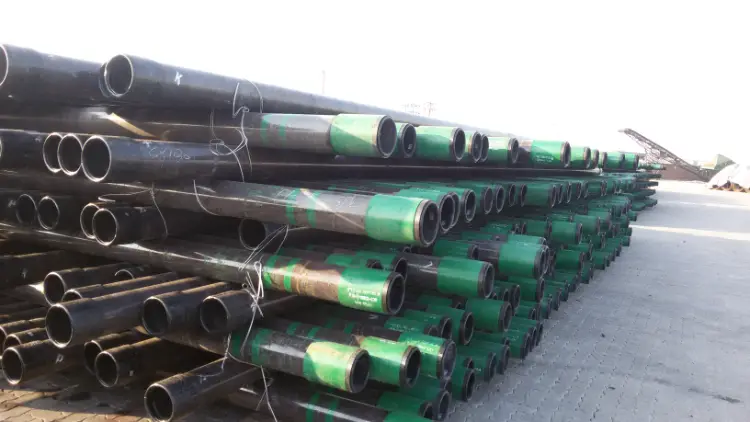
Q345C Seamless Steel Pipe for Fluid Service
Q345C Seamless Pipe per GB/T8163 for Fluid Service – Data & Equivalents
Explore comprehensive technical data for Q345C seamless steel pipe under GB/T 8163: chemical composition, tensile strength, impact toughness, physical properties, and international equivalent material standards for fluid transportation and pressure applications.
Seamless hot rolling, hot expansion, cold drawing, or cold rolling; welded manufacturing is not permitted under this standard for the base pipe.
- Phone : +8618037372205
- Email : [email protected]
- WhatsApp: Contact via Whtsapp
- WeChat: +8618037372205
Q345C Seamless Steel Pipe for Fluid Service Introduction
GB/T 8163 Q345C seamless steel pipe is a China-standard low-alloy high-strength structural steel pipe intended for conveying fluids such as water, oil, gas, and steam. The material is produced by hot-finished or cold-drawn seamless processes, ensuring uniform wall thickness and superior pressure retention.
- Key attributes: minimum yield strength of 345 MPa at thickness ≤16 mm, tensile strength in the range 470–630 MPa, and guaranteed impact toughness of at least 34 J at 0°C.
- Weldability: good, with low carbon equivalent; suitable for field welding and fabrication.
- Service temperature: reliable down to 0°C thanks to the C-class (0°C) impact testing requirement.
- Corrosion resistance: equivalent to common structural carbon-manganese steels; internal/external coatings can extend service life.
The grade is widely adopted in China and recognized internationally through equivalent standards for pitting, pressure piping, and structural tubing.
Q345C Seamless Steel Pipe for Fluid Service Chemical Composition
The chemical requirements are based on GB/T 8163-2018 Table 3 for grade Q345C. The steel is micro-alloyed with one or more grain-refining elements (Nb, V, Ti) and aluminium to achieve fine grain size and low-temperature toughness. Maximum total micro-alloying element content is 0.22%. Residual elements are controlled to ensure weldability and base metal properties.
| Element | Specified Value | Remarks |
|---|---|---|
| Carbon (C) | ≤0.20% | Heat analysis maximum |
| Silicon (Si) | ≤0.55% | |
| Manganese (Mn) | 1.00–1.60% | |
| Phosphorus (P) | ≤0.025% | Controls cold shortness |
| Sulfur (S) | ≤0.020% | Controls hot shortness |
| Niobium (Nb) | ≤0.22% (Nb+V+Ti) | When used alone, usually 0.015–0.050% |
| Vanadium (V) | ≤0.22% (Nb+V+Ti) | When used alone, usually 0.02–0.12% |
| Titanium (Ti) | ≤0.22% (Nb+V+Ti) | When used alone, usually 0.01–0.10% |
| Aluminium (Al) | ≥0.015% (acid-soluble) | Minimum required for fine grain practice |
| Chromium (Cr) | ≤0.30% (residual) | Residual element, not intentionally added |
| Nickel (Ni) | ≤0.30% (residual) | Residual element, not intentionally added |
| Copper (Cu) | ≤0.20% (residual) | Residual element, not intentionally added |
| Nitrogen (N) | ≤0.012% (if Al not used) | When not combined with sufficient Al; otherwise bounded by micro-alloy limits |
Q345C Seamless Steel Pipe for Fluid Service Thermal and Electrical Physical Properties
The following data are typical engineering values for Q345C steel and are not mandatory requirements of GB/T 8163. They are compiled from published data for similar low-alloy Mn-Si structural steels. Actual properties may vary depending on production route and heat treatment condition. These values are useful for design calculations involving heat transfer, thermal expansion, and electrical resistivity.
| Property | Typical Value | Unit | Test Condition / Remarks |
|---|---|---|---|
| Density (ρ) | 7.85 | g/cm³ | At 20°C |
| Modulus of elasticity (E) | 206 | GPa | At room temperature |
| Shear modulus (G) | 79.4 | GPa | At room temperature, derived from E and Poisson's ratio |
| Poisson's ratio (ν) | 0.30 | - | Elastic range, room temperature |
| Coefficient of thermal expansion (α) | 10.8 × 10⁻⁶ | K⁻¹ | Linear, 20–100°C range |
| Coefficient of thermal expansion (α) | 11.6 × 10⁻⁶ | K⁻¹ | Linear, 20–200°C range |
| Coefficient of thermal expansion (α) | 12.5 × 10⁻⁶ | K⁻¹ | Linear, 20–400°C range |
| Thermal conductivity (λ) | 53 | W/(m·K) | At 100°C |
| Thermal conductivity (λ) | 48 | W/(m·K) | At 300°C |
| Thermal conductivity (λ) | 42 | W/(m·K) | At 500°C |
| Specific heat capacity (cp) | 480 | J/(kg·K) | At 20°C to 100°C |
| Specific heat capacity (cp) | 520 | J/(kg·K) | At 200°C |
| Specific heat capacity (cp) | 580 | J/(kg·K) | At 400°C |
| Electrical resistivity (ρ_e) | 0.23 | μΩ·m | At 20°C (23 microhm·cm) |
Q345C Seamless Steel Pipe for Fluid Service Mechanical Properties
Mechanical properties are defined in GB/T 8163-2018, Table 4. Requirements apply to the base pipe in the delivery condition (generally normalized or as-rolled). Impact testing is mandatory for Q345C at 0°C using full-size longitudinal Charpy V-notch specimens (10×10×55 mm). For sub-size specimens, minimum absorbed energy is proportionally reduced. Ductility and bend test requirements ensure formability and resistance to cracking during installation.
| Property | Required Value | Unit | Test Condition / Remarks |
|---|---|---|---|
| Tensile strength (Rm) | 470–630 | MPa | Transverse strip or longitudinal specimen, at room temperature |
| Yield strength (ReH/Rel) | ≥345 | MPa | Wall thickness ≤16 mm |
| Yield strength (ReH/Rel) | ≥335 | MPa | Wall thickness >16 to ≤40 mm |
| Yield strength (ReH/Rel) | ≥325 | MPa | Wall thickness >40 to ≤63 mm |
| Yield strength (ReH/Rel) | ≥315 | MPa | Wall thickness >63 to ≤80 mm |
| Yield strength (ReH/Rel) | ≥305 | MPa | Wall thickness >80 to ≤100 mm |
| Elongation after fracture (A) | ≥21% (longitudinal) | % | Wall thickness ≤40 mm, gauge length 5.65√S0 |
| Elongation after fracture (A) | ≥20% (longitudinal) | % | Wall thickness >40 mm, gauge length 5.65√S0 |
| Impact absorbed energy (KV2) | ≥34 (full-size) | J | 0°C, longitudinal, 10×10×55 mm Charpy V-notch |
| Impact absorbed energy (KV2) | ≥27 (7.5×10×55) | J | 0°C, sub-size, energy proportional to cross-section area |
| Impact absorbed energy (KV2) | ≥21 (5×10×55) | J | 0°C, sub-size, energy proportional to cross-section area |
| Bend test (180°) | No cracks or opening | - | Mandrel diameter: 2a (t≤16mm); 3a (t>16mm); a=wall thickness |
| Flattening test | No cracks or laps | - | Distance between platens calculated per standard equation; applicable to OD≤400mm |
Q345C Seamless Steel Pipe for Fluid Service Completely Equivalent Material Standards and Substitute Grades
| Country/Region | Standard | Grade | Remarks |
|---|---|---|---|
| Europe | EN 10210-1 (hot-finished structural hollow sections) | S355J0H | Similar yield (355 MPa) and 0°C impact; chemistry and production route differ. Often used interchangeably for non-sour fluid service after supplementary testing. |
| Europe | EN 10025-2 (flat products) | S355J0 | Equivalent base steel for plate; not a pipe standard but indicates equivalent steel designation. |
| International | ISO 3183 (petroleum and natural gas — steel pipeline pipe) | L360NB (formerly L360) | Higher yield (360 MPa min); chemical and toughness requirements overlap, can be considered an upgrade. |
| USA | ASTM A106 / A53 | Grade B (with supplementary S5 impact test) | Lower yield (240 MPa min) but widely used for fluid pipes; not chemically equivalent; requires verification of impact and strength. |
| Japan | JIS G 3445 (machine structural carbon steel tubes) | STKM 18A / 18B | Strength is lower; only a rough functional substitute for non-critical structural applications. |
Q345C Seamless Steel Pipe for Fluid Service Application Introduction
Q345C seamless pipe under GB/T 8163 is designed for conveying fluids under pressure and for general structural applications requiring good low-temperature toughness. Its combination of moderate strength, weldability, and cost efficiency makes it a backbone material for utility, energy, and industrial piping networks.
Product Applications: Seamless line pipes for oil & gas flowlines, Pressure piping systems (ASME B31.3 / B31.4 class designs), Heat exchanger tubes (if cold-drawn tight tolerance is required), Mechanical structural hollow sections (when ordered to GB/T 8162 dual-certification), Boiler tubes (only for non-superheater, low-pressure sections, in accordance with applicable codes)
Processed into products: Straight pipes and fittings (elbows, tees, reducers) fabricated by cold/hot bending, Flanges and weld-neck connectors (when forged from equivalent plate, e.g., Q345C per GB/T 1591), Valve bodies and piping spools, Transition pieces and adapters for offshore risers (subject to corrosion allowance), Structural supports, bracing, and truss members where fluid is also carried internally
Application industries: Oil & Gas (gathering lines, utility piping, instrument air), Petrochemical and chemical plants (process water, steam, hydrocarbon transport), Power generation (cooling water, auxiliary steam, compressed air), Shipbuilding and offshore (ballast water, seawater systems, firefighting), Water treatment and municipal engineering (potable water, sewage), Construction and infrastructure (structural supports, piling, bridge service conduits)
Q345C Seamless Steel Pipe for Fluid Service Similar / Functionally Comparable Material Recommendations
| Country/Region | Standard | Grade | Remarks |
|---|---|---|---|
| China | GB/T 8162 (structural seamless pipes) | Q345C | Identical chemistry and mechanical requirements but intended for structural use. Can substitute in low-pressure fluid service if certified to GB/T 8163 additional tests. |
| China | GB/T 3091 (welded steel pipe for low-pressure fluid) | Q345B (HFW pipe) | Welded pipe with similar strength but lower impact toughness (B class, 20°C). Suitable for non-sour water/air lines. |
| Europe | EN 10217-3 (welded tubes for pressure purposes, fine grain steels) | P355N | Welded tube with similar yield and impact; seamless version available under EN 10216-3. More controlled chemistry for pressure equipment. |
| International | API 5L Line Pipe | X52 (L360) PSL1 | Higher yield (360 MPa) but very common for fluid transport; often dual-certified with ISO 3183 L360. Suitable as a higher-strength alternative. |
| USA | ASTM A500 Grade C (cold-formed welded structural tubing) | Grade C | Yield 345 MPa; not intended for pressure fluid service; may be acceptable for structural fluid conveyance under limited conditions with additional verification. |
Notes:
Supplementary remarks:
- The product analysis tolerances for chemical composition shall follow GB/T 222 or the applicable product standard.
- For pipes intended for sour service or hydrogen-containing media, additional testing per NACE MR0175/ISO 15156 and compliance with hardness limits are required; standard Q345C is not pre-qualified for sour service.
- Non-destructive testing (ultrasonic or eddy current) can be specified as a supplementary requirement for critical fluid services.
- Surface condition: the pipe shall be free from scale, cracks, and injurious defects; a protective varnish or oil coating is often applied to prevent atmospheric corrosion during transportation and storage.
- Marking includes manufacturer's name, standard, grade, diameter, wall thickness, heat number, and (when applicable) the letter "C" to denote the 0°C impact class.
- Share



