
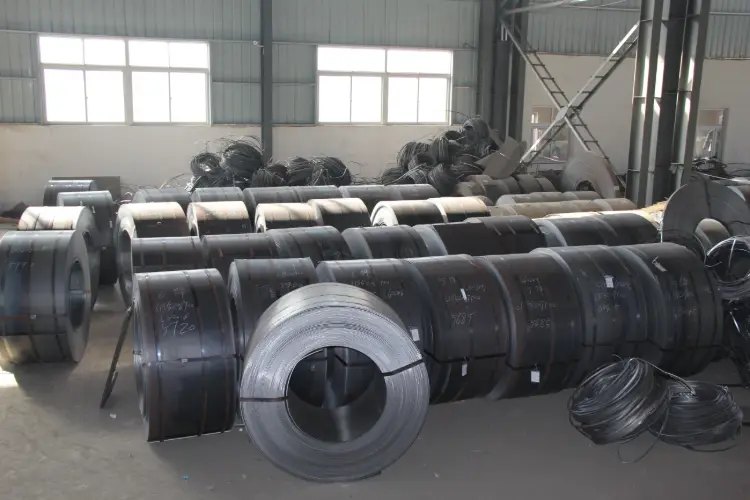
ASTM A633 Gr.A Carbon & HSLA Steel Coil for Welded Structures
ASTM A633 Gr.A Carbon & HSLA Steel Coil for Welded Structures
Explore normalized high-strength low-alloy steel coil ASTM A633 Grade A for heavy welded structures. Get complete data: chemical composition, mechanical properties, thermal performance, equivalent grades, and typical applications.
Hot rolling, Normalizing, Cutting, Welding, Bending, Forming, Machining
- Phone : +8618037372205
- Email : [email protected]
- WhatsApp: Contact via Whtsapp
- WeChat: +8618037372205
ASTM A633 Gr.A Carbon & HSLA Steel Coil for Welded Structures Introduction
ASTM A633/A633M Grade A is a carbon and low-alloy high-strength structural steel supplied in normalized condition. It offers a minimum yield strength of 290 MPa (42 ksi) and is primarily intended for welded, riveted, or bolted construction of bridges, buildings, and heavy machinery. This grade is classified as a carbon steel type within the A633 standard, characterized by its fine grain practice and improved notch toughness compared to ordinary structural carbon steels. Typical delivery forms include coil, plate, sheet, and strip, allowing versatile fabrication. With good weldability, moderate strength, and reliable toughness at low temperatures, it is widely used in North America and recognized internationally through comparable standards.
ASTM A633 Gr.A Carbon & HSLA Steel Coil for Welded Structures Chemical Composition
ASTM A633 Grade A is a carbon steel with controlled manganese and silicon content. Copper may be specified for improved atmospheric corrosion resistance (copper steel). The low carbon level ensures good weldability, while phosphorus and sulfur are restricted to guarantee cleanliness. No intentional addition of niobium, vanadium, or other microalloying elements is required, unlike higher-strength grades in the same standard. Residual elements (Ni, Cr, Mo) are allowed up to certain limits but are not typically reported unless by agreement.
| Chemical Element | Composition (%) | Notes |
|---|---|---|
| Carbon, C | ≤ 0.18 | Maximum |
| Manganese, Mn | 0.70 - 1.35 | Product analysis tolerance applies |
| Phosphorus, P | ≤ 0.040 | Maximum |
| Sulfur, S | ≤ 0.050 | Maximum |
| Silicon, Si | 0.15 - 0.50 | Product analysis tolerance applies |
| Copper, Cu | ≥ 0.20* | Minimum when copper steel is specified; otherwise residual |
| Nickel, Ni | residual ≤ 0.25 | Not required; for reference only |
| Chromium, Cr | residual ≤ 0.25 | Not required; for reference only |
| Molybdenum, Mo | residual ≤ 0.08 | Not required; for reference only |
ASTM A633 Gr.A Carbon & HSLA Steel Coil for Welded Structures Thermal and Electrical Physical Properties
The thermal and electrical properties are not specified by ASTM A633; the data provided are typical values for normalized carbon-manganese steel (0.18% C – 1.2% Mn) and should be used as engineering estimates. Actual values may vary with temperature, heat treatment, and product condition. The density is close to that of pure iron due to the low alloy content. Thermal expansion, thermal conductivity, and specific heat are essential for design calculations involving welding residual stress and fire resistance.
| Property | Typical Value | Unit | Condition |
|---|---|---|---|
| Density (ρ) | 7.85 | g/cm³ | Ambient temperature |
| Elastic Modulus (E) | 205 | GPa | Room temperature |
| Shear Modulus (G) | 80 | GPa | Calculated from E and Poisson's ratio |
| Poisson's Ratio (ν) | 0.30 | Elastic range | |
| Thermal Expansion Coefficient (α) | 11.7 | 10⁻⁶/K | 20–100 °C |
| Thermal Expansion Coefficient (α) | 12.5 | 10⁻⁶/K | 20–300 °C |
| Thermal Conductivity (λ) | 53 | W/(m·K) | At 100 °C |
| Specific Heat Capacity | 460 | J/(kg·K) | At 20–100 °C |
| Electrical Resistivity (ρ_e) | 0.16 | µΩ·m | At 20 °C |
ASTM A633 Gr.A Carbon & HSLA Steel Coil for Welded Structures Mechanical Properties
The mechanical requirements refer to transverse test pieces taken from plate/coil. For all thicknesses up to 100 mm (4 in.), the minimum yield and tensile strength are consistent. Elongation depends on gauge length; both the 200 mm (8 in.) and 50 mm (2 in.) values are given. Bending tests are conducted to ensure formability without cracking. Impact testing is not mandatory unless specifically ordered; when required, the absorbed energy must be agreed upon. This grade does not have a specific hardness limit by standard.
| Property | Specification Value | Unit | Test Condition |
|---|---|---|---|
| Yield Strength (ReH) | ≥ 290 | MPa | t ≤ 100 mm, transverse, 0.2% offset or lower yield |
| Tensile Strength (Rm) | 430 - 570 | MPa | t ≤ 100 mm, transverse |
| Elongation (A200) | ≥ 18 | % | Gauge length 200 mm (8 in.), fracture in gauge length |
| Elongation (A50) | ≥ 23 | % | Gauge length 50 mm (2 in.), fracture in gauge length |
| Bend Test (180°) | No cracks on outside surface | Bend radius: 1t (t≤9.5mm), 1.5t (9.5 |
ASTM A633 Gr.A Carbon & HSLA Steel Coil for Welded Structures Completely Equivalent Material Standards and Replaceable Designations
Because material standards differ in chemical composition and mechanical requirements, no exact international equivalent exists for ASTM A633 Grade A. The grades listed below are the closest match in terms of strength level and delivery condition, and can be considered as technical replacements after verifying thickness ranges and optional requirements.
| Country/Region | Standard | Grade | Notes |
|---|---|---|---|
| European Union | EN 10025-3 | S275N | Normalized fine-grain steel, min. yield 275 MPa (< 290 MPa); slightly lower strength, may require thicker sections for same load. |
| International | ISO 630-3 | E275C | Quality C normalized structural steel, comparable chemistry and tensile range but lower yield (275 MPa). |
| China (obsolete) | GB/T 1591-1994 | Q295B | Withdrawn; min. yield 295 MPa close to 290 MPa, but chemistry and impact requirements differ. |
| Japan | JIS G3106 | SM490A | Higher yield strength (≥325 MPa) in thickness ≤50 mm, thus overqualified; not a direct replacement unless strength is acceptable. |
ASTM A633 Gr.A Carbon & HSLA Steel Coil for Welded Structures Application Introduction
ASTM A633 Grade A steel coil and plate are primarily employed in welded constructions subjected to moderate loads and low-temperature environments, thanks to the normalized condition that provides fine grain structure and good notch toughness. Typical fabrication includes flame cutting, arc welding, cold forming, and drilling. The material can be processed into a wide range of finished products.
Product Applications: Welded bridge girders and cross-bracing systems, Industrial building frames and trusses, Heavy-duty truck and trailer chassis rails, Railway car underframes and coupler components, Offshore platform decks and module support structures, Hydraulic excavator booms and crane booms, Welded pipe and tubular structures for piling, Large storage tank roof and shell stiffeners
Processed into products: Splice plates and gusset plates, Welded I-beams and box girders, Heavy-load bearing flanges, Crane runway beams, Boom sections and hinge plates, Skid frames and base frames, Strut and tie assemblies, Supports for mechanical equipment
Application industries: Bridge engineering (girders, bracing, deck plates), Building and civil infrastructure (columns, beams, base plates), Heavy machinery manufacturing (frames, booms, chassis), Railway vehicles and transportation equipment (undercarriage parts), Shipbuilding and offshore structures (deckhouses, platforms, stiffeners), Pressure vessel and storage tank supports (where structural strength is required), Mining and earthmoving equipment (buckets, arms, structural reinforcements)
ASTM A633 Gr.A Carbon & HSLA Steel Coil for Welded Structures Similar or Substitutable Materials
| Country/Region | Standard | Grade | Notes |
|---|---|---|---|
| USA | ASTM A572/A572M | Grade 42 (290) | HSLA steel, as-rolled or normalized; chemistry broader (e.g., may have Nb/V); similar yield 290 MPa, but tensile 415 MPa min, slightly lower upper bound; commonly used as alternative. |
| European Union | EN 10025-2 | S275JR/J0/J2 | Hot-rolled structural steel, min. yield 275 MPa; substitution often requires thicker sections. J0/J2 provide specified impact energy options. |
| Germany (historical) | DIN 17100 | St44-3N | Normalized structural steel with min. yield 275–285 MPa; close to A633 Gr. A, used in older European designs. |
| China | GB/T 1591-2018 | Q355C/D | Normalized or TMCP, min. yield 355 MPa, significantly higher; may be considered when higher strength is needed but weight savings are possible. |
Notes:
Delivery condition: Coils are normally supplied in the normalized state (austenitized and air-cooled) to refine grain and improve toughness. It is also permissible to supply in an as-rolled plus normalizing treatment agreed upon by both parties. Welding: Standard welding procedures for carbon-manganese steels apply; preheat is rarely needed for thicknesses under 25 mm, but low-hydrogen practices are recommended. Tolerances: Dimensional and flatness tolerances conform to ASTM A6/A6M. Testing and certification: Mill test reports with chemical analysis and tensile properties are standard; Charpy impact testing at specific temperatures can be specified as supplementary requirement S5 in ASTM A633/A633M. Corrosion protection: When copper content ≥0.20% is specified, the steel provides better atmospheric corrosion resistance (often termed copper-bearing steel), but full weathering performance requires higher alloy content as in ASTM A588 grades.
- Share



