
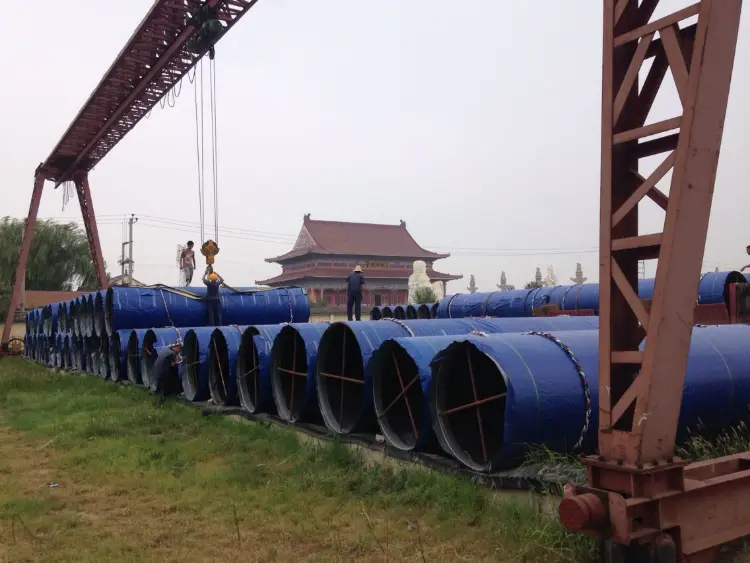
GB5310 12Cr2MoG Boiler Steel Pipe
GB5310 12Cr2MoG Boiler Steel Pipe - Technical Data, Equivalent Grades & Applications
Full technical profile of 12Cr2MoG boiler steel as per GB/T 5310-2017: chemical composition, mechanical properties at room and elevated temperatures, physical and thermal data, international equivalents, and application sectors.
Hot rolling, cold drawing, normalizing, tempering, welding (requires preheat and post-weld heat treatment), bending, expanding, flanging
- Phone : +8618037372205
- Email : [email protected]
- WhatsApp: Contact via Whtsapp
- WeChat: +8618037372205
GB5310 12Cr2MoG Boiler Steel Pipe Introduction
12Cr2MoG is a seamless ferritic-bainitic chromium-molybdenum steel tube covered by GB/T 5310-2017 for high-pressure boiler and pressure vessel service. It belongs to the 2.25Cr-1Mo family and is designed for sustained operation up to about 580 °C. The steel combines good creep strength, oxidation resistance, and thermal conductivity with adequate weldability. Typically delivered in the normalized and tempered condition, it is used for superheater and reheater tubes, main steam piping, and headers in fossil-fired power plants and in petrochemical heater tubes. Its balance of properties offers long-term reliability under cyclic thermal and mechanical loads.
GB5310 12Cr2MoG Boiler Steel Pipe Chemical Composition
Chemical composition limits for 12Cr2MoG seamless tube according to GB/T 5310-2017, Table 1. The steel is alloyed with chromium and molybdenum for elevated-temperature strength and oxidation resistance. Residual elements such as Ni, Cu and V are strictly limited to avoid adverse effects on ductility and toughness.
| Element | Content (%) | Remarks |
|---|---|---|
| Carbon (C) | 0.08 – 0.15 | Strength and hardenability |
| Silicon (Si) | ≤ 0.50 | Deoxidizer |
| Manganese (Mn) | 0.40 – 0.70 | Deoxidizer and strength enhancer |
| Phosphorus (P) | ≤ 0.025 | Controlled impurity |
| Sulphur (S) | ≤ 0.015 | Controlled impurity |
| Chromium (Cr) | 2.00 – 2.50 | Key element for oxidation/corrosion resistance and creep strength |
| Molybdenum (Mo) | 0.90 – 1.13 | Improves high-temperature strength and hardenability |
| Nickel (Ni) | ≤ 0.30 | Residual element, restricted for temper embrittlement control |
| Copper (Cu) | ≤ 0.20 | Residual element |
| Vanadium (V) | ≤ 0.08 | Residual element, grain refiner |
GB5310 12Cr2MoG Boiler Steel Pipe Thermal and Electrical Physical Properties
Typical physical data for 2.25Cr-1Mo steel in the normalized and tempered condition, representative of 12Cr2MoG. Values are compiled from ASME BPVC Section II Part D and recognized materials handbooks. Properties are given at several temperatures for engineering calculations.
| Property | Typical value | Unit | Test condition |
|---|---|---|---|
| Density (ρ) | 7.83 | g/cm³ | 20 °C |
| Elastic modulus (E) | 207 | GPa | 20 °C |
| Elastic modulus (E) | 203 | GPa | 100 °C |
| Elastic modulus (E) | 199 | GPa | 200 °C |
| Elastic modulus (E) | 192 | GPa | 300 °C |
| Elastic modulus (E) | 184 | GPa | 400 °C |
| Elastic modulus (E) | 175 | GPa | 500 °C |
| Shear modulus (G) | 80 | GPa | 20 °C (typical) |
| Poisson's ratio (ν) | 0.30 | - | 20 °C (typical) |
| Thermal expansion (α) 20-100 °C | 11.2 | 10⁻⁶/K | Mean coefficient |
| Thermal expansion (α) 20-200 °C | 12.4 | 10⁻⁶/K | Mean coefficient |
| Thermal expansion (α) 20-300 °C | 12.9 | 10⁻⁶/K | Mean coefficient |
| Thermal expansion (α) 20-400 °C | 13.4 | 10⁻⁶/K | Mean coefficient |
| Thermal expansion (α) 20-500 °C | 13.8 | 10⁻⁶/K | Mean coefficient |
| Thermal expansion (α) 20-600 °C | 14.2 | 10⁻⁶/K | Mean coefficient |
| Thermal conductivity (λ) | 36 | W/(m·K) | 20 °C |
| Thermal conductivity (λ) | 38 | W/(m·K) | 100 °C |
| Thermal conductivity (λ) | 39 | W/(m·K) | 200 °C |
| Thermal conductivity (λ) | 38 | W/(m·K) | 300 °C |
| Thermal conductivity (λ) | 37 | W/(m·K) | 400 °C |
| Thermal conductivity (λ) | 35 | W/(m·K) | 500 °C |
| Thermal conductivity (λ) | 33 | W/(m·K) | 600 °C |
| Specific heat capacity | 461 | J/(kg·K) | 20 °C |
| Specific heat capacity | 490 | J/(kg·K) | 200 °C |
| Specific heat capacity | 535 | J/(kg·K) | 400 °C |
| Specific heat capacity | 565 | J/(kg·K) | 500 °C |
| Electrical resistivity (ρₑ) | 0.24 | μΩ·m | 20 °C |
| Electrical resistivity (ρₑ) | 0.35 | μΩ·m | 200 °C |
| Electrical resistivity (ρₑ) | 0.47 | μΩ·m | 400 °C |
| Electrical resistivity (ρₑ) | 0.58 | μΩ·m | 500 °C |
GB5310 12Cr2MoG Boiler Steel Pipe Mechanical Properties
Room-temperature tensile and impact properties as per GB/T 5310-2017 for the normalized and tempered condition. Values vary with wall thickness; representative data for thin-wall (≤16 mm) and thicker-wall (>16 mm) tubes are shown. High-temperature 0.2% proof strength (Rp0.2) minimum values are taken from the same standard (Table 7) for design at elevated temperatures.
| Property | Required value | Unit | Test condition |
|---|---|---|---|
| Yield strength (ReH) | ≥ 280 | MPa | Room temperature, all thicknesses |
| Tensile strength (Rm) | 450 – 600 | MPa | Room temperature |
| Elongation (A, longitudinal) | ≥ 22 | % | Wall thickness ≤ 16 mm, L₀=5.65√S₀ |
| Elongation (A, longitudinal) | ≥ 20 | % | Wall thickness > 16 mm, L₀=5.65√S₀ |
| Elongation (A, transverse) | ≥ 20 | % | Wall thickness ≤ 16 mm |
| Elongation (A, transverse) | ≥ 18 | % | Wall thickness > 16 mm |
| Impact energy (KV₂, longitudinal) | ≥ 40 | J | Room temperature, V-notch |
| Impact energy (KV₂, transverse) | ≥ 27 | J | Room temperature, V-notch |
| Brinell hardness (HBW) | 125 – 170 | - | As-delivered condition |
| Bend test | 180°, mandrel diameter = 3a, no cracks | - | a = wall thickness |
| 0.2% proof strength (Rp0.2) at 300 °C | ≥ 230 | MPa | 300 °C |
| 0.2% proof strength (Rp0.2) at 350 °C | ≥ 218 | MPa | 350 °C |
| 0.2% proof strength (Rp0.2) at 400 °C | ≥ 206 | MPa | 400 °C |
| 0.2% proof strength (Rp0.2) at 450 °C | ≥ 198 | MPa | 450 °C |
| 0.2% proof strength (Rp0.2) at 500 °C | ≥ 187 | MPa | 500 °C |
GB5310 12Cr2MoG Boiler Steel Pipe Fully Equivalent Material Standards & Replaceable Grades
| Country/Region | Standard | Grade | Remarks |
|---|---|---|---|
| China | GB/T 5310-2017 | 12Cr2MoG | Original specification |
| USA | ASTM A335/A335M | P22 | Seamless ferritic alloy-steel pipe for high-temperature service |
| USA | ASME SA-335 | P22 | ASME boiler and pressure vessel code |
| EU | EN 10216-2 | 10CrMo9-10 | Seamless steel tubes for pressure purposes, elevated temperature |
| Germany | DIN 17175 (withdrawn) | 10CrMo910 | Predecessor of EN grade, same chemical concept |
| Japan | JIS G3458 | STPA24 | Alloy steel pipes for high temperature service |
| UK | BS 3059-2 | 622-490 | Steel boiler and superheater tubes |
| International | ISO 2604-2 | TS32 | Seamless steel tubes for pressure purposes, similar chemistry |
GB5310 12Cr2MoG Boiler Steel Pipe Application Introduction
12Cr2MoG is primarily intended for critical high-temperature, high-pressure components in energy and petrochemical industries. Its proven creep resistance and fabricability allow it to be formed into complex shapes and welded using established procedures. Common applications include:
- Power generation: superheater and reheater tube bundles, main steam pipes, desuperheater liners, headers and turbine bypass lines.
- Chemical & petrochemical: heater tubes in hydrogenation units, hydrocrackers, and ethylene cracking furnaces, as well as heat exchanger tubes in hot hydrogen service.
- Industrial boilers: high-temperature sections of water-tube boilers and waste-heat recovery boilers.
Product Applications: Superheater and reheater coils, Main steam and hot reheat piping, Boiler headers and manifolds, Petrochemical furnace tubes, High-pressure heat exchanger bundles, High-temperature steam connectors and jumpers
Processed into products: Bent tubes and serpentine loops, Welded pipe assemblies (with elbows, reducers, tees), Expanded tube-to-tubesheet joints, Forged fittings such as tees and caps, Flanged pipe spools, Inspection port nozzles and thermowell connections
Application industries: Coal-fired and gas-fired power plants, Combined-cycle and cogeneration plants, Petrochemical refining and fertilizer complexes, Industrial boiler manufacturing, Heat exchanger equipment fabrication, Pipeline engineering for steam and high-temperature fluids
GB5310 12Cr2MoG Boiler Steel Pipe Similar / Alternative Material Recommendations
| Country/Region | Standard | Grade | Remarks |
|---|---|---|---|
| China | GB/T 5310-2017 | 12Cr1MoVG | Contains V (0.15-0.30) for higher creep strength; lower Mo content (0.25-0.35). Often used as substitute when higher strength is needed up to 580°C. |
| China | GB/T 5310-2017 | 15CrMoG | 1Cr-0.5Mo steel; lower creep strength but more economical for lower temperature boiler components (≤550°C). |
| China | GB/T 5310-2017 | 12Cr2MoWVTiB (G102) | Advanced multi-alloyed steel with W, V, Ti, B; higher creep rupture strength up to 600-620°C, but less forgiving in welding. |
| USA | ASTM A335/A335M | P11 (1.25Cr-0.5Mo) | Lower chromium content; used where moderate high-temperature strength is sufficient. |
| USA | ASTM A335/A335M | P5 (5Cr-0.5Mo) | Higher chromium grade for improved oxidation resistance; suitable for more aggressive environments but lower thermal conductivity. |
| EU | EN 10216-2 | 13CrMo4-5 (1Cr-0.5Mo) | European equivalent of the 1Cr-0.5Mo type; lower-cost alternative for less demanding boiler parts. |
Notes:
- Proper heat treatment (normalizing at 900–960 °C + tempering at 680–780 °C) is essential to achieve the required creep ductility and to avoid temper embrittlement.
- Welding requires preheating (200–300 °C) and post-weld heat treatment (PWHT at 680–730 °C) to restore toughness and reduce residual stresses.
- For sour service or hydrogen-containing environments, specific hardness limits may apply to prevent stress cracking.
- Material inspection certificates according to EN 10204 type 3.1 or 3.2 are typically required for boiler applications.
- Ordering should specify the test category (e.g., ultrasonic testing, eddy current testing) as per GB/T 5310 or supplementary requirements.
- Share



