
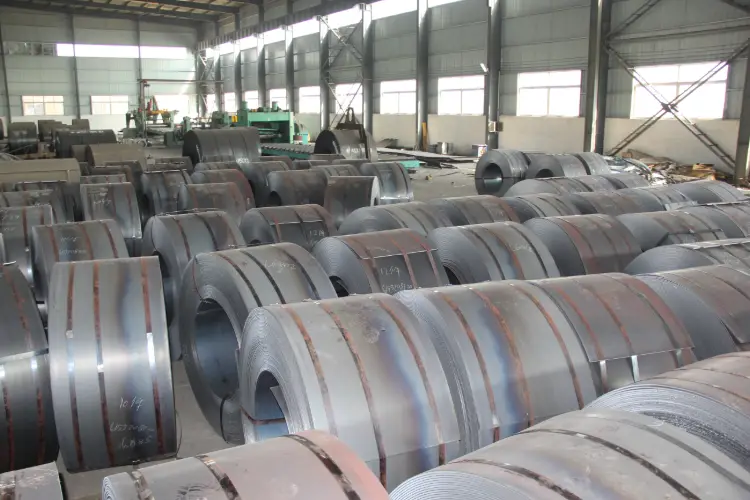
ASTM A633 Grade C Normalized HSLA Steel Coil
ASTM A633 Grade C Normalized HSLA Steel Coil - 345 MPa Yield
Comprehensive material data for ASTM A633/A633M Grade C carbon and low-alloy high-strength steel coil: chemical composition, mechanical properties, thermal properties, international equivalents, similar materials, and application guide.
Hot rolling, normalizing, flame cutting, welding, cold forming (limited), machining
- Phone : +8618037372205
- Email : [email protected]
- WhatsApp: Contact via Whtsapp
- WeChat: +8618037372205
ASTM A633 Grade C Normalized HSLA Steel Coil Introduction
ASTM A633 Grade C is a normalized high-strength low-alloy (HSLA) structural steel providing a minimum yield strength of 345 MPa (50 ksi) in thicknesses up to 65 mm. It combines good weldability, excellent notch toughness when specified, and improved atmospheric corrosion resistance compared to carbon steels. The normalizing heat treatment refines the grain structure, ensuring uniform mechanical properties and enhanced ductility. This steel is widely used in welded bridges, buildings, heavy machinery, and transportation equipment where high strength-to-weight ratio and reliability are essential. Key features:
- Normalized condition for consistent properties
- Excellent weldability with low carbon equivalent
- Optional Charpy impact testing for low-temperature service
- Good formability and machinability
ASTM A633 Grade C Normalized HSLA Steel Coil Chemical Composition
The chemical composition conforms to ASTM A633/A633M Grade C requirements. Controlled levels of carbon, manganese, and microalloying elements (niobium, vanadium) provide the high strength and good weldability. A maximum carbon equivalent (CE) of 0.44% is typically applied for thicknesses up to 40 mm to ensure weldability without preheating under normal conditions. Residual elements such as copper, nickel, chromium, and molybdenum may be present but are not specified unless required.
| Element | Standard Value | Remarks |
|---|---|---|
| Carbon (C) | ≤ 0.20 | Maximum |
| Manganese (Mn) | 1.15 - 1.50 | Range |
| Phosphorus (P) | ≤ 0.035 | Maximum |
| Sulfur (S) | ≤ 0.040 | Maximum |
| Silicon (Si) | 0.15 - 0.40 | Range |
| Niobium (Cb/Nb) | 0.01 - 0.05 | Required microalloy |
| Vanadium (V) | 0.01 - 0.10 | Optional or as agreed |
| Carbon Equivalent (CE) | ≤ 0.44 (t ≤ 40 mm) | Information value, not a chemical element |
ASTM A633 Grade C Normalized HSLA Steel Coil Thermal and Electrical Physical Properties
Typical physical properties for normalized high-strength low-alloy steel similar to ASTM A633 Grade C. These values are based on published data for C-Mn-Nb-V structural steels and are provided for design and thermal analysis purposes. Actual properties may vary slightly depending on the specific heat treatment and product form.
| Property | Typical Value | Unit | Test Condition |
|---|---|---|---|
| Density (ρ) | 7.85 | g/cm³ | 20°C |
| Modulus of Elasticity (E) | 205 - 210 | GPa | 20°C, tension |
| Shear Modulus (G) | 79 - 80 | GPa | 20°C |
| Poisson's Ratio (ν) | 0.29 - 0.30 | – | 20°C |
| Coefficient of Thermal Expansion (α) | 12.0 | µm/m·°C | 20 - 100°C |
| Coefficient of Thermal Expansion (α) | 12.5 | µm/m·°C | 20 - 200°C |
| Coefficient of Thermal Expansion (α) | 13.2 | µm/m·°C | 20 - 400°C |
| Thermal Conductivity (λ) | 45 - 48 | W/m·K | 20°C |
| Specific Heat Capacity (cp) | 470 - 490 | J/kg·K | 20 - 200°C |
| Electrical Resistivity (ρe) | 0.20 - 0.25 | µΩ·m | 20°C |
ASTM A633 Grade C Normalized HSLA Steel Coil Mechanical Properties
Mechanical properties are determined in accordance with ASTM A633/A633M. The values are valid for normalized condition and are a function of thickness. Key points:
- Yield strength and tensile strength are minimums and ranges as specified.
- Elongation is measured on 50 mm (2 in) or 200 mm (8 in) gauge length.
- Cold bending test is performed with longitudinal specimens; transverse bends require agreement.
- Charpy V-notch impact energy is optional (Supplementary Requirement S5) and can be specified for a given temperature (e.g., 27 J at -40°C).
| Property | Standard Required Value | Unit | Test Condition |
|---|---|---|---|
| Yield Strength (ReH) | ≥ 345 | MPa | Thickness ≤ 65 mm |
| Yield Strength (ReH) | ≥ 315 | MPa | 65 mm < thickness ≤ 100 mm |
| Tensile Strength (Rm) | 485 - 620 | MPa | All thicknesses |
| Elongation (A) in 200 mm (8 in) | ≥ 18 | % | Longitudinal tensile test |
| Elongation (A) in 50 mm (2 in) | ≥ 23 | % | Longitudinal tensile test |
| Bend Test (180°), bend diameter (d) | d = 1.5t | – | t ≤ 19 mm, longitudinal |
| Bend Test (180°), bend diameter (d) | d = 2t | – | 19 mm < t ≤ 25 mm, longitudinal |
| Bend Test (180°), bend diameter (d) | d = 2.5t | – | 25 mm < t ≤ 40 mm, longitudinal |
| Bend Test (180°), bend diameter (d) | d = 3t | – | 40 mm < t ≤ 50 mm, longitudinal |
| Bend Test (180°), bend diameter (d) | d = 3.5t | – | 50 mm < t ≤ 65 mm, longitudinal |
ASTM A633 Grade C Normalized HSLA Steel Coil Identical or Directly Comparable Standard Grades
| Country/Region | Standard | Grade | Remarks |
|---|---|---|---|
| USA | ASTM A633/A633M | Grade C | Original specification, normalized |
| International | ISO 630-2 | E355C | Similar chemistry and tensile requirements, normalized |
| Europe | EN 10025-3 | S355N | Closest European equivalent, 355 MPa min yield, normalized |
| Japan | JIS G3106 | SM490A (or SM490B) | Similar strength level, normalized option |
| China | GB/T 1591 | Q355ND | Formerly Q345D; normalized delivery, comparable strength |
| India | IS 2062 | E350 C | High-strength structural steel, comparable mechanical properties |
ASTM A633 Grade C Normalized HSLA Steel Coil Application Introduction
ASTM A633 Grade C steel is specially designed for robust structural applications requiring high strength, excellent weldability, and reliable low-temperature toughness when specified. Its normalization ensures consistent through-thickness properties that are critical for heavy sections.
Product Applications: Welded bridge girders and box sections, High-rise building frame members, Crane and lifting equipment structural elements, Offshore platform living quarters and process modules, Heavy-duty dump truck bodies, Industrial storage silos and hoppers
Processed into products: Flanges and webs for built-up beams, Base plates and stiffeners, Boom and dipper arms for excavators, Forklift mast channels, Ship stiffeners and bulkhead plates, Railcar underframes and side frames, Connection plates and splice members in bridges
Application industries: Civil engineering and infrastructure (bridges, highway components), Commercial and industrial building construction (columns, beams, trusses), Offshore and marine engineering (deck plates, modules, sub-sea structures), Heavy machinery and mining equipment (frames, booms, excavator parts), Railroad and transportation (railcar chassis, heavy vehicle frames), Pressure vessel and storage tank fabrication
ASTM A633 Grade C Normalized HSLA Steel Coil Similar/Cross-Reference Materials
| Country/Region | Standard | Grade | Remarks |
|---|---|---|---|
| USA | ASTM A572/A572M | Grade 50 (Type 1, 2) | Hot-rolled HSLA, similar strength, may not be normalized; weldability slightly different. |
| USA | ASTM A709/A709M | Grade 50 | Bridge steel based on A572 Gr. 50, often available normalized; comparable mechanicals. |
| Europe | EN 10025-2 | S355J2+N | Structural steel, normalized or N-condition, yield 355 MPa; slightly higher strength. |
| Europe | EN 10025-3 | S355M/ML | Thermomechanical rolled; similar strength but different production route. |
| China | GB/T 1591 | Q355C/D (as-rolled) | Not normalized; impact test temperatures differ; may substitute with caution. |
| Russia | GOST 19281 | 09G2S | Low-alloy structural steel, approximate strength match, normalizeable. |
Notes:
- Weldability: Low carbon and microalloy content give excellent weldability with conventional methods (SMAW, SAW, GMAW, FCAW). Preheating typically not required for moderate thicknesses, but recommendations should follow AWS D1.1/D1.8 depending on application.
- Toughness: When optional Charpy V-notch impact testing is invoked (ASTM A633 Supplementary Requirement S5), typical minimum average values are 27 J at prescribed temperatures (e.g., -20°C, -40°C), making it suitable for cold-climate service.
- Corrosion resistance: The grade offers moderate atmospheric corrosion resistance, approximately twice that of plain carbon steel, but is not a weathering steel; for severe environments, a coating or painting system is recommended.
- Forming: Cold bending and forming are feasible with proper radii (≥ 3t for thick plates), but hot forming may require re-normalizing to restore properties.
- Cutting: Flame and plasma cutting are standard; the heat-affected zone (HAZ) is typically manageable, but post-cut edge inspection and grinding are recommended for critical applications.
- This data is provided for general reference and based on publicly available standard specifications. For critical design, always consult the latest official standard and conduct material-specific testing.
- Share



