
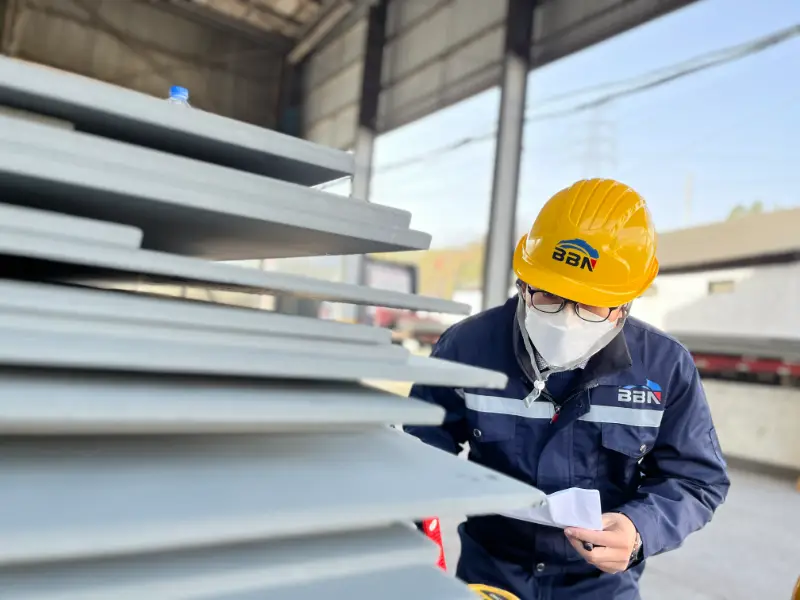
ASTM A633 Grade D Normalized High-Strength Low-Alloy Steel
ASTM A633 Grade D Normalized High-Strength Low-Alloy Steel - Properties & Global Equivalents
Complete material data for ASTM A633/A633M Grade D carbon and low-alloy high-strength structural steel. Covers chemical composition, mechanical properties, physical properties, international equivalents, and application guidance.
Hot rolling followed by normalizing; suitable for welding, machining, cold forming, and hot-dip galvanizing
- Phone : +8618037372205
- Email : [email protected]
- WhatsApp: Contact via Whtsapp
- WeChat: +8618037372205
ASTM A633 Grade D Normalized High-Strength Low-Alloy Steel Introduction
ASTM A633/A633M Grade D is a normalized high-strength low-alloy (HSLA) structural steel primarily supplied as plates and coils. It offers a minimum yield strength of 345 MPa (50 ksi) and excellent weldability, making it suitable for demanding structural applications where both high strength and good low-temperature toughness are required. The alloy contains deliberate additions of copper, nickel, chromium, and molybdenum to enhance atmospheric corrosion resistance and mechanical properties. Grade D is typically delivered in the normalized condition, ensuring uniform microstructure and consistent performance across thicknesses up to 65 mm. It is widely used in bridges, buildings, heavy machinery, and offshore structures.
ASTM A633 Grade D Normalized High-Strength Low-Alloy Steel Chemical Composition
The chemical composition conforms to ASTM A633/A633M Grade D requirements. Intentional additions of Cu, Ni, Cr, and Mo improve strength and atmospheric corrosion resistance. Carbon equivalent (CE) is typically controlled to ensure good weldability.
| Element | Content (%) | Remarks |
|---|---|---|
| Carbon (C) | 0.20 max | Maximum content |
| Manganese (Mn) | 0.70 - 1.60 | Range |
| Phosphorus (P) | 0.030 max | Maximum allowed |
| Sulfur (S) | 0.030 max | Maximum allowed |
| Silicon (Si) | 0.15 - 0.50 | Range |
| Copper (Cu) | 0.35 max | Optional addition for corrosion resistance |
| Nickel (Ni) | 0.25 max | Optional addition |
| Chromium (Cr) | 0.25 max | Optional addition |
| Molybdenum (Mo) | 0.08 max | Optional addition |
ASTM A633 Grade D Normalized High-Strength Low-Alloy Steel Physical Properties
Physical properties are representative for low-alloy carbon steel and are not specified in ASTM A633. Values are suitable for engineering calculations. Slight variations may occur depending on exact composition and heat treatment.
| Property | Typical Value | Unit | Condition |
|---|---|---|---|
| Density (ρ) | 7.85 | g/cm³ | Room temperature |
| Elastic Modulus (E) | 205 | GPa | Room temperature |
| Shear Modulus (G) | 80 | GPa | Room temperature |
| Poisson's Ratio (ν) | 0.29 | — | Room temperature |
| Thermal Expansion Coefficient (α) | 11.7 | 10⁻⁶/K | 20–100 °C |
| Thermal Conductivity (λ) | 50 | W/(m·K) | Room temperature |
| Specific Heat Capacity | 450 | J/(kg·K) | Room temperature |
| Electrical Resistivity (ρ_e) | 0.15 | μΩ·m | Room temperature |
ASTM A633 Grade D Normalized High-Strength Low-Alloy Steel Mechanical Properties
Mechanical properties are determined in accordance with ASTM A6/A6M. Tensile testing is performed on longitudinal specimens. Values vary with plate thickness. Impact toughness (Charpy V-notch) is a supplementary requirement often specified for low-temperature service.
| Property | Value | Unit | Condition / Thickness |
|---|---|---|---|
| Yield Strength (ReH) | 345 min | MPa (ksi) | t ≤ 40 mm (1.57 in.) |
| Yield Strength (ReH) | 315 min | MPa (ksi) | 40 < t ≤ 65 mm (1.57-2.56 in.) |
| Tensile Strength (Rm) | 450 – 590 | MPa (ksi) | All thicknesses (65 – 85 ksi) |
| Elongation (A) in 200 mm | 18 min | % | t ≤ 40 mm, transverse strip specimen |
| Elongation (A) in 50 mm | 23 min | % | t ≤ 40 mm, longitudinal round specimen |
| Charpy V-Notch Impact (KV) | 27 min | J (ft·lbf) | S5 supplementary requirement, typical at -45°C (-50°F) in longitudinal direction |
ASTM A633 Grade D Normalized High-Strength Low-Alloy Steel Exact Equivalent Material Standards and Substitute Grades
| Country/Region | Standard | Grade | Remarks |
|---|---|---|---|
| USA | ASTM A633/A633M | Grade D | Original specification – normalized condition |
| Europe | EN 10025-3 | S355N (1.0545) / S355NL (1.0546) | Normalized rolled; equivalent strength and similar chemistry with optional low-temp toughness |
| China | GB/T 1591 | Q345D (normalized) | Comparable yield and tensile strength; normalized delivery required |
| Japan | JIS G3106 | SM490YB (normalized) | Similar strength class; verify low-temperature impact requirements |
ASTM A633 Grade D Normalized High-Strength Low-Alloy Steel Application Introduction
ASTM A633 Grade D is engineered for welded structural applications demanding high strength, good weldability, and reliable low-temperature toughness. Its normalized condition guarantees uniform mechanical properties, making it a preferred choice in critical infrastructure and heavy equipment.
Product Applications: Welded plate girders and box columns, Crane booms and lattice structures, Offshore structural nodes and decks, Heavy-duty chassis and truck frames, Reinforcement ribs for tunnel linings, Wind turbine tower flanges and transition pieces
Processed into products: Butt-welded joints in bridge main beams, Reinforced stiffeners and diaphragms, Machined pin plates and clevises, Folded and welded boom sections, Drilled base plates for anchoring systems, Laser- or plasma-cut flanges and brackets
Application industries: Civil engineering and bridge construction, Building and stadium structures, Offshore platforms and marine structures, Mining and earthmoving equipment, Pressure vessels and storage tanks (non-cryogenic service), Railway wagon and heavy transport vehicle manufacturing
ASTM A633 Grade D Normalized High-Strength Low-Alloy Steel Similar and Alternative Material Recommendations
| Country/Region | Standard | Grade | Remarks |
|---|---|---|---|
| USA | ASTM A572/A572M | Grade 50 (345) | Hot-rolled HSLA steel; not necessarily normalized; similar strength, lower Mn and no deliberate alloy addition |
| USA | ASTM A588/A588M | Grade A (345) | Weathering steel with higher Cu, Cr, Ni; corrosion resistance similar but not identical |
| Europe | EN 10025-2 | S355J2+N | Hot-rolled normalized structural steel; minor differences in Mn and residual elements |
| International | ISO 630-2 | Fe 510D | Former ISO grade; similar strength with impact requirements at -20°C |
Notes:
Supplementary Requirements: ASTM A633/A633M includes optional supplementary requirements (e.g., S5 for Charpy V-notch impact testing at specified temperatures, S2 for product analysis). Buyers should specify these at the time of enquiry and order to receive guaranteed toughness or tighter tolerance levels. Weldability: Due to its low carbon equivalent, Grade D can be welded by all common processes (SMAW, SAW, GMAW, FCAW) without special preheating for thicknesses up to 50 mm when ambient temperatures are above 5 °C. Post-weld heat treatment is generally not required. Forming: The steel is suitable for cold bending provided the minimum recommended bend radius is observed (typically 2.0t for transverse direction and 2.5t for longitudinal direction at thickness ≤25 mm).
- Share



