
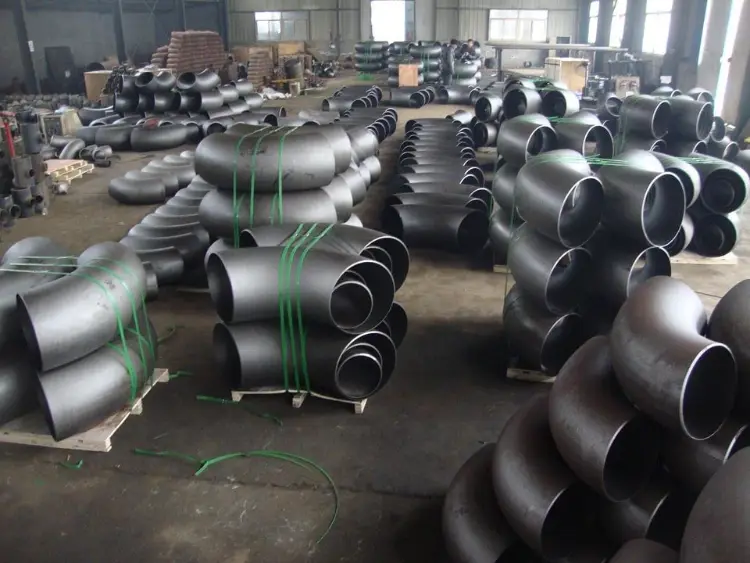
Q345E Seamless Steel Pipe for Fluid Service per GB/T 8163
Q345E Seamless Steel Pipe for Fluid Service per GB/T 8163: Material Properties & Data
Comprehensive reference for Q345E seamless pipe under GB/T 8163, covering chemical composition, mechanical strength, low-temperature impact, physical properties, and applications in fluid transport and structural engineering.
Hot rolling, hot expansion, cold drawing; normalized heat treatment typically applied.
- Phone : +8618037372205
- Email : [email protected]
- WhatsApp: Contact via Whtsapp
- WeChat: +8618037372205
Q345E Seamless Steel Pipe for Fluid Service per GB/T 8163 Introduction
Q345E seamless steel pipe is a high-strength low-alloy structural grade specified for fluid service in GB/T 8163. The base steel conforms to Q345E of GB/T 1591, offering a minimum yield strength of 345 MPa and guaranteed impact toughness at -40°C (KV2 ≥ 34 J). The material exhibits excellent weldability, good ductility, and reliable low-temperature performance, making it suitable for critical piping systems in cold environments.
- High strength: yield ≥345 MPa (t≤16 mm), tensile 470-630 MPa.
- Superior low-temperature toughness: Charpy V-notch energy ≥34 J at -40°C.
- Good formability and weldability with proper preheating and low-hydrogen procedures.
- Commonly delivered in normalized condition to refine grain structure and enhance toughness.
- Used in oil & gas, petrochemical, power generation, and heavy machinery sectors.
The pipe is produced by hot rolling or cold drawing and can be supplied with various end finishes and protective coatings.
Q345E Seamless Steel Pipe for Fluid Service per GB/T 8163 Chemical Composition
The chemical composition of Q345E according to GB/T 1591-2008, also adopted by GB/T 8163, is designed to balance strength, weldability, and low-temperature toughness. Micro-alloying elements (Nb, V, Ti) provide grain refinement and precipitation strengthening. Phosphorus and sulfur are strictly controlled to ensure cleanliness and ductility.
- Carbon equivalent (CEV) is typically limited to 0.45% max for good weldability.
- Aluminum content ensures fine grain size through deoxidation.
- Residual elements (Ni, Cr, Cu) are kept low to avoid adverse effects on toughness.
| Chemical Element | Standard Value (wt%) | Remarks |
|---|---|---|
| Carbon (C) | ≤0.18 | Crucial for strength, upper limit ensures weldability. |
| Silicon (Si) | ≤0.50 | Deoxidizer, contributes to strength. |
| Manganese (Mn) | ≤1.70 | Increases hardenability and strength, mildly improves toughness. |
| Phosphorus (P) | ≤0.020 | Strict control prevents embrittlement. |
| Sulfur (S) | ≤0.010 | Low sulfur for improved ductility and impact properties. |
| Vanadium (V) | 0.02–0.15 | Grain refiner and precipitation strengthener. |
| Niobium (Nb) | 0.015–0.060 | Powerful grain refiner, enhances strength. |
| Titanium (Ti) | 0.02–0.20 | Fixes nitrogen, refines grain, improves toughness. |
| Total Aluminum (Alt) | ≥0.015 | Fine grain practice, acid-soluble Al often specified. |
| Nickel (Ni) | ≤0.50 | Residual element, limited to avoid cost and weldability issues. |
| Chromium (Cr) | ≤0.30 | Residual, may slightly improve corrosion resistance. |
| Copper (Cu) | ≤0.30 | Residual, limited to prevent hot shortness. |
| Molybdenum (Mo) | ≤0.10 | Residual, trace amounts acceptable. |
| Nitrogen (N) | ≤0.012 | Controlled to avoid strain aging and toughness loss. |
Q345E Seamless Steel Pipe for Fluid Service per GB/T 8163 Thermal and Electrical Physical Properties
The following physical properties are typical for Q345 grade low-alloy steel at ambient temperature and are derived from authoritative material handbooks. They are not specified in the product standard but serve as design guidelines for thermal expansion, heat transfer, and electrical conductivity.
- Density and elastic constants are nearly constant across low-alloy steels.
- Thermal expansion coefficient increases with temperature; values at different ranges are provided.
- Thermal conductivity decreases as temperature rises; room-temperature value is conservative for design.
| Performance Item | Standard Requirement Value | Unit | Test Condition |
|---|---|---|---|
| Density (ρ) | 7.85 | g/cm³ | Room temperature |
| Elastic modulus (E) | 206 | GPa | Ambient temperature |
| Shear modulus (G) | 79.3 | GPa | Calculated from E and ν |
| Poisson's ratio (ν) | 0.3 | — | Ambient temperature |
| Thermal expansion coefficient (α) | 12.0 | 10⁻⁶/K | 20–100°C |
| Thermal expansion coefficient (α) | 13.2 | 10⁻⁶/K | 20–300°C |
| Thermal conductivity (λ) | 52 | W/(m·K) | 20°C |
| Specific heat capacity (c) | 460 | J/(kg·K) | 20°C |
| Electrical resistivity (ρe) | 0.23 | 10⁻⁶ Ω·m | 20°C |
Q345E Seamless Steel Pipe for Fluid Service per GB/T 8163 Mechanical Properties
Tensile and impact requirements for Q345E seamless pipe follow GB/T 8163-2018, which references the strength and toughness values of GB/T 1591. The properties are guaranteed at room temperature except for the impact test conducted at -40°C. Actual values depend on wall thickness and heat treatment condition.
- Yield strength decreases with increasing wall thickness.
- Elongation measured on proportional test pieces (gauge length 5.65√S0) or 50 mm fixed gauge length.
- Charpy V-notch impact tests are performed on longitudinal specimens; transverse testing is optional.
| Performance Item | Standard Requirement | Unit | Test Condition |
|---|---|---|---|
| Yield Strength (ReH) | ≥345 | MPa | Wall thickness ≤16 mm, room temperature |
| Yield Strength (ReH) | ≥335 | MPa | Wall thickness >16 mm to 30 mm |
| Yield Strength (ReH) | ≥325 | MPa | Wall thickness >30 mm to 50 mm |
| Tensile Strength (Rm) | 470–630 | MPa | All thicknesses, room temperature |
| Elongation (A) | ≥21 | % | Thickness ≤40 mm, gauge length 5.65√S₀ |
| Elongation (A) | ≥20 | % | Thickness >40 mm to 63 mm |
| Charpy Impact Energy (KV₂) | ≥34 (average, min single 27) | J | At -40°C, longitudinal specimen |
Q345E Seamless Steel Pipe for Fluid Service per GB/T 8163 Completely Equivalent Material Standards and Substitutable Grades
| Country/Region | Standard | Grade | Remarks |
|---|---|---|---|
| Europe | EN 10216-3 | P355NL1 | Seamless steel tubes for pressure purposes; -40°C impact requirement (KV ≥27 J at -50°C). Closest normalized pipe grade with low-temperature toughness. |
| International | ISO 3183 | L360NE | Petroleum and natural gas pipeline steel; Charpy at -45°C or lower. Strength and toughness match Q345E pipe. |
| USA | ASTM A714 | Grade 70 | High-strength low-alloy seamless and welded pipe. Supplementary requirement S8 (Charpy at -40°C) can be specified to approximate Q345E. |
| Japan | JIS G 3460 | STPG410 | Carbon steel pipe for pressure service. Not fully equivalent; impact test at -10°C by default; low-temperature grade requires separate negotiation. |
Q345E Seamless Steel Pipe for Fluid Service per GB/T 8163 Application Introduction
Q345E seamless pipe excels in applications demanding high reliability at sub-zero temperatures and in pressurized fluid systems. Its combination of strength, weldability, and notch toughness enables safe operation in harsh environments. Typical uses and fabricated components include:
Product Applications: Cross-country oil and gas transmission pipelines (especially in cold climate areas), High-pressure hydraulic fluid conduits in heavy equipment, Seamless boiler tubes and superheater tubes, Structural hollow sections for offshore platforms and bridges, Chemical plant and refinery fluid handling systems
Processed into products: Pipe fittings: elbows, tees, reducers, caps, Forged flanges (WN, BL, SW, etc.), Valve bodies and bonnets, Hydraulic cylinder barrels and piston rods, Pump shafts and casings, Prefabricated piping spools and modules
Application industries: Oil & Gas (upstream and midstream pipelines, gathering systems), Petrochemical (process piping, heat exchangers), Power Generation (boiler feedwater lines, high-pressure steam piping), Water Treatment (desalination plants, high-pressure pump stations), Shipbuilding (ballast, bilge, and hydraulic systems), Mining (slurry transport, high-pressure air lines), Construction Machinery (hydraulic cylinders, telescopic arms)
Q345E Seamless Steel Pipe for Fluid Service per GB/T 8163 Similar / Alternative Materials for Reference
| Country/Region | Standard | Grade | Remarks |
|---|---|---|---|
| China | GB/T 1591 | Q345D | Same base composition, impact toughness at -20°C. Suitable where less demanding low-temperature service is adequate. |
| China | GB/T 1591-2018 | Q355E | Evolutionary grade with minimum yield 355 MPa and -40°C impact. Direct replacement for Q345E in new designs. |
| Europe | EN 10025-2 | S355J2 | Common structural steel with -20°C impact (27 J). Comparable strength but poorer low-temperature performance. |
| Europe | EN 10025-3 | S355N | Normalized structural steel, -20°C impact; S355NL variant offers -50°C toughness, close to Q345E when selected. |
| USA | ASTM A572 | Grade 50 (Type 2) | High-strength low-alloy structural steel; no mandatory impact test, can be ordered with low-temperature impact supplementary requirement. |
Notes:
Q345E fluid seamless pipe is typically supplied in normalized (N) condition to guarantee fine-grain structure and low-temperature toughness. Non-destructive testing (ultrasonic or eddy current) is often performed according to GB/T 8163 or client specifications. Surface protection such as anti-corrosion coating (3LPE, FBE) or hot-dip galvanizing can be applied upon request. For welding, low-hydrogen electrodes and appropriate preheat/interpass temperatures (100–150°C) are recommended to avoid cold cracking. When specifying, verify the latest edition of GB/T 8163 for any updates to chemical limits or testing requirements.
- Share



