
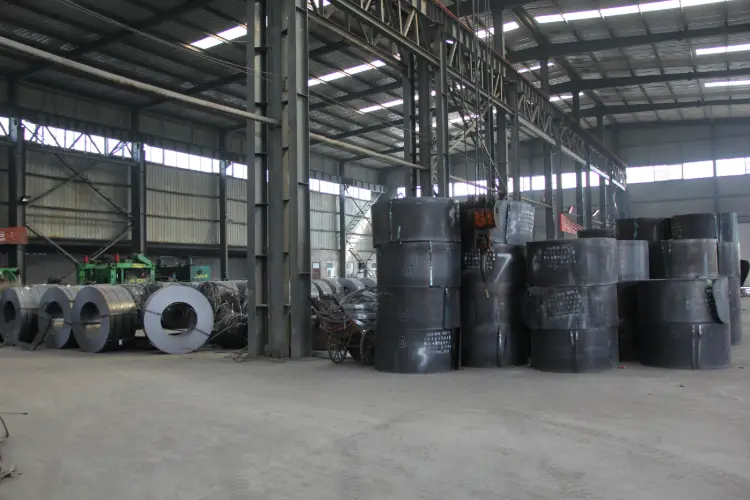
ASTM A709 Grade 50 Steel Coil
ASTM A709 Grade 50 Steel Coil: High-Strength Carbon & Low-Alloy Structural Steel for Bridges
ASTM A709 Grade 50 is a carbon and low-alloy high-strength structural steel coil primarily used in bridge construction. It offers a minimum yield strength of 50 ksi (345 MPa) and excellent weldability, with controlled chemistry for enhanced toughness and durability.
Hot-rolling, controlled rolling, normalizing, welding, cutting, forming
- Phone : +8618037372205
- Email : [email protected]
- WhatsApp: Contact via Whtsapp
- WeChat: +8618037372205
ASTM A709 Grade 50 Steel Coil Introduction
ASTM A709/A709M Grade 50 is a structural steel grade specified for use in bridge construction and other structural applications. It belongs to the carbon and low-alloy high-strength steel category, offering a minimum yield strength of 50 ksi (345 MPa) and tensile strength of 65 ksi (450 MPa). This steel can be supplied as coils, plates, or shapes and is often produced through controlled rolling or normalizing rolling. Grade 50 is available in several types (50, 50S, 50W, 50F) for non-fracture-critical or fracture-critical members, but the base Grade 50 (without suffix) is a general-purpose structural steel with good formability and weldability. Its balanced chemical composition ensures reliable mechanical performance across a wide thickness range, making it suitable for main bridge components, heavy equipment, and building frames where high load-carrying capacity is required.
ASTM A709 Grade 50 Steel Coil Chemical Composition
The chemical composition of ASTM A709 Grade 50 is designed to provide high strength while maintaining good weldability and toughness. The standard specifies maximum limits for most elements; no minimum values are mandated for C, Mn, Si except for certain types. Copper (Cu) content is optional when specified for improved atmospheric corrosion resistance, but not required for the basic Grade 50. If Cu is not specified, a value up to 0.40% is permitted by residuals. The table lists the standard requirements per ASTM A709/A709M.
| Element | Standard Requirement | Remarks |
|---|---|---|
| Carbon (C) | ≤ 0.23 | Max, heat analysis |
| Manganese (Mn) | ≤ 1.35 | Max; product analysis may be slightly higher |
| Phosphorus (P) | ≤ 0.04 | Max |
| Sulfur (S) | ≤ 0.05 | Max |
| Silicon (Si) | ≤ 0.40 | Max; typically 0.15–0.30 for deoxidation |
| Copper (Cu) | ≤ 0.20 (optional ≤ 0.60) | Optional for atmospheric corrosion resistance; when specified, max 0.60 |
| Nitrogen (N) | ≤ 0.015 | Typical maximum for some products, not explicitly in Grade 50 basic, but common to limit |
| Other alloying | Not specified | Grade 50 typically not microalloyed; Grade 50S/50F may contain V, Nb, Ti |
ASTM A709 Grade 50 Steel Coil Thermal and Electrical Physical Properties
The following physical properties are typical for carbon and low-alloy structural steels like ASTM A709 Grade 50. These values are not specified in the standard but are provided for engineering reference. Slight variations may occur depending on actual composition and processing conditions. Density is generally 7.85 g/cm³; elastic modulus around 200 GPa; thermal expansion approximately 11.7 × 10⁻⁶/K between 20°C and 100°C.
| Property | Typical Value | Unit | Test Condition / Notes |
|---|---|---|---|
| Density (ρ) | 7.85 | g/cm³ | At room temperature |
| Elastic modulus (E) | 200 | GPa | Ambient temperature |
| Shear modulus (G) | 77 | GPa | Calculated from E and ν |
| Poisson's ratio (ν) | 0.30 | —— | Ambient temperature |
| Thermal expansion coefficient (α) | 11.7 | ×10⁻⁶/K | 20°C to 100°C |
| Thermal conductivity (λ) | 51.9 | W/(m·K) | At 100°C |
| Specific heat capacity | 486 | J/(kg·K) | At 50–100°C |
| Electrical resistivity (ρe) | 1.5 × 10⁻⁷ | Ω·m | At 20°C, typical for carbon steel |
ASTM A709 Grade 50 Steel Coil Mechanical Properties
The mechanical properties of ASTM A709 Grade 50 are guaranteed by the producer through tension testing. Test specimens are taken in longitudinal or transverse direction depending on product form. Elongation is measured in a 2-inch (50 mm) or 8-inch (200 mm) gage length as per ASTM A6/A6M. Values apply to full thicknesses of coils and plates. Charpy V-notch impact testing is not a mandatory requirement for Grade 50 unless specified by purchase order with supplementary requirements (e.g., S5 for toughness).
| Property | Standard Requirement | Unit | Test Condition |
|---|---|---|---|
| Yield Strength (ReH) | 50–65 | ksi | Tensile test, 0.2% offset, thickness ≤ 4 in. (100 mm) |
| Yield Strength (ReH) | 345–450 | MPa | Tensile test, 0.2% offset, thickness ≤ 100 mm |
| Tensile Strength (Rm) | ≥ 65 | ksi | —— |
| Tensile Strength (Rm) | ≥ 450 | MPa | —— |
| Elongation (A) in 2 in. (50 mm) | ≥ 21 | % | Thickness ≤ 3/4 in. (20 mm) |
| Elongation (A) in 2 in. (50 mm) | ≥ 19 | % | Thickness > 3/4 to 1.5 in. (20–40 mm) |
| Elongation (A) in 2 in. (50 mm) | ≥ 18 | % | Thickness > 1.5 to 2.5 in. (40–65 mm) |
| Elongation (A) in 2 in. (50 mm) | ≥ 17 | % | Thickness > 2.5 to 4 in. (65–100 mm) |
| Elongation (A) in 8 in. (200 mm) | ≥ 15 | % | Thickness ≤ 3/4 in. (20 mm) |
| Elongation (A) in 8 in. (200 mm) | ≥ 14 | % | Thickness > 3/4 to 1.5 in. (20–40 mm) |
| Elongation (A) in 8 in. (200 mm) | ≥ 13 | % | Thickness > 1.5 to 2.5 in. (40–65 mm) |
| Elongation (A) in 8 in. (200 mm) | ≥ 12 | % | Thickness > 2.5 to 4 in. (65–100 mm) |
ASTM A709 Grade 50 Steel Coil Fully Equivalent Material Standards and Replaceable Grades
| Country/Region | Standard | Grade | Remarks |
|---|---|---|---|
| USA | ASTM A572/A572M | Grade 50 | Same strength level, widely accepted substitute; chemistry comparable but may include optional elements. |
| USA | ASTM A992/A992M | Grade 50* | For structural shapes only; also meets A709 Grade 50 requirements with added requirements on max yield and C.E. |
| European Union | EN 10025-2 | S355JR | Equivalent 355 MPa min yield; requires agreement on impact properties and thickness tolerances. |
| Japan | JIS G3106 | SM490A | Comparable strength, but different tensile range; suitable for static loads. |
| China | GB/T 1591 | Q345B | Consistent yield and tensile properties; widely used in bridge and building structures. |
| International | ISO 630 | Fe510B | Mechanical properties match; often used for general structural applications. |
ASTM A709 Grade 50 Steel Coil Application Introduction
ASTM A709 Grade 50 is engineered for structural integrity in bridge and building construction. Its balanced strength, weldability, and formability allow for efficient fabrication of primary load-bearing components. The steel is commonly supplied in coil form for subsequent slitting, blanking, or rolling into welded structural sections. Typical applications include:
Product Applications: Bridge girders, floor beams, and cross frames, Steel columns, beams, and trusses for framed buildings, Welded plate girders for long-span structures, Crane rails and runway beams, Piling and sheet piling for foundation works, Cold-formed structural sections (when further processed from coils)
Processed into products: Splice plates and gusset plates for bolted connections, Bearing stiffeners and diaphragms in bridge girders, End plates and base plates for columns, Lifting lugs and padeyes for heavy lifts, Structural tubes and hollow sections fabricated from coil, Flanges and webs of built-up beams
Application industries: Bridge engineering and highway infrastructure, Commercial and industrial building construction, Heavy machinery and earth-moving equipment manufacturing, Offshore and marine structural components, Transmission towers and telecommunication structures, Wind turbine towers and support structures
ASTM A709 Grade 50 Steel Coil Similar or Alternative Materials with Close Properties
| Country/Region | Standard | Grade | Remarks |
|---|---|---|---|
| USA | ASTM A36/A36M | —— | Lower strength (36 ksi yield), but often used in secondary structural members where lighter loads are expected. |
| European Union | EN 10025-2 | S275JR | Yield 275 MPa, similar weldability; suitable for less demanding structures. |
| China | GB/T 1591 | Q420B | Higher strength (420 MPa yield), can be used where weight savings justify higher grade. |
| Japan | JIS G3106 | SM490B | Improved low-temperature toughness vs. SM490A, but strength slightly different. |
| USA | ASTM A572 | Grade 55 | Slightly higher yield strength (55 ksi), may be considered if 50 ksi grade is unavailable. |
Notes:
Supplementary requirements: ASTM A709 Grade 50 can be ordered with various supplementary requirements to enhance performance, such as Charpy V-notch toughness (S5, S8), through-thickness tensile properties (S4), or improved atmospheric corrosion resistance (Grade 50W with specified copper content). The basic Grade 50 is suitable for non-fracture-critical applications. For fracture-critical bridge components, Grades 50F or 50T may be required. When specifying coils, attention should be given to coil weight, inner diameter, and surface condition (e.g., oiled or dry) as per ASTM A6/A6M or appropriate product specifications. Welding: Preheating and electrode selection should follow AWS D1.1 or D1.5 guidelines; low hydrogen processes are recommended for thicknesses above 1 inch.
- Share



