
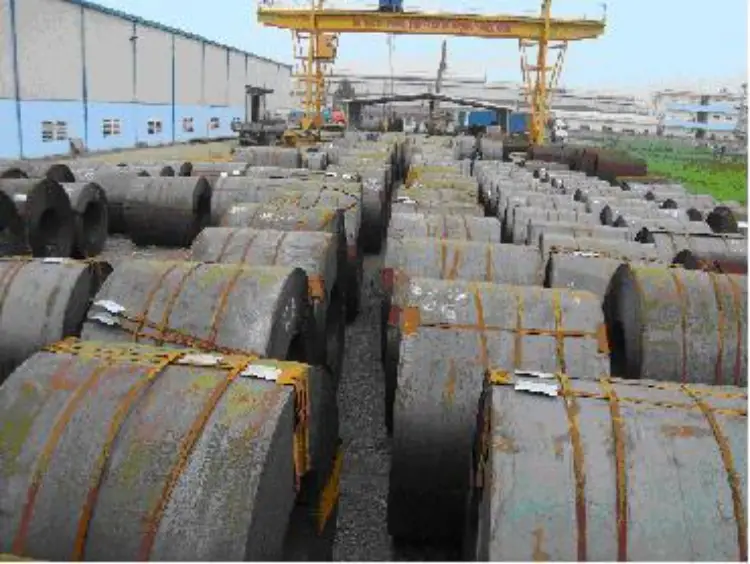
EN10025-2 S355J2 Carbon and Low-alloy High-strength Steel Coil
EN10025-2 S355J2 Carbon and Low-alloy High-strength Steel Coil | Technical Datasheet
Comprehensive datasheet for EN10025-2 S355J2 carbon and low-alloy high-strength steel coil, including chemical composition, mechanical and physical properties, international equivalents, and application guidance.
Welding, cutting, cold forming, machining, galvanizing
- Phone : +8618037372205
- Email : [email protected]
- WhatsApp: Contact via Whtsapp
- WeChat: +8618037372205
EN10025-2 S355J2 Carbon and Low-alloy High-strength Steel Coil Introduction
EN10025-2 S355J2 is a hot-rolled structural steel grade with minimum yield strength of 355 MPa, classified as a carbon and low-alloy high-strength steel. It offers excellent weldability, good toughness at low temperatures, and reliable mechanical properties, making it suitable for demanding structural applications. The material is typically supplied in the normalized or thermomechanical rolled condition and is widely used in construction, bridges, and heavy machinery. Key features include:
- Minimum yield strength 355 MPa for thicknesses up to 16 mm
- Guaranteed Charpy impact energy of 27 J at -20°C
- Fine grain structure ensured by aluminium, vanadium, or niobium microalloying
- Good cold-forming and welding characteristics
EN10025-2 S355J2 Carbon and Low-alloy High-strength Steel Coil Chemical Composition
Chemical composition limits according to EN 10025-2:2004 for grades S355J2. Values are maximum unless a range is indicated. The steel is fine-grain treated with a minimum aluminium content or other grain-refining elements, ensuring improved toughness.
- Optional elements Nb, V, Ti may be added singly or in combination to achieve mechanical properties.
- Carbon equivalent value (CEV) typically ≤0.45% for thicknesses up to 30 mm.
| Element | Specified Value (max) | Remarks |
|---|---|---|
| Carbon (C) | 0.22 % | For product thickness ≤40 mm; for >40 mm consult standard |
| Silicon (Si) | 0.55 % | |
| Manganese (Mn) | 1.60 % | For long products may be up to 1.70 % by agreement |
| Phosphorus (P) | 0.025 % | |
| Sulfur (S) | 0.025 % | |
| Nitrogen (N) | 0.012 % | |
| Copper (Cu) | 0.55 % | If specified, higher copper may be agreed |
| Aluminium (Al, total) | ≥ 0.02 % | Grain refinement; alternatively other measures as per standard |
| Niobium (Nb) | 0.05 % | Optional microalloying element |
| Vanadium (V) | 0.05 % | Optional microalloying element; V+Nb+Ti ≤0.22 % |
| Titanium (Ti) | 0.05 % | Optional microalloying element |
EN10025-2 S355J2 Carbon and Low-alloy High-strength Steel Coil Thermal and Electrical Physical Properties
Typical physical properties for S355J2 structural steel at room temperature unless otherwise noted. These values are based on published literature and are not mandatory requirements of EN 10025-2. They are useful for design calculations involving heat transfer, thermal expansion, and electromagnetic considerations.
- Density is nearly constant for all structural steels.
- Thermal conductivity decreases with increasing temperature.
- Electrical resistivity is typical for low-alloy steels.
| Property | Typical Value | Unit | Condition / Temperature Range |
|---|---|---|---|
| Density (ρ) | 7.85 | g/cm³ | 20°C |
| Modulus of Elasticity (E) | 210 | GPa | 20°C |
| Shear Modulus (G) | ~81 | GPa | 20°C (calculated from E and ν) |
| Poisson's Ratio (ν) | 0.3 | — | 20°C, elastic range |
| Thermal Expansion Coeff. (α) | 11.1 | 10⁻⁶/K | 20°C – 100°C |
| Thermal Expansion Coeff. (α) | 12.1 | 10⁻⁶/K | 20°C – 200°C |
| Thermal Expansion Coeff. (α) | 12.9 | 10⁻⁶/K | 20°C – 300°C |
| Thermal Expansion Coeff. (α) | 13.5 | 10⁻⁶/K | 20°C – 400°C |
| Thermal Expansion Coeff. (α) | 13.9 | 10⁻⁶/K | 20°C – 500°C |
| Thermal Conductivity (λ) | 50 | W/(m·K) | 20°C |
| Specific Heat Capacity (cp) | 460 | J/(kg·K) | 20°C – 100°C |
| Electrical Resistivity (ρe) | ~0.23 | μΩ·m | 20°C |
EN10025-2 S355J2 Carbon and Low-alloy High-strength Steel Coil Mechanical Properties
Mechanical properties as specified in EN 10025-2:2004 for S355J2 in the delivery condition. Values depend on product thickness. Yield strength (ReH), tensile strength (Rm), and elongation are determined on longitudinal test pieces. Impact energy is measured on Charpy V-notch specimens at -20°C. Bending test with specified mandrel diameter applies for verification of formability.
| Property | Specified Value | Unit | Test Condition / Thickness Range |
|---|---|---|---|
| Yield Strength (ReH, min) | 355 | MPa | t ≤ 16 mm |
| Yield Strength (ReH, min) | 345 | MPa | 16 mm < t ≤ 40 mm |
| Yield Strength (ReH, min) | 335 | MPa | 40 mm < t ≤ 63 mm |
| Yield Strength (ReH, min) | 325 | MPa | 63 mm < t ≤ 80 mm |
| Yield Strength (ReH, min) | 315 | MPa | 80 mm < t ≤ 100 mm |
| Yield Strength (ReH, min) | 295 | MPa | 100 mm < t ≤ 150 mm |
| Tensile Strength (Rm) | 470 - 630 | MPa | t ≤ 100 mm |
| Tensile Strength (Rm) | 470 - 630 | MPa | 100 mm < t ≤ 200 mm |
| Tensile Strength (Rm) | 450 - 600 | MPa | 200 mm < t ≤ 250 mm |
| Elongation (A, min, longitudinal) | 22 | % | t ≤ 40 mm (L0 = 80 mm or proportional) |
| Elongation (A, min, longitudinal) | 21 | % | 40 mm < t ≤ 63 mm |
| Elongation (A, min, longitudinal) | 20 | % | 63 mm < t ≤ 100 mm |
| Elongation (A, min, longitudinal) | 18 | % | 100 mm < t ≤ 150 mm |
| Elongation (A, min, longitudinal) | 17 | % | 150 mm < t ≤ 200 mm |
| Elongation (A, min, longitudinal) | 17 | % | 200 mm < t ≤ 250 mm |
| Charpy Impact Energy (KV, min) | 27 | J | -20°C, longitudinal, standard specimen |
| Bend Test (mandrel diameter) | 2 t | t ≤ 16 mm, 180° bend | |
| Bend Test (mandrel diameter) | 3 t | 16 mm < t ≤ 100 mm, 180° bend |
EN10025-2 S355J2 Carbon and Low-alloy High-strength Steel Coil Directly Equivalent Material Standards and Alternative Designations
| Country/Region | Standard | Designation | Remarks |
|---|---|---|---|
| International | ISO 630-2:2011 | S355J2 | Identical to EN 10025-2; fine-grain structural steel |
| China | GB/T 1591-2018 | Q355D | Charpy impact at -20°C, ≥27 J; technical delivery conditions aligned |
| Germany | DIN EN 10025-2 | S355J2 | European standard, direct adoption |
| United Kingdom | BS EN 10025-2 | S355J2 | British adoption of EN standard |
| France | NF EN 10025-2 | S355J2 | French adoption of EN standard |
| Italy | UNI EN 10025-2 | S355J2 | Italian adoption of EN standard |
| Spain | UNE EN 10025-2 | S355J2 | Spanish adoption of EN standard |
| Japan | JIS G 3106 (2008) | SM490B | Comparable in strength; verify impact test temperature (usually 0°C); S355J2 often specified as equivalent in international projects |
| USA | ASTM A572/A572M | Grade 50 [345] | Similar yield strength; no mandatory impact at -20°C; supplementary requirement S5 for Charpy may be invoked |
EN10025-2 S355J2 Carbon and Low-alloy High-strength Steel Coil Application Introduction
S355J2 steel is a versatile structural grade suitable for welded, bolted, and riveted constructions. Its combination of high strength, excellent weldability, and guaranteed low-temperature toughness makes it ideal for load-bearing structures in aggressive environments.
- Widely employed in building frames, bridges, and offshore platforms.
- Can be galvanized and painted for corrosion protection.
- The material is available in a variety of forms including coils, plates, and sections, enabling efficient production of components.
Product Applications: Steel frameworks for high-rise buildings, Highway and railway bridge girders, Offshore platform modules and decks, Crane booms and jibs, Pressure vessel shells (within thickness limits), Wind tower tubular sections, Heavy-duty vehicle chassis rails, Industrial storage tanks and silos
Processed into products: Beams, columns, and trusses, Flanges and web plates for welded girders, Brackets, gussets, and stiffeners, Anchor plates and embedments, Boom sections for excavators and cranes, Bolted and welded connections in steel frames
Application industries: Civil engineering and construction, Bridge and highway infrastructure, Offshore and marine engineering, Heavy machinery and equipment manufacturing, Transportation (rail vehicles, truck chassis), Energy (wind turbine towers, power plant structural frames)
EN10025-2 S355J2 Carbon and Low-alloy High-strength Steel Coil Similar or Alternative Structural Steels with Comparable Properties
| Country/Region | Standard | Designation | Remarks |
|---|---|---|---|
| EU | EN 10025-2 | S355JR | Lower toughness, Charpy ≥27 J at +20°C; other mechanical properties identical |
| EU | EN 10025-2 | S355J0 | Charpy ≥27 J at 0°C; suitable for less demanding low-temperature service |
| EU | EN 10025-2 | S355K2 | Higher toughness, Charpy ≥40 J at -20°C; otherwise same strength and chemistry ranges |
| China | GB/T 1591 | Q355C | Charpy at 0°C; while Q355D is the direct equivalent, C grade may be accepted for less critical applications |
| USA | ASTM A709/A709M | Grade 50 [345] | Bridge steel with mandatory Charpy; grades 50W available for atmospheric corrosion resistance |
| Japan | JIS G3106 | SM490A | Lower toughness (no guaranteed impact); structural use where impact requirements are not strict |
| Russia | GOST 27772 | S355 (C355) | Similar yield class; check impact properties for exact correspondence |
Notes:
Welding: S355J2 is readily weldable by all conventional methods; preheat may be required for thick sections. Forming: Minimum bending radii as per EN 10025-2 or project specifications; hot forming may affect mechanical properties. Corrosion protection: The steel has no enhanced atmospheric corrosion resistance; protective coatings are recommended for outdoor exposure. Certification: EN 10204 type 3.1 or 3.2 inspection certificates are typically provided upon request.
- Share



