
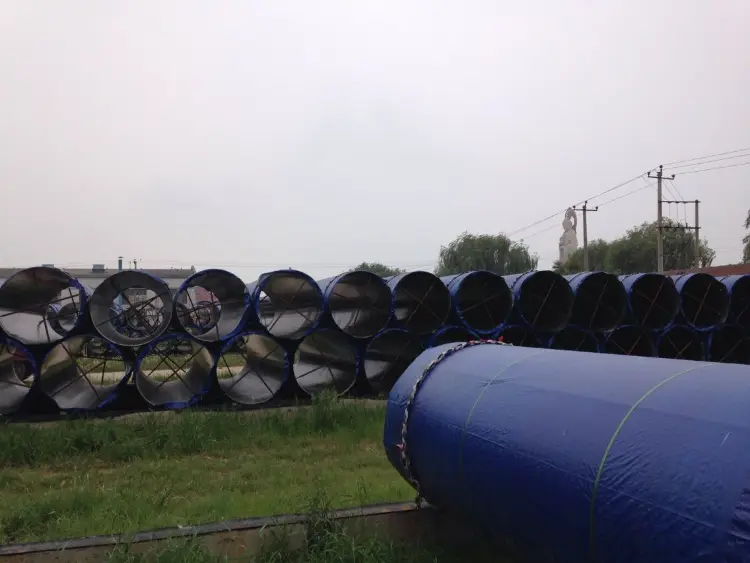
Q345C Seamless Steel Pipe for Low-Temperature Service
Q345C Seamless Steel Pipe for Low-Temperature Service - GB/T 8163 Grade Analysis
Comprehensive material profile of Q345C seamless steel pipe under GB/T 8163 for low-temperature fluid transport, including chemical, mechanical, and physical properties.
Hot-rolled or cold-drawn seamless; normalizing or stress-relief heat treatment available
- Phone : +8618037372205
- Email : [email protected]
- WhatsApp: Contact via Whtsapp
- WeChat: +8618037372205
Q345C Seamless Steel Pipe for Low-Temperature Service Introduction
Q345C is a Chinese low-alloy high-strength structural steel grade specified in GB/T 8163-2018 for seamless steel tubes used in fluid transport at low temperatures. It belongs to the Q345 series with enhanced notch toughness, designed for service down to 0 °C. The steel is widely applied in pressure piping, cryogenic pipelines, and structural hollow sections where reliable low-temperature performance is essential.
- Minimum yield strength of 345 MPa for thin-wall sections
- Excellent weldability and moderate cold-forming capability
- Delivered in hot-rolled, cold-drawn, or normalized condition
- Impact energy guaranteed at 0 °C
Its balanced composition of C-Mn with optional microalloying elements (Nb, V, Ti) refines grain size and improves toughness, meeting the demands of industrial low-temperature pipeline systems.
Q345C Seamless Steel Pipe for Low-Temperature Service Chemical Composition
The chemical composition of Q345C as per GB/T 8163-2018 is based on C-Mn strengthening with optional microalloying. The limits ensure a balance of strength, toughness, and weldability, especially for low-temperature service. Residual elements are controlled to avoid detrimental effects on low-temperature properties.
| Chemical Element | Standard Value (%) | Remarks |
|---|---|---|
| C | ≤ 0.20 | Maximum carbon content |
| Si | ≤ 0.50 | Silicon |
| Mn | ≤ 1.70 | Manganese |
| P | ≤ 0.030 | Phosphorus |
| S | ≤ 0.030 | Sulfur |
| Alt | ≥ 0.020 | Total aluminum (acid-soluble Al when Alt not reported) |
| Nb | ≤ 0.07 | If added; Nb+V+Ti ≤ 0.15 when any microalloying used |
| V | ≤ 0.15 | If added |
| Ti | ≤ 0.20 | If added |
| Cr | ≤ 0.30 | Residual (not intentionally added) |
| Ni | ≤ 0.50 | Residual |
| Cu | ≤ 0.20 | Residual |
Q345C Seamless Steel Pipe for Low-Temperature Service Thermal and Electrical Physical Properties
Physical properties listed are representative values for low-alloy C-Mn steel similar to Q345C at room temperature unless otherwise noted. These values are useful for design calculations but are not mandatory in the standard. Properties may vary slightly with actual composition and processing.
| Property | Typical Value | Unit | Test Condition |
|---|---|---|---|
| Density (ρ) | 7.85 | g/cm³ | Room temperature |
| Modulus of Elasticity (E) | 200 | GPa | Room temperature |
| Shear Modulus (G) | 80 | GPa | Room temperature |
| Poisson's Ratio (ν) | 0.3 | - | Room temperature |
| Thermal Expansion Coefficient (α) | 12.0 | ×10⁻⁶ /K | 20–100 °C |
| Thermal Expansion Coefficient (α) | 13.0 | ×10⁻⁶ /K | 20–200 °C |
| Thermal Conductivity (λ) | 50 | W/(m·K) | 20 °C |
| Specific Heat Capacity (c) | 460 | J/(kg·K) | 20 °C |
| Electrical Resistivity (ρₑ) | 0.25 | ×10⁻⁶ Ω·m | 20 °C |
Q345C Seamless Steel Pipe for Low-Temperature Service Mechanical Properties
Mechanical properties are specified in GB/T 8163-2018 for the as-delivered condition. Property values vary with wall thickness. Impact test is mandatory at 0 °C for longitudinal or transverse specimens. Bending test is required for all thicknesses.
| Property | Required Value | Unit | Test Condition / Wall Thickness |
|---|---|---|---|
| Tensile Strength (Rm) | 470 - 630 | MPa | All thicknesses |
| Yield Strength (ReL) | ≥ 345 | MPa | Wall thickness ≤ 16 mm |
| Yield Strength (ReL) | ≥ 325 | MPa | Wall thickness > 16 mm to 30 mm |
| Yield Strength (ReL) | ≥ 295 | MPa | Wall thickness > 30 mm |
| Elongation (A) | ≥ 20 | % | Longitudinal, wall thickness ≤ 16 mm (gauge length 5.65√S₀) |
| Elongation (A) | ≥ 19 | % | Longitudinal, wall thickness > 16 mm to 30 mm |
| Elongation (A) | ≥ 18 | % | Longitudinal, wall thickness > 30 mm |
| Impact Energy (KV₂) | KV₂ ≥ 34 | J | Longitudinal, at 0 °C |
| Impact Energy (KV₂) | KV₂ ≥ 27 | J | Transverse, at 0 °C (if agreed) |
| Bend Test | Bend angle 180° | Mandrel diameter 4a for t ≤ 16 mm | |
| Bend Test | Bend angle 180° | Mandrel diameter 5a for 16 < t ≤ 30 mm | |
| Bend Test | Bend angle 180° | Mandrel diameter 6a for t > 30 mm |
Q345C Seamless Steel Pipe for Low-Temperature Service Exact Equivalent Material Standards and Substitutable Grade Recommendations
| Country / Region | Standard | Grade | Remarks |
|---|---|---|---|
| China | GB/T 8163-2018 | Q345C | Original specification for seamless pipe |
| China | GB/T 1591-2008 (archived) | Q345C | Same chemistry; applies to plates and sections. Replaced by Q355C in newer GB/T 1591-2018, but chemical composition differs slightly. |
| International | EN 10210-1 | S355J2H | Closest European hollow section grade, impact at -20 °C; minor differences in Mn and microalloying; not a full equivalent but widely accepted for substitution. |
| International | ASTM A106 / A106M | Grade C | Carbon steel pipe for high temperature, no mandatory low-temperature toughness; can be used if supplementary impact testing at 0 °C is performed and agreed. |
Q345C Seamless Steel Pipe for Low-Temperature Service Application Introduction
Q345C seamless pipe under GB/T 8163 is particularly suited for low-temperature fluid transport and structural applications where reliable notch toughness at 0 °C is required. Its combination of moderate strength, good weldability, and low-temperature toughness allows it to be used in:
- Industrial low-temperature pressure piping
- Liquefied gas and cryogenic pipelines
- Cold-region structural hollow sections
- Machinery and equipment exposed to sub-zero environments
Typical products include seamless tubes, but the same grade is also available in other shapes, which can be fabricated into various components.
Product Applications: Low-temperature fluid pipelines (liquid ammonia, LPG, ethylene), Process piping in LNG terminals and gas processing plants, Heat exchanger tubes and boiler tubes (if impact properties required), Structural hollow sections for arctic building structures, Line pipe for gathering and distribution systems
Processed into products: Pipe spools, elbows, tees, and reducers (fabricated from parent pipe), Flanges, weld neck flanges, and blind flanges (when forged in equivalent grade), Low-temperature pressure vessel nozzles and shells (using plate equivalent Q345C), Valve bodies and fittings (as cast or forged equivalent), Manifolds and suction/discharge piping for cryogenic pumps, Structural bracings and columns for cold storage facilities
Application industries: Oil & gas (onshore/offshore low-temperature transfer lines), Chemical and petrochemical plants (cryogenic piping), Energy and power generation (cooling water lines, auxiliary piping), Construction and infrastructure (cold-climate structural members), Machinery and equipment manufacturing (low-temperature process equipment)
Q345C Seamless Steel Pipe for Low-Temperature Service Similar / Alternative Material Recommendations
| Country / Region | Standard | Grade | Remarks |
|---|---|---|---|
| China | GB/T 1591-2018 | Q355C | Replaces Q345C for structural products; slightly higher Mn and controlled CEV; impact at 0 °C. |
| China | GB/T 6479 | Q345C | Seamless steel pipe for high-pressure chemical fertilizer equipment; similar composition but more stringent inspection. |
| EU | EN 10217-1 | P355N | Pressure purpose pipe with normalized delivery; minimum impact energy at 0 °C; good alternative for low-temperature piping. |
| USA | ASTM A572 / A572M | Grade 50 [345] | Structural steel with 345 MPa yield; impact properties optional; can match Q345C if specified with Charpy at 0 °C. |
| USA (API) | API 5L | X52 (L360) | Line pipe with similar strength; PSL2 with supplementary low-temperature toughness can substitute for Q345C in pipeline applications. |
Notes:
When using Q345C to GB/T 8163, the purchaser should specify the required impact test temperature (0 °C) and any supplementary non-destructive testing (e.g., ultrasonic inspection). For welding, low-hydrogen procedures are recommended, and preheat may be required for thick sections based on carbon equivalent (typically ≤0.45 CEV). Heat treatment after cold forming may be necessary to restore toughness. The material is not intended for prolonged use above 400 °C. For sub-zero service below -20 °C, a lower-temperature grade (Q345D or Q345E) should be considered.
- Share



