
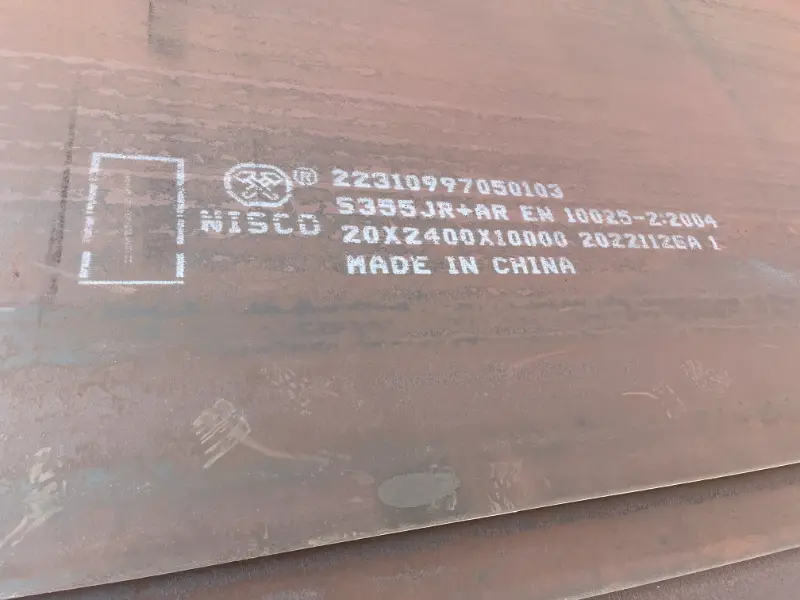
EN10025-2 S355JR Steel
EN10025-2 S355JR Steel: Properties, Equivalents & Applications Guide
In-depth technical data sheet for S355JR hot-rolled structural steel under EN 10025-2, including chemical composition, mechanical and thermal properties, international equivalents, and application guidance.
Hot rolling, cold forming, cutting, welding (all common methods), machining, forging, and drilling
- Phone : +8618037372205
- Email : [email protected]
- WhatsApp: Contact via Whtsapp
- WeChat: +8618037372205
EN10025-2 S355JR Steel Introduction
S355JR is a hot-rolled, weldable structural steel grade defined in EN 10025-2:2019. It is a low-carbon, low-alloy manganese steel designed for general structural and engineering applications. With a minimum yield strength of 355 MPa for nominal thicknesses ≤16 mm, it offers an excellent combination of high strength, good ductility, and superior weldability. The 'JR' designation guarantees a minimum impact energy of 27 Joules at +20°C (longitudinal test piece), making it suitable for ambient temperature applications. It is widely used in building construction, bridge engineering, and mechanical components, and is typically supplied in an as-rolled or normalized condition.
EN10025-2 S355JR Steel Chemical Composition as per EN 10025-2:2019
The table below details the maximum chemical element limits for S355JR based on ladle (heat) analysis. For product analysis, slight deviations are permitted as defined in the standard. A high manganese content is key for enhancing strength and toughness, while strict limits on phosphorus and sulfur enhance weldability and prevent hot shortness. The carbon equivalent value (CEV) is limited to ensure good weldability.
| Element | Standard Value (Max, unless range) | Notes |
|---|---|---|
| Carbon (C) | ≤0.24% for t≤40mm; ≤0.26% for t>40mm | Critical for strength and hardness. |
| Manganese (Mn) | ≤1.60% for t≤40mm; ≤1.70% for t>40mm | Compensates for sulfur brittleness. |
| Silicon (Si) | ≤0.55% | Deoxidizer, improves strength. |
| Phosphorus (P) | ≤0.035% | Strictly limited to avoid cold brittleness. |
| Sulfur (S) | ≤0.035% | Strictly limited to ensure weldability. |
| Nitrogen (N) | ≤0.012% | Limited to improve aging properties. |
| Copper (Cu) | ≤0.55% | Alloying element for corrosion resistance. |
EN10025-2 S355JR Steel Thermal and Electrical Physical Properties
Physical properties listed are typical reference values for low-alloy structural steels at room temperature (20°C), unless otherwise stated. These values are essential for calculating thermal expansion in building structures, distortion during welding, and for designing components exposed to fluctuating temperatures. The modulus values are standard for carbon steel types.
| Property | Tipical Reference Value | Unit | Test Condition / Temperature |
|---|---|---|---|
| Density (ρ) | 7.85 | kg/dm³ | At 20°C |
| Modulus of Elasticity (E) | 210 | GPa | At 20°C |
| Shear Modulus (G) | ≈81 | GPa | At 20°C |
| Poisson's Ratio (ν) | 0.3 | — | At 20°C |
| Thermal Expansion Coefficient (α) | 11.1 | 10⁻⁶/K | 100°C to 200°C |
| Thermal Expansion Coefficient (α) | 11.9 | 10⁻⁶/K | 200°C to 300°C |
| Thermal Expansion Coefficient (α) | 12.5 | 10⁻⁶/K | 300°C to 400°C |
| Thermal Conductivity (λ) | 52 | W/(m·K) | At 20°C |
| Specific Heat Capacity | 470 | J/(kg·K) | At 20°C |
| Electrical Resistivity (ρ_e) | ≈0.22 | Ω·mm²/m | At 20°C |
EN10025-2 S355JR Steel Mechanical Properties as per EN 10025-2:2019
The mechanical property requirements for S355JR are dependent on the product's nominal thickness. The values shown are mandatory minimums for transverse test pieces. The yield strength decreases with increasing thickness. The impact energy test is mandatory and must be verified at +20°C for longitudinal 'JR' quality. Elongation is tested on a proportional gauge length, L₀=5.65√S₀.
| Property | Standard Requirement | Unit | Test Condition / Nominal Thickness |
|---|---|---|---|
| Yield Strength (ReH) - Upper | ≥355 | MPa | Nominal thickness (t) ≤16 mm |
| Yield Strength (ReH) - Upper | ≥345 | MPa | 16 mm < t ≤40 mm |
| Yield Strength (ReH) - Upper | ≥335 | MPa | 40 mm < t ≤63 mm |
| Tensile Strength (Rm) | 470-630 | MPa | t ≤100 mm (Ambient temp.) |
| Tensile Strength (Rm) | 450-600 | MPa | 100 mm < t ≤250 mm (Ambient temp.) |
| Elongation after fracture (A) | ≥22 | % | L₀=5.65√S₀, t ≤1 mm |
| Elongation after fracture (A) | ≥20 | % | L₀=5.65√S₀, 1 mm < t ≤1.5 mm |
| Elongation after fracture (A) | ≥20 | % | L₀=5.65√S₀, 1.5 mm < t ≤2 mm |
| Impact Energy (KV) - Longitudinal | ≥27 | J | Temperature: +20°C, Charpy V-notch |
| Bend Test (Mandrel Diameter) | No cracks | — | 180° bend, mandrel diameter = 2 × t (t≤16mm inward test piece) |
EN10025-2 S355JR Steel Complete Equivalent Material Standards & Replaceable Grade Designations
| Country/Region | Standard | Grade | Notes |
|---|---|---|---|
| International (ISO) | ISO 630-2:2011 | S355B | Closest ISO equivalent for structural steels. Impact test at +20°C. |
| China (GB) | GB/T 1591-2018 | Q355B | Equivalent yield strength and impact requirement at +20°C. |
| Germany (DIN) | DIN EN 10025-2:2019 | S355JR | Identical, as the standard is harmonized in the EU. |
| France (NF) | NF EN 10025-2:2019 | S355JR | Identical. |
EN10025-2 S355JR Steel Application Introduction
S355JR steel is a fundamental material for modern steel construction and engineering. Its balance of high strength and excellent weldability makes it the steel of choice for static and dynamic loads in ambient conditions. The guaranteed impact toughness at +20°C (27 J) ensures safety for general applications without the need for costlier low-temperature grades. The material is readily available in various forms and thicknesses, and it can be processed with all conventional fabrication techniques, including gas cutting, plasma cutting, drilling, and cold forming.
Product Applications: Multi-story and high-rise building frameworks, Pedestrian and highway bridges, Industrial workshops and warehouses, Storage tanks and silos, Earth-moving and heavy transport equipment, Transmission poles and telecommunication towers
Processed into products: I-beams, H-piles, and other structural sections, Truss girders and roof trusses, Steel columns and bracing systems, Welded plate girders, Flanges and stiffeners for bridge boxes, Construction machinery booms and buckets
Application industries: Civil Engineering and Construction, Bridge Building, Mechanical Engineering, Shipbuilding (for structural parts), Offshore Structures (non-critical, non-arctic), Transportation (Railway and Heavy Vehicle Chassis), Renewable Energy (Wind Tower Internal Components)
EN10025-2 S355JR Steel Similar/Proximate Substitute Material Recommendations
| Country/Region | Standard | Grade | Notes |
|---|---|---|---|
| USA | ASTM A572/A572M-21 | Grade 50 | Similar yield strength (345 MPa). Requires verification of impact test temperature (usually -20°C or -30°C for structural tubes), which is superior to JR. |
| Japan | JIS G3101:2015 | SS490 | Tensile strength range is comparable (490-610 MPa), but yield strength is not guaranteed. Impact properties are not defined, limiting direct substitution without agreement. |
| Russia/CIS | GOST 27772-2015 | S345 (C345-3) | For welded structures and bridge building. Verification of impact work (KCU) and delivery condition is essential. |
Notes:
Important Processing and Application Notes:
- Weldability: Excellent with all common welding processes. Preheating is generally not required for material thicknesses below 30 mm. For greater thicknesses, a preheating temperature of ~100-150°C is recommended to prevent hydrogen-induced cold cracking.
- Corrosion Protection: As an unalloyed carbon steel, S355JR has no inherent atmospheric corrosion resistance. It must be protected by painting, hot-dip galvanizing, or metallic coatings for outdoor use. The high silicon limit (≤0.55%) must be considered for optimal hot-dip galvanizing results.
- Formability: Suitable for cold forming such as bending and edge rolling up to recommended limits. For severe cold deformation, stress relief annealing may be necessary.
- Availability: This grade is predominantly supplied as hot-rolled coil and cut-to-length plates. Access to thicker plates (>60mm) may require inquiry regarding sufficient impact toughness values.
- Share



