
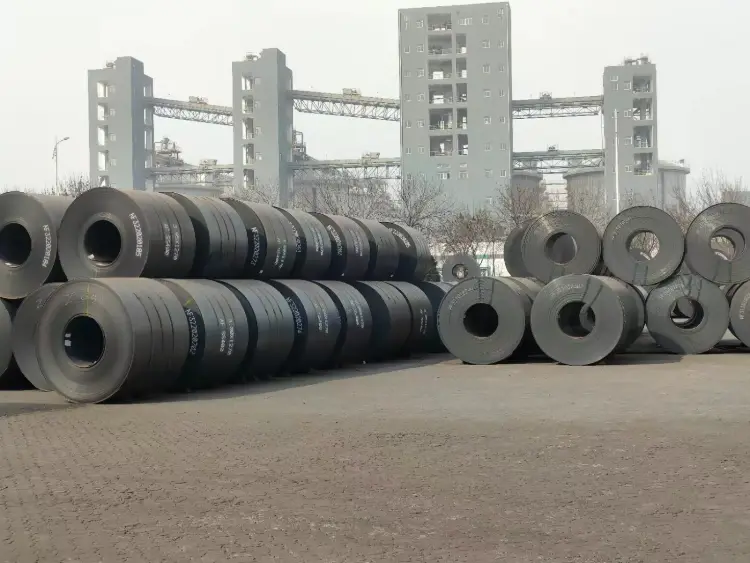
ASME SA656/SA656M Grade 80 Carbon and Low-alloy High-strength Steel Coil
ASME SA656/SA656M Grade 80 Carbon and Low-alloy High-strength Steel Coil - Properties & Equivalents
Detailed material data for ASME SA656/SA656M Grade 80 high-strength low-alloy steel coil, including chemical composition, mechanical and physical properties, international equivalents, and application guidance.
Hot rolling, controlled rolling, normalizing (optional), stress relieving, cold forming, welding
- Phone : +8618037372205
- Email : [email protected]
- WhatsApp: Contact via Whtsapp
- WeChat: +8618037372205
ASME SA656/SA656M Grade 80 Carbon and Low-alloy High-strength Steel Coil Introduction
ASME SA656/SA656M Grade 80 is a hot-rolled carbon and low-alloy high-strength steel coil and plate designed for structural applications requiring a high strength-to-weight ratio. It falls under the ASME Boiler and Pressure Vessel Code (BPVC) specification and is identical to ASTM A656/A656M Grade 80. The grade provides a minimum yield strength of 80 ksi (550 MPa) and a minimum tensile strength of 90 ksi (620 MPa) in thicknesses up to 50 mm. The steel is produced using fine grain practice with microalloying additions (niobium, vanadium, titanium) for grain refinement and precipitation strengthening, achieving good weldability and formability. It is typically supplied in the as-rolled or controlled-rolled condition and may be normalized or stress-relieved upon agreement. Common applications include heavy machinery, pressure vessels, offshore structures, and automotive components where weight reduction and high structural capacity are essential.
ASME SA656/SA656M Grade 80 Carbon and Low-alloy High-strength Steel Coil Chemical Composition
The chemical composition of ASME SA656/SA656M Grade 80 is based on heat analysis. Carbon and manganese are controlled to ensure strength and weldability. Phosphorus and sulfur are limited for cleanliness and toughness. Microalloying elements such as niobium, vanadium, and titanium are commonly added to achieve the required mechanical properties through grain refinement and precipitation hardening. Residual elements are restricted unless otherwise agreed between the producer and purchaser.
| Chemical Element | Standard Value (max, unless noted) | Remarks |
|---|---|---|
| Carbon (C) | 0.18% | Heat analysis |
| Manganese (Mn) | 1.65% | Heat analysis |
| Phosphorus (P) | 0.025% | Heat analysis |
| Sulfur (S) | 0.035% | Heat analysis |
| Silicon (Si) | 0.60% | Optional; heat analysis when specified |
| Niobium (Nb), Vanadium (V), Titanium (Ti), etc. | As required to meet mechanical properties | Microalloying elements; by agreement |
| Copper (Cu) | 0.35% | When specified |
| Nickel (Ni) | 0.25% | When specified |
| Chromium (Cr) | 0.25% | When specified |
| Molybdenum (Mo) | 0.08% | When specified |
ASME SA656/SA656M Grade 80 Carbon and Low-alloy High-strength Steel Coil Thermal and Electrical Physical Properties
The following physical properties are typical for carbon and low-alloy high-strength steels and are not specified in the material standard. Actual values may vary slightly depending on the exact chemical composition and processing history. These data are provided for engineering calculations and design purposes.
| Property | Typical Value | Unit | Test Condition / Notes |
|---|---|---|---|
| Density (ρ) | 7.85 | g/cm³ | At 20°C |
| Modulus of Elasticity (E) | 205 | GPa | At 20°C |
| Shear Modulus (G) | 80 | GPa | Calculated |
| Poisson's Ratio (ν) | 0.29 | - | At 20°C |
| Thermal Expansion Coefficient (α) | 11.7 | 10⁻⁶/K | Between 20°C and 100°C |
| Thermal Conductivity (λ) | 51.9 | W/(m·K) | At 20°C |
| Specific Heat Capacity | 460 | J/(kg·K) | At 20°C |
| Electrical Resistivity (ρ_e) | 0.18 | μΩ·m | At 20°C |
ASME SA656/SA656M Grade 80 Carbon and Low-alloy High-strength Steel Coil Mechanical Properties
Mechanical properties are determined on test specimens taken from the product in accordance with ASME SA656/SA656M. The yield strength and tensile strength apply to all thicknesses up to 50 mm. Elongation requirements depend on specimen gauge length and product thickness. The bend test verifies ductility with no cracking on the outside of the bent portion. Charpy V-notch impact properties are not mandatory in the base specification but can be agreed upon as a supplementary requirement (e.g., Type 3 or Type 7).
| Property | Standard Required Value | Unit | Test Condition / Thickness |
|---|---|---|---|
| Yield Strength (ReH) | ≥550 | MPa | Thickness ≤ 50 mm |
| Tensile Strength (Rm) | ≥620 | MPa | Thickness ≤ 50 mm |
| Elongation (A) in 50 mm (2 in.) | ≥18 | % | Thickness ≤ 20 mm |
| Elongation (A) in 50 mm (2 in.) | ≥16 | % | Thickness 20–40 mm |
| Elongation (A) in 50 mm (2 in.) | ≥14 | % | Thickness >40–50 mm |
| Elongation (A) in 200 mm (8 in.) | ≥15 | % | Thickness ≤ 20 mm |
| Elongation (A) in 200 mm (8 in.) | ≥13 | % | Thickness 20–40 mm |
| Elongation (A) in 200 mm (8 in.) | ≥11 | % | Thickness >40–50 mm |
| Bend Test (180°) | No cracks; mandrel = 1 × thickness | - | Thickness ≤ 25 mm |
| Bend Test (180°) | No cracks; mandrel = 1.5 × thickness | - | Thickness >25–50 mm |
ASME SA656/SA656M Grade 80 Carbon and Low-alloy High-strength Steel Coil Completely Equivalent Material Standards and Substitute Grades
| Country/Region | Standard | Grade | Remarks |
|---|---|---|---|
| USA / International | ASTM A656/A656M | Grade 80 | Identical specification to ASME SA656/SA656M Grade 80; chemical and mechanical requirements are the same. |
ASME SA656/SA656M Grade 80 Carbon and Low-alloy High-strength Steel Coil Application Introduction
ASME SA656/SA656M Grade 80 is engineered for load‐bearing structural components where high strength, good ductility, and moderate toughness are required. It is often used to replace mild steel when weight reduction is critical. Typical processing includes cutting, cold forming, welding, and machining.
- Construction & Infrastructure: Heavy columns, beams, trusses, and bridge components.
- Heavy Machinery: Crane booms, excavator arms, bulldozer frames, and mining equipment.
- Pressure Vessels: Shells and heads for low to medium pressure under ASME Section VIII Div. 1 when appropriate toughness is verified.
- Offshore & Marine: Platform decks, legs, and stiffeners in shipbuilding.
- Transportation: Truck chassis, railcar components, and trailer frames.
Product Applications: Structural beams and columns, Crane and lifting equipment, Pressure vessel shells and heads, Offshore platform decks and legs, Automotive chassis frames
Processed into products: Welded beams and columns, Load-bearing gusset plates, Crane booms and jibs, Excavator buckets and arms, Pressure vessel shells, Truck frame rails, Wind tower base plates
Application industries: Construction and Infrastructure, Heavy Machinery and Earthmoving, Pressure Vessels and Boilers, Offshore and Marine Engineering, Transportation (Railcar, Truck, Trailer)
ASME SA656/SA656M Grade 80 Carbon and Low-alloy High-strength Steel Coil Similar and Alternative Material Recommendations
| Country/Region | Standard | Grade | Remarks |
|---|---|---|---|
| Europe | EN 10149-2 | S550MC | Hot-rolled high yield strength steel for cold forming; minimum yield 550 MPa, but chemical composition differs (lower C, higher Mn) and it is intended for thinner gauges. |
| USA | ASTM A1011/A1011M | HSLAS Grade 80 Class 1/2 | High-strength low-alloy steel for hot-rolled sheet and strip; similar strength levels but generally applicable to thinner products (up to 6 mm). |
| Japan | JIS G 3134 | SPFC 590Y | Hot-rolled high yield strength steel for automobile structural uses; comparable 590 MPa class, but chemistry and delivery condition differ; check specific thickness and formability requirements. |
Notes:
When notch toughness is required, supplementary impact testing (e.g., Charpy V-notch) can be specified by choosing the appropriate type in accordance with ASME SA656/SA656M (e.g., Type 3 for 20°F or Type 7 for 50°F). Welding should follow standard procedures for HSLA steels; preheating and post-weld heat treatment may be necessary based on thickness and service conditions. For hot-dip galvanizing, attention to chemistry is recommended to avoid embrittlement. This grade is also available in 50, 60, 70, and 100 strength levels under the same specification.
- Share



