
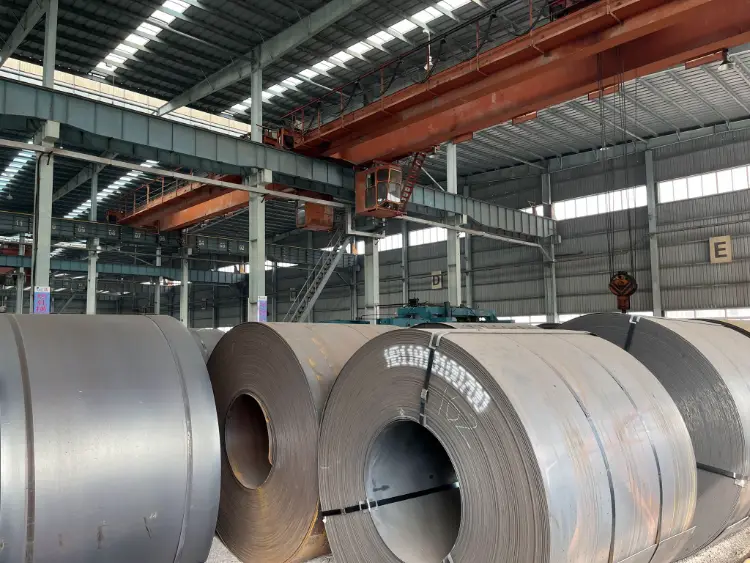
ASME SA709 Grade 36 Steel Coil
ASME SA709/SA709M Grade 36 Carbon & HSLA Steel Coil for Bridge Structures
Explore ASME SA709/SA709M Grade 36 carbon steel coil: chemical composition, mechanical properties, thermal & electrical data, international equivalents, and bridge engineering applications.
Welding, gas cutting, cold forming, punching, and machining
- Phone : +8618037372205
- Email : [email protected]
- WhatsApp: Contact via Whtsapp
- WeChat: +8618037372205
ASME SA709 Grade 36 Steel Coil Introduction
ASME SA709/SA709M Grade 36 is a carbon and low-alloy high-strength structural steel coil intended primarily for bridge construction. It is manufactured to the requirements of ASME Boiler and Pressure Vessel Code, Section II, Part A (equivalent to ASTM A709/A709M). Grade 36 offers a minimum yield strength of 250 MPa (36 ksi) and a tensile strength ranging from 400 to 550 MPa (58–80 ksi). The grade is typically supplied in the hot-rolled condition and provides good weldability, formability, and adequate toughness for structural applications. When optional supplementary requirements for notch toughness are specified, the material can be used in fracture-critical members. The chemistry is tightly controlled with a maximum carbon of 0.26%, ensuring reliable performance in welded bridge components. This coil form allows efficient processing into beams, girders, stiffeners, and other built-up sections.
ASME SA709 Grade 36 Steel Coil Chemical Composition
The chemical composition of ASME SA709/SA709M Grade 36 is designed to provide a balance of strength, ductility, and weldability. Maximum limits for carbon, phosphorus, and sulfur are controlled to ensure good welding characteristics and resilience. Manganese is specified within a range to enhance strength and toughness. Silicon is limited to maintain surface quality. Copper is not mandatory unless specified for atmospheric corrosion resistance (when Grade 36 is ordered as a weathering steel, minimum Cu 0.20% applies); the table reflects the standard non-weathering composition.
| Chemical Element | Standard Value (wt%) | Remarks |
|---|---|---|
| Carbon (C) | ≤ 0.26 | For thickness ≤ 20 mm; for thicker sections, the same limit applies per the standard |
| Manganese (Mn) | 0.60 – 1.20 | For thickness ≤ 20 mm, the lower limit may be adjusted to 0.60–0.90 by agreement; typical range 0.80–1.20 for structural shapes |
| Phosphorus (P) | ≤ 0.04 | Maximum allowed |
| Sulfur (S) | ≤ 0.05 | Maximum allowed |
| Silicon (Si) | ≤ 0.40 | Typical limit for killed or semi-killed steel |
| Copper (Cu) | ≥ 0.20 (when specified) | Required only when ordered as weathering steel (Grade 36W); otherwise residual elements may be present |
ASME SA709 Grade 36 Steel Coil Thermal and Electrical Physical Properties
These physical properties are not specified in the ASME SA709 standard but are typical for carbon-manganese structural steels at room temperature. They serve as general engineering references for design calculations involving thermal expansion, heat transfer, and weight estimation.
| Property | Reference Value | Unit | Test Condition / Remarks |
|---|---|---|---|
| Density (ρ) | 7.85 | g/cm³ | Room temperature |
| Modulus of Elasticity (E) | 200 – 210 | GPa | Tension, room temperature |
| Shear Modulus (G) | 80 | GPa | Calculated from E and Poisson's ratio |
| Poisson's Ratio (ν) | 0.3 | – | Elastic range |
| Coefficient of Thermal Expansion (α) | 12.0 × 10⁻⁶ | 1/°C | From 20 °C to 100 °C (approx.) |
| Thermal Conductivity (λ) | 52 | W/(m·K) | At 100 °C; decreases with increasing temperature |
| Specific Heat Capacity (c) | 480 | J/(kg·K) | Room temperature |
| Electrical Resistivity (ρ_e) | 0.142 × 10⁻⁶ | Ω·m | At 20 °C |
ASME SA709 Grade 36 Steel Coil Mechanical Properties
Mechanical tests are performed on specimens taken from the coil/plate in the as-delivered condition. The tensile and bend requirements are mandatory. Charpy V-notch impact testing is optional and invoked by supplementary requirements (e.g., S5.1, S5.2) depending on the bridge service temperature zone. The values below represent standard minimum requirements for thicknesses up to 100 mm; specific elongation and bend diameter vary with product thickness.
| Property | Standard Requirement | Unit | Test Condition / Thickness Range |
|---|---|---|---|
| Yield Strength (ReH) | ≥ 250 | MPa | All thicknesses (36 ksi min) |
| Tensile Strength (Rm) | 400 – 550 | MPa | All thicknesses (58–80 ksi) |
| Elongation (A) in 200 mm (8 in.) | ≥ 20 | % | Thickness ≤ 20 mm |
| Elongation (A) in 200 mm (8 in.) | ≥ 18 | % | Thickness > 20 mm to 40 mm |
| Elongation (A) in 200 mm (8 in.) | ≥ 16 | % | Thickness > 40 mm |
| Elongation (A) in 50 mm (2 in.) | ≥ 23 | % | All thicknesses (for plates and shapes) |
| Bend Test (bend diameter = n × thickness) | 1.5 t | – | Thickness ≤ 20 mm, 180° flatwise bend, no cracks |
| Bend Test | 2.0 t | – | Thickness > 20 mm to 25 mm, 180° flatwise bend |
| Bend Test | 2.5 t | – | Thickness > 25 mm to 50 mm |
| Bend Test | 3.0 t | – | Thickness > 50 mm to 100 mm |
| Charpy V-notch Impact Energy (Optional) | ≥ 27 @ 0 °C | J | When supplementary requirement S5.2 (Zone 2) is invoked; other temperatures available per S5.1 |
ASME SA709 Grade 36 Steel Coil Directly Equivalent Material Standards & Substitutable Grades
| Country/Region | Standard | Grade/Designation | Remarks |
|---|---|---|---|
| United States | ASTM A709/A709M | Grade 36 | Identical to ASME SA709 Grade 36; same chemistry and mechanical requirements |
| United States | ASTM A36/A36M | A36 | General structural steel plate; comparable strength but does not carry the mandatory bridge fracture-critical supplementary requirements of A709 |
| United States | ASME SA36/SA36M | Grade 36 | ASME pressure vessel equivalent to A36; mechanical properties match SA709 Grade 36 |
ASME SA709 Grade 36 Steel Coil Application Introduction
ASME SA709/SA709M Grade 36 coil is engineered for demanding bridge and structural applications where reliable welded fabrication is required. Hot-rolled coils can be uncoiled, leveled, slit, cut-to-length, and formed into a wide range of components. The material is readily weldable using all common methods, provided proper preheat and interpass controls are followed for thicker sections. Formability allows cold bending to moderate radii. The optional notch toughness requirements make it suitable for primary tension members in bridges located in cold climates.
Product Applications: Bridge girders, beams, and cross-frames, Floor plates and decking panels, Welded box sections and built-up columns, Stiffeners, gusset plates, and connection plates, Temporary works and shoring systems
Processed into products: Main bridge girders (plate welded girders), Stiffening ribs for webs and flanges, Splice plates and bolted connections, Deck troughs and stringers, Bearing stiffener assemblies
Application industries: Bridge construction and highway infrastructure, Commercial and industrial building frames, Offshore structural platforms (secondary members), Railway bridges and transit structures, Heavy machinery and equipment supports
ASME SA709 Grade 36 Steel Coil Similar / Comparable Material Recommendations
| Country/Region | Standard | Grade/Designation | Remarks |
|---|---|---|---|
| European Union | EN 10025-2 | S275JR / S275J0 / S275J2 | S275 has a slightly higher minimum yield strength (275 MPa) and tensile range up to 510–560 MPa; good structural substitute with appropriate notch toughness selection |
| Japan | JIS G3101 | SS400 | General structural rolled steel with min. yield 245 MPa; similar in carbon content and widely used for welded structures; need to verify Charpy requirements if fracture-critical |
| China | GB/T 700 | Q235B | Yield strength 235 MPa, tensile 370–500 MPa; composition similar but lower strength; can be considered for secondary members with reduced strength demands |
| International | ISO 630-2 | S235B / S275B | ISO structural steels; S235B yield 235 MPa is lower, while S275B strength matches well; check impact requirements for specific bridge jobs |
Notes:
Supplementary Requirements: SA709 offers a range of optional supplementary requirements, such as Charpy V-notch toughness (S5.1, S5.2, S5.3), carbon equivalent limits (S83), and ultrasonic testing (S8). When ordering for fracture-critical members, specify the appropriate notch toughness zone and testing temperature. Coil Processing: Coil material may exhibit some crown or camber inherent to hot-rolled products; leveling and edge trimming are recommended before fabrication. Weathering Option: Grade 36W with minimum copper 0.20% and additional alloying elements (Cr, Ni) can be supplied for improved atmospheric corrosion resistance; check standard for exact composition limits if unpainted weathering design is planned.
- Share



