
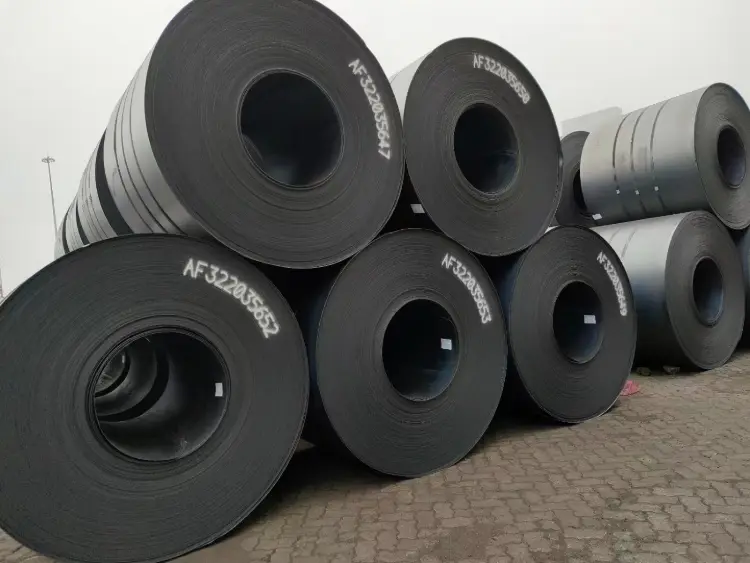
ASME SA656/SA656M Grade 70 High-Strength Low-Alloy Steel Coil
ASME SA656/SA656M Grade 70 High-Strength Low-Alloy Steel Coil: Properties, Equivalents & Applications
Complete material data for ASME SA656/SA656M Grade 70 carbon and low-alloy high-strength steel coil, including chemical composition, mechanical and thermal properties, international equivalents, and usage guide.
Cold forming, bending, stamping, roll forming, welding, painting, galvanizing
- Phone : +8618037372205
- Email : [email protected]
- WhatsApp: Contact via Whtsapp
- WeChat: +8618037372205
ASME SA656/SA656M Grade 70 High-Strength Low-Alloy Steel Coil Introduction
ASME SA656/SA656M Grade 70 is a hot-rolled, high-strength low-alloy (HSLA) carbon steel coil with improved formability and weldability. It achieves a minimum yield strength of 480 MPa (70 ksi) through microalloying with elements such as vanadium, niobium, or titanium. This grade is widely used in structural, automotive, and heavy equipment industries where weight reduction and high strength are required. The steel exhibits good cold-forming characteristics and is suitable for bending and moderate drawing operations. It is supplied in the as-rolled or normalized condition, offering a balance between strength, ductility, and cost-effectiveness.
ASME SA656/SA656M Grade 70 High-Strength Low-Alloy Steel Coil Chemical Composition
Chemical composition as per ASME SA656/SA656M Grade 70. Microalloying elements such as V, Nb, or Ti are added individually or in combination to achieve grain refinement and precipitation strengthening. The values shown are maximum percentages unless a range is indicated. Residual elements (Cu, Ni, Cr, Mo) may be present up to 0.30% each.
| Element | Standard Value (%) | Remarks |
|---|---|---|
| Carbon (C) | ≤ 0.18 | Improves hardenability; kept low for weldability |
| Manganese (Mn) | ≤ 1.65 | Contributes to strength and toughness |
| Phosphorus (P) | ≤ 0.025 | Controlled to avoid embrittlement |
| Sulfur (S) | ≤ 0.035 | Controlled for cleanliness and formability |
| Silicon (Si) | ≤ 0.60 | Deoxidizer; aids strength |
| Vanadium (V) | 0.005 – 0.15 (if added) | Microalloying for grain refinement |
| Niobium (Nb) | 0.005 – 0.10 (if added) | Microalloying for grain refinement |
| Titanium (Ti) | 0.005 – 0.15 (if added) | Microalloying for grain refinement; also nitrogen stabilization |
| Nitrogen (N) | ≤ 0.020 | Typically controlled when Ti is added |
ASME SA656/SA656M Grade 70 High-Strength Low-Alloy Steel Coil Thermal and Electrical Physical Properties
Typical physical properties for high-strength low-alloy steel of this type. These values are not mandated by the standard but are representative for engineering calculations. Actual values can vary slightly with composition and processing.
| Property | Typical Value | Unit | Condition / Remarks |
|---|---|---|---|
| Density (ρ) | 7.85 | g/cm³ | At 20 °C |
| Elastic modulus (E) | 200 | GPa | At room temperature |
| Shear modulus (G) | 77 | GPa | Calculated from E and Poisson's ratio |
| Poisson's ratio (ν) | 0.29 | — | Typical for structural steel |
| Thermal expansion coefficient (α) | 12.0 ×10⁻⁶ | /K | Between 20 °C and 100 °C |
| Thermal conductivity (λ) | 45 | W/(m·K) | At room temperature |
| Specific heat capacity (Cp) | 460 | J/(kg·K) | At room temperature |
| Electrical resistivity (ρe) | 0.15 | µΩ·m | At room temperature |
ASME SA656/SA656M Grade 70 High-Strength Low-Alloy Steel Coil Mechanical Properties
Mechanical properties for as-rolled Grade 70 steel coil per SA656/SA656M. Values presented are minima or ranges as specified for standard thickness up to 6.35 mm. Testing is performed on longitudinal test pieces. The bend test confirms cold formability without cracking.
| Property | Required Value | Unit | Test Condition |
|---|---|---|---|
| Yield strength (ReH) | ≥ 480 | MPa | Longitudinal, 0.5% offset, specimen thickness ≤ 6.35 mm |
| Tensile strength (Rm) | 550 – 690 | MPa | Longitudinal, specimen thickness ≤ 6.35 mm |
| Elongation (A50) | ≥ 14 | % | Gauge length 50 mm, thickness ≤ 6.35 mm |
| Bend test | 180° bend, r = 1t | — | Thickness ≤ 6.35 mm, mandrel radius equal to specimen thickness |
ASME SA656/SA656M Grade 70 High-Strength Low-Alloy Steel Coil Fully Equivalent Standards and Substitute Grades
| Country/Region | Standard | Grade | Remarks |
|---|---|---|---|
| USA | ASTM A656/A656M | Grade 70 | Identical specification; same chemical and mechanical requirements. |
| Europe | EN 10149-2 | S500MC | Comparable microalloyed steel, min yield 500 MPa; slightly higher strength, similar formability. |
| Japan | JIS G3134 | SPFH590 | Hot-rolled high-strength steel sheet, min tensile 590 MPa; check ductility and bend radii. |
| International | ISO 4995 | HSLA480 | Nominal min yield 480 MPa; availability may be limited. |
ASME SA656/SA656M Grade 70 High-Strength Low-Alloy Steel Coil Application Introduction
Grade 70 steel coil is engineered for demanding structural and automotive applications requiring high strength-to-weight ratio and good weldability. It can be processed by cold stamping, roll forming, and welded fabrication. Typical industries include automotive, transportation, construction, agricultural, and heavy machinery. The material is suitable for manufacturing parts such as chassis frames, reinforcement members, container side panels, and agricultural implements. With appropriate forming techniques, complex shapes can be achieved without sacrificing strength.
Product Applications: Automobile underbody components, Chassis frames and crossmembers, Truck trailer beams, Container and structural sections, Agricultural harvester parts, Crane booms and lifting equipment
Processed into products: Stamped brackets and reinforcement plates, Longitudinal frame rails, Roll-formed profiles, Welded assemblies, Machine frames, Bumper reinforcements
Application industries: Automotive manufacturing, Transportation and trailer engineering, Construction and structural engineering, Agricultural machinery, Heavy equipment and crane manufacturing
ASME SA656/SA656M Grade 70 High-Strength Low-Alloy Steel Coil Similar / Close Alternative Materials
| Country/Region | Standard | Grade | Remarks |
|---|---|---|---|
| USA | ASTM A1011/A1011M | HSLAS Class 70 | Hot-rolled sheet with matching yield and tensile ranges; formability may differ slightly. |
| Europe | EN 10149-2 | S460MC | Lower min yield (460 MPa); can substitute if slight thickness increase is acceptable. |
| Germany | DIN EN 10268 | H340LA | 340 MPa yield; microalloyed for cold forming; not directly replaceable but part of HSLA family. |
Notes:
The material is typically supplied as hot-rolled coil. Optional supplementary requirements (e.g., impact testing, improved surface finish, controlled sulfur content) may be available by agreement. Welding should follow low-carbon equivalent procedures to avoid hardening in the heat-affected zone. Forming lubricants are recommended for severe drawing operations. Stress relieving may be performed after extensive welding, though it is not commonly required.
- Share



