
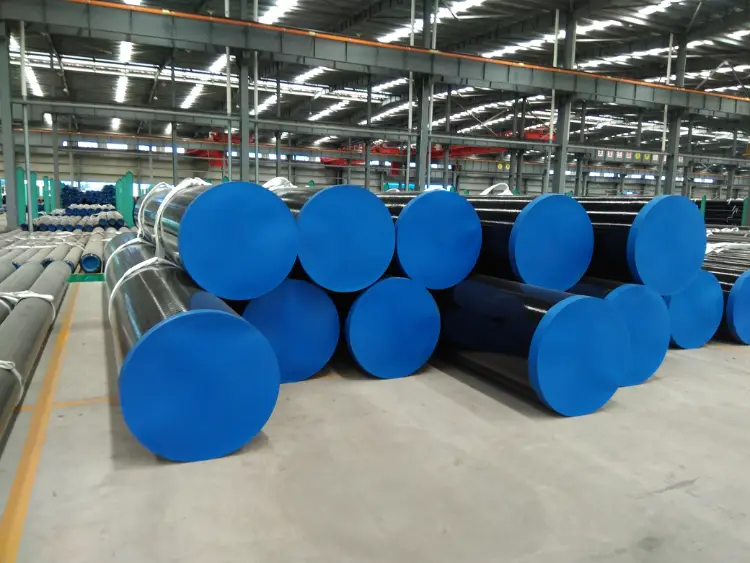
EN10297-1 42CrMo4 Seamless Pipe
EN10297-1 42CrMo4 Seamless Pipe: High-Strength Alloy Steel for Automotive & Structural Applications
Comprehensive technical data for 42CrMo4 seamless steel tube under EN 10297-1, including chemical composition, mechanical properties, physical performance, international equivalents, and application guidelines. Ideal for high-stress automotive and mechanical engineering components.
Hot rolling + cold finishing; can be supplied in as-rolled, annealed (+A), quenched and tempered (+QT), or stress relieved (+SR) condition. Machinability is good in the +QT state; welding requires preheating and post-weld heat treatment.
- Phone : +8618037372205
- Email : [email protected]
- WhatsApp: Contact via Whtsapp
- WeChat: +8618037372205
EN10297-1 42CrMo4 Seamless Pipe Introduction
EN10297-1 42CrMo4 is a quenched and tempered alloy steel supplied as a seamless circular tube for mechanical and general engineering purposes. It belongs to the Cr-Mo group, offering an excellent combination of high tensile strength, good toughness, and wear resistance after heat treatment. This grade is widely used in the automotive industry and structural engineering where components are subjected to high static and dynamic loads. Key characteristics include deep hardenability, minimal distortion during quenching, and the ability to achieve a uniform microstructure across wall thicknesses up to approximately 80 mm. The material is typically delivered in the +QT (quenched and tempered) condition, ensuring consistent mechanical properties and facilitating subsequent machining or cold forming operations.
EN10297-1 42CrMo4 Seamless Pipe Chemical Composition
The chemical composition of 42CrMo4 as specified in EN 10297-1 is designed to ensure deep hardenability and high strength after quenching and tempering. The carbon content provides the necessary hardness, while chromium and molybdenum improve hardenability, strength at elevated temperatures, and resistance to tempering. Sulphur and phosphorus are strictly limited to maintain ductility and toughness. Typical residual elements (e.g., Cu, Ni) are not specified but are controlled to avoid detrimental effects on hot workability.
| Element | Standard value (%) | Remarks |
|---|---|---|
| Carbon (C) | 0.38 – 0.45 | Key hardenability & strength element |
| Silicon (Si) | ≤ 0.40 | Deoxidizer; higher levels may affect toughness |
| Manganese (Mn) | 0.60 – 0.90 | Contributes to hardenability and strength |
| Phosphorus (P) | ≤ 0.025 | Maximum limit to avoid embrittlement |
| Sulfur (S) | ≤ 0.035 | Controlled for machinability and toughness |
| Chromium (Cr) | 0.90 – 1.20 | Primary hardenability & carbide forming element |
| Molybdenum (Mo) | 0.15 – 0.30 | Increases hardenability, high-temperature strength, and tempering resistance |
EN10297-1 42CrMo4 Seamless Pipe Thermal & Electrical Physical Properties
The following physical properties are typical for quenched and tempered 42CrMo4 steel at room temperature unless otherwise noted. Actual values may vary slightly depending on heat treatment and composition. These data are based on published material property references for AISI 4140 or equivalent Cr-Mo steels and are provided for design guidance.
| Property | Typical value | Unit | Test condition / Remarks |
|---|---|---|---|
| Density (ρ) | 7.85 | g/cm³ | 20°C |
| Modulus of elasticity (E) | 210 | GPa | Tensile, 20°C |
| Shear modulus (G) | 80 | GPa | Calculated from E and ν |
| Poisson's ratio (ν) | 0.3 | – | Elastic range |
| Thermal expansion coefficient (α) | 11.1 × 10⁻⁶ | K⁻¹ | 20–100°C |
| Thermal expansion coefficient (α) | 12.2 × 10⁻⁶ | K⁻¹ | 20–200°C |
| Thermal expansion coefficient (α) | 12.8 × 10⁻⁶ | K⁻¹ | 20–300°C |
| Thermal expansion coefficient (α) | 13.2 × 10⁻⁶ | K⁻¹ | 20–400°C |
| Thermal conductivity (λ) | 42.6 | W/(m·K) | 20°C |
| Specific heat capacity (cp) | 460 | J/(kg·K) | 20°C |
| Electrical resistivity (ρe) | 0.22 | μΩ·m | 20°C |
EN10297-1 42CrMo4 Seamless Pipe Mechanical Properties
Mechanical properties listed apply to test pieces taken from seamless tubes in the quenched and tempered (+QT) condition as per EN 10297-1. Values vary with wall thickness; thicker sections exhibit slightly lower strength but better ductility. Testing is performed at room temperature on longitudinal specimens. The impact energy is determined on Charpy V-notch specimens (KV) at +20°C. Elongation refers to a proportional gauge length (A).
| Property | Required value | Unit | Test condition |
|---|---|---|---|
| Tensile strength (Rm) | 1000 – 1200 | MPa | Wall thickness ≤ 8 mm, +QT |
| Yield strength (ReH) | ≥ 800 | MPa | Wall thickness ≤ 8 mm, +QT |
| Elongation (A) | ≥ 11 | % | Wall thickness ≤ 8 mm, +QT |
| Charpy impact energy (KV, longitudinal) | ≥ 30 | J | +20°C, wall thickness ≤ 8 mm |
| Tensile strength (Rm) | 900 – 1100 | MPa | 8 < t ≤ 20 mm, +QT |
| Yield strength (ReH) | ≥ 700 | MPa | 8 < t ≤ 20 mm, +QT |
| Elongation (A) | ≥ 12 | % | 8 < t ≤ 20 mm, +QT |
| Charpy impact energy (KV, longitudinal) | ≥ 30 | J | +20°C, 8 < t ≤ 20 mm |
| Tensile strength (Rm) | 800 – 950 | MPa | 20 < t ≤ 50 mm, +QT |
| Yield strength (ReH) | ≥ 600 | MPa | 20 < t ≤ 50 mm, +QT |
| Elongation (A) | ≥ 14 | % | 20 < t ≤ 50 mm, +QT |
| Charpy impact energy (KV, longitudinal) | ≥ 30 | J | +20°C, 20 < t ≤ 50 mm |
| Tensile strength (Rm) | 750 – 900 | MPa | 50 < t ≤ 80 mm, +QT |
| Yield strength (ReH) | ≥ 530 | MPa | 50 < t ≤ 80 mm, +QT |
| Elongation (A) | ≥ 15 | % | 50 < t ≤ 80 mm, +QT |
| Charpy impact energy (KV, longitudinal) | ≥ 30 | J | +20°C, 50 < t ≤ 80 mm |
EN10297-1 42CrMo4 Seamless Pipe Fully Equivalent Material Standards & Substitute Grades
| Country / Region | Standard | Designation | Remarks |
|---|---|---|---|
| Europe | EN 10297-1 | 42CrMo4 | Seamless tubes – base standard |
| Europe | EN 10083-3 | 42CrMo4 | Bars and wire rods; identical chemical and mechanical scope |
| International | ISO 683-1 | 42CrMo4 | Heat-treatable steels; identical requirements |
| Germany | DIN 17204 | 42CrMo4 | Withdrawn but historically equivalent |
| France | NF A35-552 | 42CD4 | Equivalent chemical and strength class |
| UK | BS 970-1 | 708M40 | Closely equivalent; check minor compositional tolerances |
| Italy | UNI 7845 | 42CrMo4 | Identical designation |
| USA | ASTM A519 | 4140 | Seamless mechanical tubing; slightly wider composition |
| USA | ASTM A322 | 4140 | Bars; fully interchangeable after quench & temper |
| Japan | JIS G4105 | SCM440 | Minor Mn/Cr differences but functionally equivalent |
| China | GB/T 3077 | 42CrMo | Same composition and application |
EN10297-1 42CrMo4 Seamless Pipe Application Introduction
42CrMo4 seamless tubes are designed for components that must withstand high mechanical stresses, often in dynamic loading environments. Their combination of high fatigue strength, good ductility, and suitability for induction hardening makes them an ideal choice for safety‑critical automotive and heavy‑machinery parts. The material can be further processed by machining, welding (with proper preheating and post-weld heat treatment), and surface hardening (e.g., nitriding).
Product Applications: High‑pressure pipes and cylinders, Hydraulic cylinder barrels, Drive shafts and propeller shafts, Axle tubes and steering knuckles, Roll cages and structural roll‑formed tubes, Machine frames subjected to vibration
Processed into products: Automotive: rear axle shafts, steering columns, anti‑roll bars, shock absorber tubes, Hydraulics: cylinder tubes for telescopic and rod cylinders, piston rods, Oilfield: mandrels, sub‑assemblies for downhole tools, stabilizers, General engineering: torsion bars, crankshafts, connecting rods, gear‑box shafts, Construction: pins, bushings, and excavator arm components
Application industries: Automotive and commercial vehicle manufacturing, Mechanical and plant engineering, Hydraulic and pneumatic systems, Oil and gas exploration (e.g., drill collars, subs), Power generation (turbine components), Agricultural and construction machinery
EN10297-1 42CrMo4 Seamless Pipe Similar / Comparable Alternative Materials
| Country / Region | Standard | Designation | Remarks |
|---|---|---|---|
| Europe | EN 10083-3 | 34CrMo4 | Lower carbon; lower achievable strength but better toughness and weldability |
| Europe | EN 10083-3 | 50CrMo4 | Higher carbon; can achieve higher hardness and wear resistance, but reduced ductility |
| Europe | EN 10083-3 | 42CrMoS4 | Sulfur-added variant for improved machinability; slight reduction in transverse toughness |
| USA | ASTM A519 | 4142 | Slightly higher carbon (0.40-0.45) for increased hardenability |
| Japan | JIS G4105 | SCM435 | Lower carbon (0.33-0.38); slightly lower strength but excellent for items requiring higher toughness |
Notes:
- Heat treatment: Austenitising at 830–860°C, quenching in oil or water, followed by tempering at 540–680°C to achieve the desired strength level. Tempering should be avoided in the range 250–400°C to prevent tempered martensite embrittlement.
- Welding: Preheating to 200–300°C is recommended. Post‑weld stress relieving or full re‑tempering is required to restore mechanical properties in the heat‑affected zone.
- Machinability: In the +QT condition, machinability is good; typical cutting speed with carbide tools is 120–180 m/min. Use of high‑sulfur free‑cutting variants (e.g., 42CrMoS4) can be considered for improved chip breaking.
- Surface treatments: Suitable for induction hardening, nitriding, and chrome plating to enhance wear and corrosion resistance.
- Standards compliance: All data conform to EN 10297‑1:2003. For critical applications, supplementary testing (e.g., ultrasonics, eddy current) can be specified according to EN 10246 series.
- Share



