
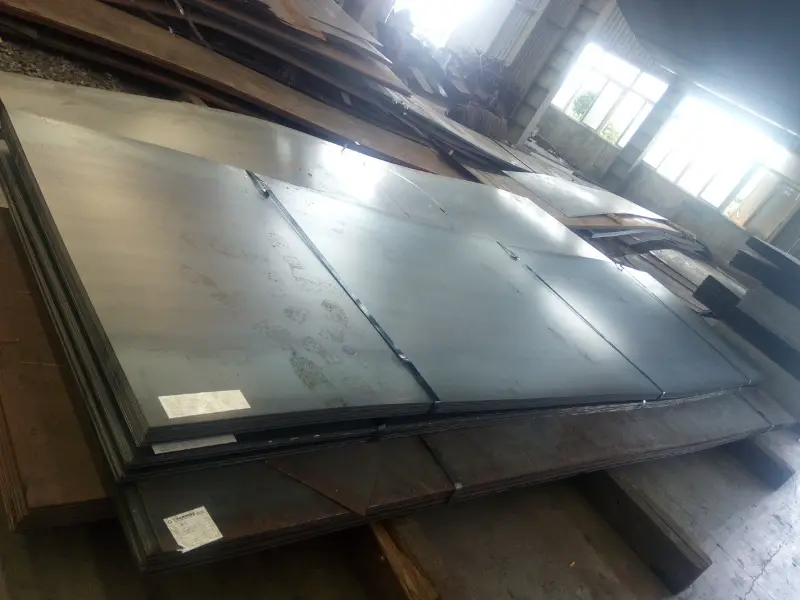
ASTM A709 HPS50W Weathering Steel
ASTM A709 HPS50W Weathering Steel: High-Performance Bridge Material Datasheet
Comprehensive datasheet for ASTM A709/A709M Grade HPS50W high-performance weathering steel coil, including chemical composition, mechanical properties, thermal & electrical physical properties, equivalent grades, and application guide.
Hot rolling, normalizing, quenching and tempering, thermo-mechanically controlled processing (TMCP), welding, cutting, forming, machining
- Phone : +8618037372205
- Email : [email protected]
- WhatsApp: Contact via Whtsapp
- WeChat: +8618037372205
ASTM A709 HPS50W Weathering Steel Introduction
ASTM A709/A709M Grade HPS50W is a high-performance, weathering structural steel specifically developed for welded bridge construction. It belongs to the carbon and low-alloy high-strength steel category. HPS stands for High-Performance Steel, offering superior weldability, low-temperature toughness, and atmospheric corrosion resistance compared to conventional 50W grades. The controlled addition of copper, chromium, nickel, and vanadium promotes the formation of a dense, adherent patina that provides long-term corrosion protection without painting in many environments. With a minimum yield strength of 50 ksi (345 MPa) and excellent fracture toughness, HPS50W is ideal for critical bridge components such as girders, trusses, and deck plates. The steel is typically supplied in as-rolled, normalized, quenched-and-tempered, or TMCP condition, and is available in coil, plate, and structural shapes. Its lean chemistry design also enables cost-effective fabrication and extended service life with reduced maintenance.
ASTM A709 HPS50W Weathering Steel Chemical Composition
The following table lists the required chemical composition for ASTM A709 HPS50W according to the specification. The controlled addition of Cu, Cr, Ni, and V provides atmospheric corrosion resistance and strength. Very low S and P levels are maintained to ensure high toughness and weldability. Al is used for grain refinement, and N is limited to avoid detrimental effects on toughness. Values represent heat (ladle) analysis; product analysis tolerances apply as per ASTM A709.
| Element | Content (wt%) | Notes |
|---|---|---|
| C | ≤0.11 | Carbon control improves weldability and toughness |
| Mn | 1.10-1.35 | Provides strength and hardenability |
| P | ≤0.020 | Low phosphorus for improved ductility and impact properties |
| S | ≤0.006 | Very low sulfur to avoid hot shortness and enhance through-thickness ductility |
| Si | 0.30-0.50 | Deoxidizer and ferrite strengthener |
| Cu | 0.25-0.40 | Key element for weathering resistance; promotes protective patina |
| Ni | 0.25-0.40 | Improves toughness and adds to corrosion resistance |
| Cr | 0.45-0.70 | Enhances atmospheric corrosion and oxidation resistance |
| V | 0.04-0.08 | Provides precipitation strengthening and grain refinement |
| Al | 0.010-0.040 | Used for deoxidation and grain size control |
| N | ≤0.015 | Limiting nitrogen ensures good toughness, forms V(C,N) precipitates |
ASTM A709 HPS50W Weathering Steel Thermal and Electrical Physical Properties
The following thermal and electrical properties are typical values for low-alloy structural steel comparable to HPS50W. These are not specified in ASTM A709 but are based on published data for similar alloy compositions. Actual values may vary slightly depending on exact composition, heat treatment, and temperature.
| Property | Typical Value | Unit | Test Condition / Notes |
|---|---|---|---|
| Density (ρ) | 7850 | kg/m³ | Room temperature |
| Elastic Modulus (E) | 200 | GPa | Room temperature, typical for steel |
| Shear Modulus (G) | 80 | GPa | Calculated from E and ν |
| Poisson's Ratio (ν) | 0.3 | - | Typical for structural steel |
| Thermal Expansion Coefficient (α) | 11.7 | ×10⁻⁶/°C | 20–100°C average |
| Thermal Conductivity (λ) | 48 | W/(m·K) | At 20°C |
| Specific Heat Capacity (c) | 480 | J/(kg·K) | At 20°C |
| Electrical Resistivity (ρₑ) | 0.25 | ×10⁻⁶ Ω·m | At 20°C |
ASTM A709 HPS50W Weathering Steel Mechanical Properties
The mechanical properties apply to plates, coils, and structural shapes in the as-delivered condition. Yield strength and tensile strength are guaranteed up to 4 inches (100 mm) thickness. Elongation values depend on thickness and gauge length. The bend test is performed with guided bending over specified pin diameters. Charpy V-notch impact energy is a mandatory supplementary requirement when ordered with temperature zones; typical zone temperatures and energy minimums are listed.
| Property | Requirement | Unit | Test Condition / Notes |
|---|---|---|---|
| Yield Strength (ReH) | ≥50 | ksi [≥345 MPa] | Thickness ≤ 4 in. (100 mm) |
| Tensile Strength (Rm) | ≥70 | ksi [≥485 MPa] | Thickness ≤ 4 in. (100 mm) |
| Elongation (A) in 8 in. (200 mm) | ≥18 | % | Thickness ≤ ¾ in. (20 mm) |
| Elongation (A) in 2 in. (50 mm) | ≥21 | % | Thickness ≤ ¾ in. (20 mm) |
| Elongation (A) in 8 in. | ≥17 | % | Thickness > ¾ in. to 2 in. (20–50 mm) |
| Elongation (A) in 2 in. | ≥18 | % | Thickness > ¾ in. to 2 in. (20–50 mm) |
| Elongation (A) in 2 in. | ≥18 | % | Thickness > 2 in. to 4 in. (50–100 mm) |
| Bend Test (guided bend, 180°) | 1.5t | - | t ≤ 1 in. (25 mm) |
| Bend Test | 2.5t | - | 1 in. < t ≤ 2 in. (25–50 mm) |
| Bend Test | 3.0t | - | 2 in. < t ≤ 4 in. (50–100 mm) |
| Charpy V-notch impact (CVN) | ≥25 ft·lbf [≥34 J] | ft·lbf [J] | Zone 1 at -18°C (0°F), average of three |
| CVN | ≥25 ft·lbf [≥34 J] | ft·lbf [J] | Zone 2 at -34°C (-30°F), average |
| CVN | ≥25 ft·lbf [≥34 J] | ft·lbf [J] | Zone 3 at -51°C (-60°F), average |
ASTM A709 HPS50W Weathering Steel Directly Equivalent Material Standards and Replaceable Grades
| Country / Region | Standard | Grade | Remarks |
|---|---|---|---|
| USA | ASTM A709/A709M | HPS50W | Original specification and grade; no other standard is exactly equivalent. |
| USA | ASTM A709/A709M | Grade 50W (non-HPS) | Comparable strength and weathering resistance, but does not meet HPS toughness and chemistry requirements (e.g., higher carbon and no V). |
| Europe | EN 10025-5 | S355J2W+N (1.8965) | Weathering structural steel with similar yield strength; different chemical limits and toughness testing (KV at -20°C). Not HPS. |
| Japan | JIS G3114 | SMA490BW | Weathering steel for welded structures with 490 MPa tensile class; does not have the HPS V-N chemistry and toughness regime. |
ASTM A709 HPS50W Weathering Steel Application Introduction
ASTM A709 HPS50W is optimized for welded bridge construction in unpainted service where atmospheric corrosion resistance is essential. Its low carbon equivalent and low sulfur content allow for excellent weldability with minimal preheat. The steel is typically used for main load-carrying members, with the weathering patina providing a maintenance-free coating in most environments. Fabrication processes include gas cutting, plasma cutting, cold and hot forming, and all common welding methods (SMAW, SAW, FCAW, GMAW). Suitable for temperatures as low as -51°C (with Zone 3 toughness), it is well suited for bridges in cold climates. Typical products involve thick plates and coils that are cut and welded into box girders, plate girders, and truss assemblies.
Product Applications: Box and plate girders for highway and railway bridges, Truss members and chords, Orthotropic deck plates, Tubular and hollow structural sections for architectural exposure, Corrosion-resistant structural frames for industrial buildings
Processed into products: Main girder webs and flanges, Cross beams, stringers, and floor beams, Stiffeners, connection plates, and gusset plates, Splice plates and bolted joints, Welded built-up members and transitions
Application industries: Civil Engineering and Infrastructure, Bridge Construction (highway, railway, pedestrian), Architectural Metalwork (exposed structural frames), Offshore and Marine Structures, Industrial Plant Buildings and Transmission Towers
ASTM A709 HPS50W Weathering Steel Similar and Alternative Material Recommendations
| Country / Region | Standard | Grade | Remarks |
|---|---|---|---|
| USA | ASTM A588/A588M | Grade B | Popular weathering steel for structural applications; lower phosphorus and slightly different Cr-Cu balance; no HPS toughness. |
| USA | ASTM A709/A709M | Grade 50S | High-performance steel with 50 ksi yield in the "S" chemistry variant; differs in alloy design and may be considered for non-weathering applications. |
| Europe | EN 10025-5 | S355K2W (1.8967) | Higher toughness variant of weathering steel (KV at -20°C or -40°C); still not designated as HPS. |
| China | GB/T 4171 | Q355NH | Chinese weathering steel with nominal 355 MPa yield; similar corrosion mechanism but different microalloying approach. |
| India | IS 11587 | WR 50C | Indian structural weathering steel with 50 kgf/mm² min tensile strength; less stringent on toughness control. |
Notes:
Supplementary Requirements: ASTM A709/A709M offers optional supplementary requirements (S1 to S99) that can be invoked when ordering HPS50W. Common additions include S30 (Charpy V-notch impact testing) for specified temperature zones, S31 (fracture toughness control), and S78 (restricted chemical composition for improved through-thickness properties).
Weathering Notes: For uncoated applications, alternating wet/dry cycles are needed to form the protective patina. Design should avoid water traps and prolonged wetness. In highly aggressive marine or industrial atmospheres, periodic inspection is recommended.
Fabrication: Welding consumables should be selected to match the base metal corrosion resistance; low-hydrogen practices are essential for toughness. Preheating may be omitted for lean chemistry, but always follow the structural welding code (AWS D1.5) for bridge fabrication.
- Share



