
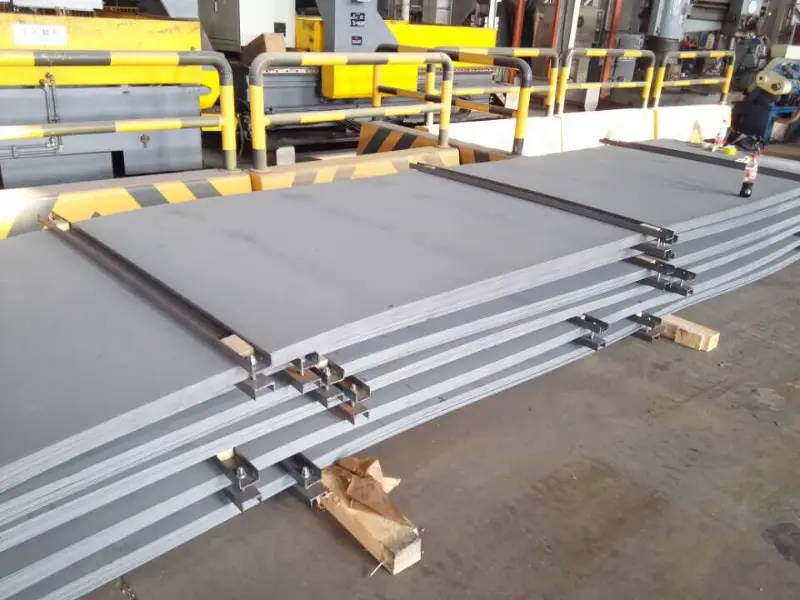
ASTM A709/A709M HPS 70W
ASTM A709/A709M HPS 70W: High-Performance Weathering Steel for Modern Bridges
Detailed material data sheet for ASTM A709/A709M Grade HPS 70W, a high-performance weathering steel for structural bridge applications, including chemical composition, mechanical properties, and equivalents.
Hot Rolling, Thermomechanical Controlled Processing (TMCP), Quenching and Tempering (Q&T)
- Phone : +8618037372205
- Email : [email protected]
- WhatsApp: Contact via Whtsapp
- WeChat: +8618037372205
ASTM A709/A709M HPS 70W Introduction
ASTM A709/A709M Grade HPS 70W is a high-performance structural steel (HPS) primarily utilized in bridge construction. As a 'W' grade weathering steel, it is designed to develop a stable, protective rust-like patina when exposed to atmospheric conditions, eliminating the need for painting in many environments. The 'HPS' designation signifies superior toughness and weldability compared to conventional 70W grades, achieved through controlled microalloying and advanced thermomechanical processing. It provides a minimum yield strength of 70 ksi (485 MPa) and excellent fracture toughness at low temperatures, making it suitable for critical welded bridge components.
ASTM A709/A709M HPS 70W Chemical Composition
The chemical composition of ASTM A709 HPS 70W is carefully balanced to achieve high strength, excellent weathering resistance, and superior weldability. It features additions of chromium, nickel, and copper for atmospheric corrosion resistance. The HPS variant strictly controls carbon and microalloying elements like vanadium and niobium to ensure the high level of notch toughness required for fracture-critical bridge applications.
- Carbon (C) is strictly limited to enhance weldability.
- Manganese (Mn) range is specified for strength and toughness.
- A corrosion resistance index (CRI) based on ASTM G101 is often a requirement to guarantee weathering capability.
| Element | Standard Value (Max, unless range) | Remarks |
|---|---|---|
| Carbon (C) | 0.11% | Max |
| Manganese (Mn) | 1.10 - 1.50% | For plates; may vary for shapes |
| Phosphorus (P) | 0.020% | Max |
| Sulfur (S) | 0.006% | Max |
| Silicon (Si) | 0.30 - 0.50% | |
| Nickel (Ni) | 0.25 - 0.40% | |
| Chromium (Cr) | 0.45 - 0.70% | |
| Copper (Cu) | 0.25 - 0.40% | |
| Molybdenum (Mo) | 0.02 - 0.08% | |
| Vanadium (V) | 0.04 - 0.08% | |
| Aluminum (Al) | 0.010 - 0.040% | Soluble, for grain refinement |
| Nitrogen (N) | 0.015% | Max |
| Titanium (Ti) | 0.005 - 0.035% |
ASTM A709/A709M HPS 70W Thermal and Electrical Physical Properties
These physical properties are typical for HPS 70W grade steel at ambient temperature and are provided for design calculations. They are similar to those of other low-alloy structural steels.
- Thermal expansion coefficient (α) is essential for calculating thermal movements in bridge structures.
- Modulus of elasticity (E) and shear modulus (G) are standard for structural steel analysis.
- These values are generally not specified by ASTM A709 but are widely accepted for this class of steel.
| Property | Typical Value | Unit | Condition |
|---|---|---|---|
| Density (ρ) | 7.85 | g/cm³ | Ambient temperature |
| Modulus of Elasticity (E) | 29,000 | ksi | Tension, ambient |
| Modulus of Elasticity (E) | 200 | GPa | Tension, ambient |
| Shear Modulus (G) | 11,200 | ksi | Ambient |
| Shear Modulus (G) | 77.2 | GPa | Ambient |
| Poisson's Ratio (ν) | 0.30 | Elastic range | |
| Thermal Expansion Coefficient (α) | 6.5 (for 70-200 °F) | 10⁻⁶/°F | Mean coefficient |
| Thermal Expansion Coefficient (α) | 11.7 (for 20-100 °C) | 10⁻⁶/°C | Mean coefficient |
| Thermal Conductivity (λ) | 26 | W/(m·K) | At 20 °C |
| Specific Heat Capacity (c) | 450 | J/(kg·K) | At 20 °C |
| Electrical Resistivity (ρ_e) | ~0.25 (25) | Ω·mm²/m (µΩ·cm) | Typical for low-alloy steel |
ASTM A709/A709M HPS 70W Mechanical Properties
ASTM A709 HPS 70W is specified for its high strength and exceptional fracture toughness. The high-performance (HPS) designation mandates Charpy V-notch (CVN) impact testing at specified temperatures to guarantee performance in fracture-critical applications, a key differentiator from standard Grade 70W. Tensile and yield strength requirements are defined for different thickness ranges.
- Minimum yield strength of 70 ksi is a fundamental requirement.
- Elongation requirements ensure adequate ductility.
- Charpy V-notch (CVN) toughness values are mandatory for HPS grades.
| Property | Standard Requirement | Unit | Test Condition / Thickness |
|---|---|---|---|
| Yield Strength (ReH) | Min 70 | ksi | Plates ≤ 4 in. (100 mm) |
| Yield Strength (ReH) | Min 485 | MPa | Plates ≤ 100 mm |
| Tensile Strength (Rm) | 85 - 110 | ksi | Plates ≤ 4 in. (100 mm) |
| Tensile Strength (Rm) | 585 - 760 | MPa | Plates ≤ 100 mm |
| Elongation in 8 in. (200 mm) | Min 18 | % | Plates and shapes |
| Elongation in 2 in. (50 mm) | Min 21 | % | Plates and shapes |
| Charpy V-notch (CVN) Energy | Min 35 | ft·lbf | at 10 °F (-12 °C), Zone 2 |
| Charpy V-notch (CVN) Energy | Min 47 | J | at -12 °C, Zone 2 |
| Charpy V-notch (CVN) Energy | Min 35 | ft·lbf | at -10 °F (-23 °C), Zone 3 |
| Charpy V-notch (CVN) Energy | Min 47 | J | at -23 °C, Zone 3 |
ASTM A709/A709M HPS 70W Complete Equivalent Standards and Substitutable Grades
| Country/Region | Standard & Grade | Equivalent Grade | Remarks |
|---|---|---|---|
| USA | ASTM A709/A709M | HPS 70W | Primary specification and grade. |
| USA | AASHTO M 270 | M 270 70W (with HPS provisions) | Technically identical to ASTM A709 for bridge applications. |
ASTM A709/A709M HPS 70W Application Introduction
HPS 70W is an advanced engineering material tailored for the most critical components in modern bridge design. Its combination of high strength, atmospheric corrosion resistance, and guaranteed low-temperature toughness makes it ideal for designs where weight reduction, long service life with minimal maintenance, and structural integrity are paramount.
- Weathering steel should not be used in marine coastal environments or areas with high industrial chemical fume concentration without careful evaluation, as the protective patina may not form properly.
- Welding procedures must be qualified specifically for HPS-grade steels to maintain toughness in the heat-affected zone (HAZ).
Product Applications: Cable-stayed and suspension bridges, Long-span arch bridges, Composite steel-concrete bridge girders, Heavy-load movable bridges, Pedestrian bridges with architectural exposure
Processed into products: Main longitudinal girders and box girders, Fracture-critical cross-frames and diaphragms, Welded stiffeners and connection plates, Arch ribs and tie girders, Bolted splice plates and gusset plates, Steel bridge deck plates
Application industries: Bridge and Highway Infrastructure Construction, Railway Engineering, Military Bridge Systems, Heavy Civil Engineering and Infrastructure
ASTM A709/A709M HPS 70W Proximate/Similar Substitute Material Recommendations
| Country/Region | Standard & Grade | Similar Grade | Description |
|---|---|---|---|
| USA | ASTM A709/A709M | 70W | Conventional (non-HPS) version with less stringent toughness requirements. May not be suitable for fracture-critical members. |
| Europe | EN 10025-5 | S355J2W+N | Similar strength level (355 MPa yield) and weathering properties. Requires verification of toughness (J2 impact class) and is not a direct substitute for 485 MPa yield. |
| Japan | JIS G 3114 | SMA570W | Weathering steel with minimum yield strength of 570 MPa, but lower toughness specifications compared to HPS 70W. |
Notes:
ASTM A709/A709M HPS 70W is often supplied as a thermomechanical controlled processed (TMCP) product. The Charpy V-notch impact test temperature zones (1, 2, 3) are specified on the purchase order based on the minimum service temperature for the bridge location. This steel has a corrosion resistance index based on ASTM G101 that must meet a minimum value of 6.0. Refer to the AWS D1.5 Bridge Welding Code for mandatory welding procedure specifications for this material.
- Share



