
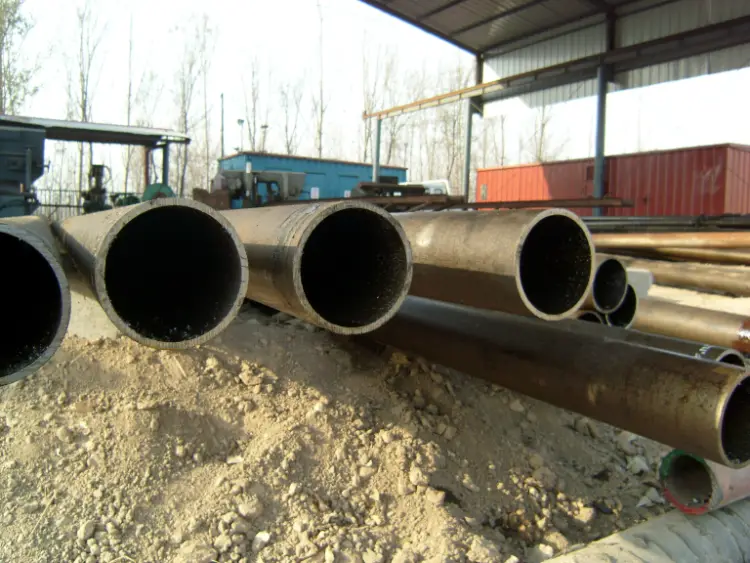
ASME SA213 T2 Boiler Steel Pipe
ASME SA213 T2 Boiler Steel Pipe - Ferritic Alloy Steel for Elevated Temperature Service
Comprehensive technical data for ASME SA213 T2 seamless ferritic alloy steel pipe, including chemical composition, mechanical and physical properties, equivalent grades, and application guidelines for boiler, superheater, and heat exchanger systems.
Hot rolling, cold drawing, welding, bending, machining
- Phone : +8618037372205
- Email : [email protected]
- WhatsApp: Contact via Whtsapp
- WeChat: +8618037372205
ASME SA213 T2 Boiler Steel Pipe Introduction
ASME SA213 T2 is a seamless ferritic alloy steel pipe designed for high-temperature service in boilers, superheaters, and heat exchangers. With a nominal composition of 0.5% chromium and 0.5% molybdenum (C-0.5Mo type), it offers improved creep strength and oxidation resistance compared to plain carbon steels up to approximately 500 °C. The material is specified under ASME SA213/SA213M standard and is widely used in power generation and petrochemical applications. Key attributes include:
- Good weldability with conventional fusion methods
- Suitable for service involving steam, water, and moderate corrosive environments
- Available in various sizes and wall thicknesses as seamless tubes
- May be supplied in annealed or normalized and tempered condition
ASME SA213 T2 Boiler Steel Pipe Chemical Composition
The chemical composition of ASME SA213 T2 steel pipe must conform to the following limits based on the ASME SA213/SA213M standard. The analysis represents the heat (ladle) analysis; product analysis is subject to specified tolerances. Residual elements such as Cu, Ni, etc., may be present but are not specified.
| Element | Standard Value (wt%) | Remarks |
|---|---|---|
| Carbon (C) | 0.10 – 0.20 | |
| Manganese (Mn) | 0.30 – 0.61 | |
| Phosphorus (P) | max 0.025 | |
| Sulfur (S) | max 0.025 | |
| Silicon (Si) | 0.10 – 0.30 | |
| Chromium (Cr) | 0.50 – 0.81 | |
| Molybdenum (Mo) | 0.44 – 0.65 |
ASME SA213 T2 Boiler Steel Pipe Thermal and Electrical Physical Properties
The following physical properties are typical for C-0.5Mo low-alloy steel similar to ASME SA213 T2. Actual values may vary slightly depending on heat treatment and product form. These data serve as general engineering references.
| Property | Standard Value | Unit | Test Condition |
|---|---|---|---|
| Density (ρ) | 7.85 | g/cm³ | at 20 °C |
| Modulus of elasticity (E) | 210 | GPa | at 20 °C |
| Shear modulus (G) | 81 | GPa | at 20 °C (calculated) |
| Poisson's ratio (ν) | 0.27 – 0.30 | — | at 20 °C |
| Thermal expansion (α) | 11.2 | µm/(m·°C) | 20 – 100 °C |
| Thermal expansion (α) | 12.2 | µm/(m·°C) | 20 – 200 °C |
| Thermal expansion (α) | 12.8 | µm/(m·°C) | 20 – 300 °C |
| Thermal expansion (α) | 13.3 | µm/(m·°C) | 20 – 400 °C |
| Thermal expansion (α) | 13.7 | µm/(m·°C) | 20 – 500 °C |
| Thermal conductivity (λ) | 45 | W/(m·K) | at 100 °C |
| Thermal conductivity (λ) | 44 | W/(m·K) | at 200 °C |
| Thermal conductivity (λ) | 42 | W/(m·K) | at 300 °C |
| Thermal conductivity (λ) | 40 | W/(m·K) | at 400 °C |
| Thermal conductivity (λ) | 38 | W/(m·K) | at 500 °C |
| Specific heat capacity (c) | 460 | J/(kg·K) | at 20 °C (approx.) |
| Electrical resistivity (ρ_e) | 0.16 | µΩ·m | at 20 °C |
ASME SA213 T2 Boiler Steel Pipe Mechanical Properties
The mechanical properties listed below are minimum requirements for room-temperature tensile test according to ASME SA213. The values apply to tubes in the as-delivered condition (usually annealed). Hardness and impact toughness are not mandatory unless specified in the purchase order.
| Property | Standard Requirement | Unit | Test Condition |
|---|---|---|---|
| Tensile strength (Rm) | ≥ 415 (60 ksi) | MPa (ksi) | Room temperature |
| Yield strength (ReH, 0.2% offset) | ≥ 205 (30 ksi) | MPa (ksi) | Room temperature |
| Elongation (A) | ≥ 30 | % | 50 mm (2 in.) gauge length; for walls < 7.94 mm, elongation is calculated per formula in specification |
ASME SA213 T2 Boiler Steel Pipe Exactly Equivalent Material Standards and Substitutable Grades
| Country/Region | Standard | Grade | Remarks |
|---|---|---|---|
| USA | ASTM A213/A213M | T2 | Identical specification and chemistry |
| USA | UNS | K11547 | Unified Numbering System designation for T2 |
ASME SA213 T2 Boiler Steel Pipe Application Introduction
ASME SA213 T2 tubes are primarily employed in power plants, refineries, and chemical processing industries where moderate high-temperature strength and oxidation resistance are required. The chromium addition distinguishes it from plain 0.5Mo steels by improving resistance to graphitization and oxidation. Typical service temperatures range from 400 °C to 500 °C. The material can be formed, bent, and welded using standard practices; post-weld heat treatment (PWHT) is generally recommended to restore ductility and reduce residual stresses.
Product Applications: Boiler tubes (water walls, economizer sections), Superheater and reheater tubes, Heat exchanger tube bundles, Steam piping and headers, Process furnace tubes
Processed into products: Seamless pipe and tube bends (U-bends, elbows), Tube panels and membrane wall panels, Finned tubes for enhanced heat transfer, Tube-to-tubesheet joints (welded or expanded), Forged fittings and flanges (from tubular products)
Application industries: Power generation (fossil fuel and nuclear), Petrochemical refining, Chemical processing, Industrial boiler manufacturing, Heat recovery steam generators (HRSG)
ASME SA213 T2 Boiler Steel Pipe Similar or Substitute Material Grades
| Country/Region | Standard | Grade | Remarks |
|---|---|---|---|
| USA | ASTM A213 | T1 | C-0.5Mo without Cr; lower oxidation resistance |
| USA | ASTM A213 | T11 | 1.25Cr-0.5Mo; higher strength and creep resistance |
| USA | ASTM A213 | T12 | 1Cr-0.5Mo; slightly higher Cr than T2 |
| Europe | EN 10216-2 | 13CrMo4-5 | 0.7–1.15Cr, 0.4–0.6Mo; comparable elevated temperature properties, but Cr range slightly higher |
| Europe | EN 10216-2 | 16Mo3 | 0.3Mo steel without Cr; used for lower-temperature service |
| China | GB/T 5310 | 12CrMoG | 0.08–0.15C, 0.40–0.70Cr, 0.40–0.55Mo; close match, though C upper limit is lower than T2 |
| Japan | JIS G3458 | STPA 12 | 0.5Mo steel (no Cr); not a direct substitute for T2 |
| International | ISO 9329-2 | – | No exact equivalent for 0.5Cr-0.5Mo in ISO; 10CrMo5-5 (1.0–1.5Cr) is a higher alloy option |
Notes:
Welding considerations: T2 steel exhibits good weldability. Preheating (150–250 °C) and post-weld heat treatment (620–700 °C) are typically applied to avoid cold cracking and to temper the heat-affected zone. Heat treatment: The standard delivery condition is annealed or normalized and tempered, which yields a ferritic-pearlitic microstructure with fine carbides. For optimum creep performance, a normalizing temperature of 900–950 °C followed by tempering at 650–720 °C is common. Ordering information: Tubes can be ordered with supplementary requirements like hardness limits, hydrostatic testing, or nondestructive examination per ASME SA450/SA450M.
- Share



