
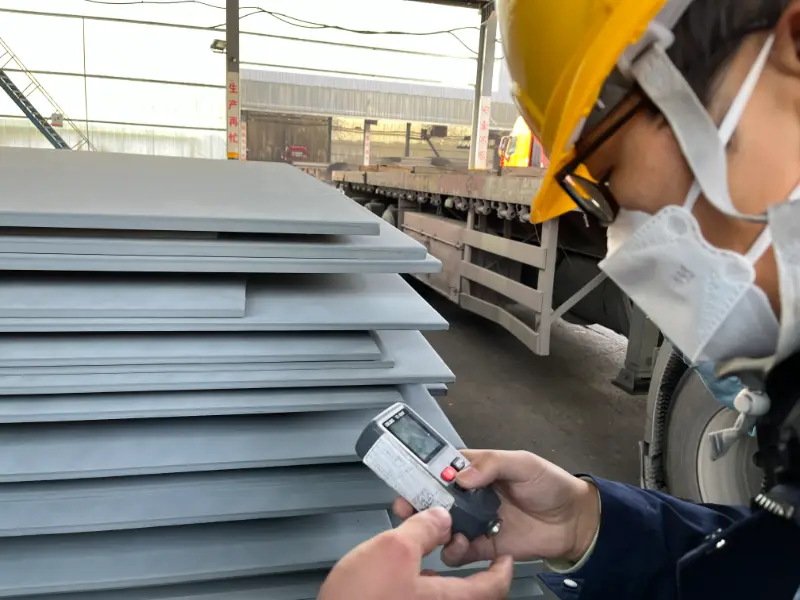
ASTM A588 Grade K Weathering Steel
ASTM A588 Grade K High-Strength Low-Alloy Weathering Steel – Composition, Properties & Data
Comprehensive material data for ASTM A588/A588M Grade K high-strength low-alloy structural steel with enhanced atmospheric corrosion resistance. Includes chemical composition, mechanical properties, physical and thermal properties, international equivalents, similar alternatives, and application guide.
Welding, bolting, riveting, cutting, cold forming, hot forming, machining
- Phone : +8618037372205
- Email : [email protected]
- WhatsApp: Contact via Whtsapp
- WeChat: +8618037372205
ASTM A588 Grade K Weathering Steel Introduction
ASTM A588/A588M Grade K is a high-strength low-alloy (HSLA) structural steel designed for superior atmospheric corrosion resistance. It is part of the A588 family of weathering steels, which achieve enhanced durability through a controlled patina formation that protects the base metal from further oxidation. Grade K is microalloyed with vanadium and/or niobium, providing improved yield strength and weldability while retaining good formability. Typical applications include welded bridges, buildings, and railroad equipment where weight savings and long service life with minimal maintenance are critical. The material is typically supplied in the hot-rolled or normalised condition.
ASTM A588 Grade K Weathering Steel Chemical Composition
The chemical composition of ASTM A588 Grade K must conform to the ranges specified in ASTM A588/A588M. The steel is microalloyed with vanadium and/or niobium to refine grain structure and enhance mechanical properties. This composition provides a balance of strength and atmospheric corrosion resistance by forming a protective oxide layer. Limits shown are in weight percent.
| Element | Standard Value (%) | Remarks |
|---|---|---|
| Carbon (C) | 0.17 max | Essential for strength; kept low for weldability |
| Manganese (Mn) | 0.50 – 1.20 | Contributes to strength and toughness |
| Phosphorus (P) | 0.040 max | Residual element; controlled for ductility |
| Sulfur (S) | 0.050 max | Residual element; controlled for hot workability |
| Silicon (Si) | 0.25 – 0.50 | Deoxidizer; improves strength |
| Nickel (Ni) | 0.40 max | Enhances corrosion resistance |
| Chromium (Cr) | 0.40 – 0.70 | Key element for atmospheric corrosion resistance |
| Copper (Cu) | 0.30 – 0.50 | Key element for atmospheric corrosion resistance |
| Molybdenum (Mo) | 0.10 max | Optional element; may improve strength |
| Vanadium (V) | 0.01 – 0.10 | Microalloying element for grain refinement; at least one of V or Nb is added |
| Niobium (Nb) | 0.005 – 0.05 | Microalloying element for grain refinement; at least one of V or Nb is added |
ASTM A588 Grade K Weathering Steel Thermal & Electrical Physical Properties
The following physical properties are typical for ASTM A588 Grade K weathering steel and are provided as reference for design calculations. These values are not part of the ASTM specification but are representative of similar HSLA grades. Actual values may vary slightly depending on exact composition and processing. Testing at room temperature unless noted.
| Property | Typical Value | Unit | Test Condition |
|---|---|---|---|
| Density (ρ) | 7.85 | g/cm³ | Room temperature (20°C) |
| Modulus of Elasticity (E) | 200 | GPa | Room temperature |
| Shear Modulus (G) | 80 | GPa | Room temperature (estimated) |
| Poisson's Ratio (ν) | 0.30 | — | Room temperature |
| Thermal Expansion Coefficient (α) | 12.0 | µm/m·°C | 20–100°C average |
| Thermal Expansion Coefficient (α) | 13.0 | µm/m·°C | 20–200°C average |
| Thermal Expansion Coefficient (α) | 13.8 | µm/m·°C | 20–300°C average |
| Thermal Conductivity (λ) | 42 | W/m·K | At 20°C |
| Specific Heat Capacity | 460 | J/kg·K | At 20°C |
| Electrical Resistivity (ρₑ) | 0.22 | µΩ·m | At 20°C |
ASTM A588 Grade K Weathering Steel Mechanical Properties
Mechanical properties are determined on test specimens taken in accordance with ASTM A6/A6M. Tensile and bend test requirements depend on plate/section thickness. Yield strength (ReH) and tensile strength (Rm) are minimum values; elongation is measured on a 2 in. (50 mm) gauge length. Bend tests are performed with the axis of bend transverse to the rolling direction for flat-rolled products. Thickness ranges and corresponding property requirements are listed below.
| Property | Standard Requirement | Unit | Test Condition / Thickness Range |
|---|---|---|---|
| Yield Strength (ReH) | 345 min | MPa | t ≤ 100 mm (4 in.) |
| Tensile Strength (Rm) | 485 min | MPa | t ≤ 100 mm (4 in.) |
| Elongation (A) in 2 in. | 21 min | % | t ≤ 20 mm (3/4 in.) |
| Elongation (A) in 2 in. | 18 min | % | 20 mm < t ≤ 100 mm (0.75–4 in.) |
| Bend Test (bend diameter) | 1t (180° flat) | — | t ≤ 20 mm (3/4 in.) |
| Bend Test (bend diameter) | 1.5t | — | 20 mm < t ≤ 25 mm (0.75–1 in.) |
| Bend Test (bend diameter) | 2t | — | 25 mm < t ≤ 50 mm (1–2 in.) |
| Bend Test (bend diameter) | 2.5t | — | 50 mm < t ≤ 100 mm (2–4 in.) |
ASTM A588 Grade K Weathering Steel Exact International Equivalent Grades
| Country/Region | Standard | Grade | Remarks |
|---|---|---|---|
| — | — | — | No identical grade with completely matching composition and property requirements is defined in other international standards. Similar weathering steel grades are listed in the Similar Materials section. |
ASTM A588 Grade K Weathering Steel Application Introduction
ASTM A588 Grade K is engineered for exposed structural applications where long-term durability with minimal maintenance is required. Its weathering property allows it to be used unpainted in many environments, developing a stable rust-like patina.
Typical industries and components:
Product Applications: Welded and bolted bridge girders, beams, and columns, Unpainted weathering steel bridges and pedestrian structures, Architectural exposed structural elements, Steel poles and transmission towers, Shipping containers and freight car components, Heavy-duty industrial framing where corrosion resistance is needed
Processed into products: Bridge main girders, cross frames, and deck plates, Structural building columns and trusses, Railway car side frames and bolsters, Container corner posts and roof bows, Lattice tower legs and bracings, Welded fabrications for earthmoving and mining equipment, Piling and foundation elements in corrosive environments
Application industries: Bridge construction (highway and railway bridges), Building and civil infrastructure (stadiums, towers, architectural steel), Railway rolling stock (cars, locomotives), Container and transport equipment (shipping containers, truck trailers), Energy transmission (poles, lattice towers), Industrial equipment (ductwork, hoppers, heavy machinery)
ASTM A588 Grade K Weathering Steel Similar/Comparable Alternative Materials
| Country/Region | Standard | Grade | Remarks |
|---|---|---|---|
| USA | ASTM A588/A588M | Grade B | Similar corrosion resistance; Grade K has higher yield strength (345 MPa vs. 345 MPa) but microalloyed with V/Nb for improved toughness; often interchangeable in structural applications. |
| USA | ASTM A572/A572M | Grade 50 | Structural steel with same strength level (345 MPa) but without guaranteed atmospheric corrosion resistance; can replace A588 Gr.K if painting is required. |
| European Union | EN 10025-5 | S355J2W (1.8965) | Close match in corrosion resistance and mechanical properties; minor differences in Mn, Cu, and absence of mandatory V/Nb; often used interchangeably in bridges and buildings. |
| Japan | JIS G3125 | SPA-H (SMA570P) | High-strength weathering steel with similar minimum tensile strength (~570 MPa); suitable for welded structures; Cu-Cr-Ni based system. |
| China | GB/T 4171 | Q355NH | High-strength atmospheric corrosion resisting steel with similar minimum yield strength (355 MPa) and comparable weathering characteristics; used in bridges, containers, and buildings. |
Notes:
- A588 Grade K is typically supplied in the as-rolled condition with a mill scale that aids patina formation; shot-blasting or pickling is avoided unless specified.
- Supplementary requirements (e.g., Charpy impact testing, ultrasonic examination) may be added as per ASTM A6/A6M to meet project specifications.
- When used in marine or heavy-industrial environments, regular washing of surfaces may be recommended to maintain stable patina.
- Welding procedures should follow the guidelines of AWS D1.1 or equivalent, using low-hydrogen practices and matching-strength welding consumables.
- Share



