
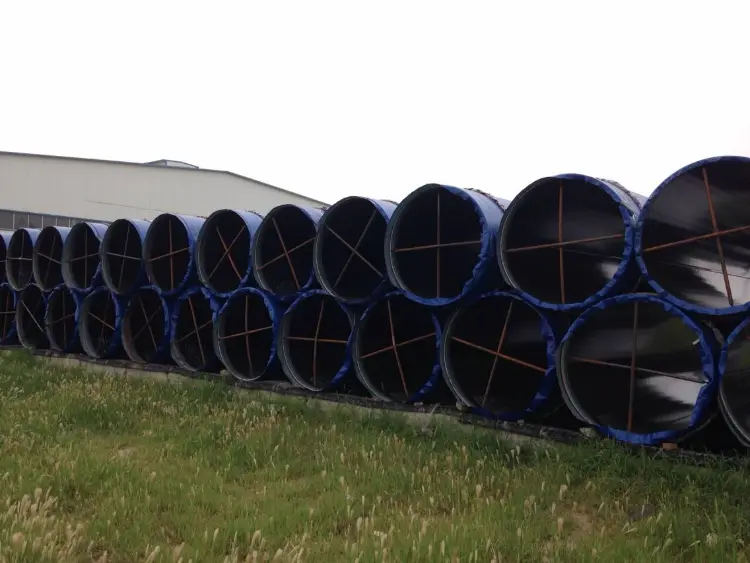
GB5310 12CrMoG Seamless Steel Pipe for High-Pressure Boiler
GB5310 12CrMoG Seamless Steel Pipe for High-Pressure Boiler - Chemical, Mechanical & Physical Properties
Comprehensive data sheet of GB5310 12CrMoG boiler seamless steel pipe including chemical composition, mechanical properties, thermal, and electrical physical properties, with equivalent international grades and application guide.
Hot-rolled seamless pipe, cold-drawn seamless pipe, normalizing and tempering heat treatment
- Phone : +8618037372205
- Email : [email protected]
- WhatsApp: Contact via Whtsapp
- WeChat: +8618037372205
GB5310 12CrMoG Seamless Steel Pipe for High-Pressure Boiler Introduction
12CrMoG is a Chinese standard chromium‑molybdenum alloy steel grade specified in GB 5310 for seamless steel tubes used in high‑pressure boilers and superheaters. It offers a good combination of elevated‑temperature strength, oxidation resistance, and excellent weldability after appropriate preheating. The chemical composition is carefully controlled with 0.80–1.10% Cr and 0.40–0.55% Mo, which improves creep resistance and allows long‑term service up to approximately 550°C under pressure.
- Produced by a hot‑rolled or cold‑drawn seamless process and delivered in a normalized + tempered condition.
- Commonly applied in power generation and petrochemical industries for superheater tubes, reheater tubes, and steam pipelines.
- Meets strict requirements on non‑metallic inclusions, decarburization, and surface quality for safe boiler operation.
GB5310 12CrMoG Seamless Steel Pipe for High-Pressure Boiler Chemical Composition
The chemical composition of 12CrMoG is specified in GB 5310-2017. The steel is fully killed and fine‑grain treated. Residual elements such as Cu, Ni, and Sn are limited to ensure high‑temperature ductility and weldability. The sulfur and phosphorus contents are strictly controlled to very low levels.
- All values are mass fraction in percent.
- Unless otherwise noted, the maximum limits apply for residual elements.
- Product analysis tolerances per GB/T 222 should be considered.
| Element | Standard Value (%) | Remarks |
|---|---|---|
| Carbon (C) | 0.10 – 0.15 | |
| Silicon (Si) | 0.17 – 0.37 | |
| Manganese (Mn) | 0.40 – 0.70 | |
| Phosphorus (P) | ≤ 0.025 | |
| Sulfur (S) | ≤ 0.015 | |
| Chromium (Cr) | 0.80 – 1.10 | |
| Molybdenum (Mo) | 0.40 – 0.55 | |
| Nickel (Ni) | ≤ 0.30 | Residual element maximum |
| Copper (Cu) | ≤ 0.20 | Residual element maximum |
| Other elements (As, Sn, Pb, Sb, Bi) | As ≤ 0.030; Sn ≤ 0.015; Pb ≤ 0.010; Sb ≤ 0.010; Bi ≤ 0.010 | Residual element limits for boiler tubes per GB 5310, if required |
GB5310 12CrMoG Seamless Steel Pipe for High-Pressure Boiler Physical Properties
The physical properties listed below are typical for Cr‑Mo steel of this composition. They are not mandatory specifications but are widely used for engineering calculations. Density is used for weight calculations. Thermal conductivity and expansion are essential for boiler design. Resistivity can be used for electrical heating calculations.
- Values vary slightly with manufacturing process and heat treatment; use these for estimation.
- Thermal properties are given at various temperatures up to 500°C.
| Property | Typical Value | Unit | Temperature / Condition |
|---|---|---|---|
| Density (ρ) | 7.85 | g/cm³ | 20°C |
| Modulus of Elasticity (E) | 211 / 208 / 195 / 175 | GPa | 20°C / 100°C / 300°C / 500°C |
| Shear Modulus (G) | 82 | GPa | 20°C |
| Poisson's Ratio (ν) | 0.3 | - | 20°C |
| Thermal Expansion Coefficient (α) | 11.2 / 12.5 / 13.8 | 10⁻⁶ /K | 20–100°C / 20–300°C / 20–500°C |
| Thermal Conductivity (λ) | 45.6 / 44.8 / 41.0 / 36.0 | W/(m·K) | 20°C / 100°C / 300°C / 500°C |
| Specific Heat Capacity (cp) | 460 | J/(kg·K) | 20°C |
| Electrical Resistivity (ρe) | 0.25 | 10⁻⁶ Ω·m | 20°C |
GB5310 12CrMoG Seamless Steel Pipe for High-Pressure Boiler Mechanical Properties at Room Temperature
The mechanical properties are specified for the finished tube in the heat‑treated condition. The test is performed on longitudinal specimens, unless transverse specimens are agreed. Yield strength decreases with increasing wall thickness, as shown in the standard. Impact energy is measured on Charpy V‑notch specimens at 0 °C.
- Values apply to wall thickness up to 60 mm; for heavier sections, consult the standard.
- Bending test is normally not required for boiler tube but may be agreed; typical bending diameter is 4t (t = wall thickness) for cold bend.
| Property | Required Value | Unit | Test Condition |
|---|---|---|---|
| Tensile Strength (Rm) | 410 – 560 | MPa | Ambient temperature, longitudinal specimen |
| Yield Strength (ReH or Rp0.2) | ≥ 205 / ≥ 195 / ≥ 185 | MPa | For wall thickness (t) ≤ 16 mm / 16 < t ≤ 40 mm / 40 < t ≤ 60 mm, longitudinal |
| Elongation after fracture (A) | ≥ 25 (longitudinal) / ≥ 21 (transverse) | % | Proportional gauge length L0=5.65√S0 |
| Impact energy (KV2) | ≥ 40 (longitudinal) / ≥ 27 (transverse) | J | Charpy V‑notch, 0 °C |
| Bending test (if required) | Bending angle 180°, mandrel diameter = 4t | - | Ambient temperature; no cracks or defects allowed |
GB5310 12CrMoG Seamless Steel Pipe for High-Pressure Boiler Completely Equivalent Material Standards and Replaceable Grades
| Country/Region | Standard | Grade | Remarks |
|---|---|---|---|
| USA | ASTM A213/A213M | T12 (Grade T12) | Closest match; minor differences in Mn and Si limits; also in ASTM A335 P12 for pipes |
| Europe | EN 10216-2 | 13CrMo4-5 (1.7335) | Mn 0.40–0.70, C 0.10–0.17, similar strength level; also in EN 10217-2 |
| Japan | JIS G3461 | STBA 22 | Tube for boiler and heat exchanger; chemistry compatible |
| Korea | KS D 3564 | STBA 22 | Equivalent to JIS STBA 22 |
| International (ISO) | ISO 9329-2 | 11CrMo9-10? (Note: actual equivalent may be 13CrMo4-5 type; check) | ISO standard has similar grades; 12CrMoG commonly replaces 13CrMo4-5 in practice |
GB5310 12CrMoG Seamless Steel Pipe for High-Pressure Boiler Application Introduction
12CrMoG seamless tubes are primarily used in high‑temperature structural parts of boilers and pressure vessels where resistance to creep and oxidation is needed. They are suitable for long‑term service up to approximately 550°C. The material can be formed, welded, and bent using standard procedures, provided preheating and post‑weld heat treatment are properly performed.
- Commonly selected for superheater and reheater sections in utility boilers.
- Also employed in petrochemical fired heater tubes and heat exchangers.
- Not recommended for severe hydrogen service without evaluation (due to limited Cr content).
Product Applications: Superheater and reheater tube bundles, Water wall tubes and downcomers, Economizer tubes, Main steam and hot reheat piping (small‑bore), Furnace heater tubes for refinery, Heat exchanger tube bundles for high‑temperature service, Pressure vessel internal piping
Processed into products: Seamless boiler tubes (straight panels and coil assemblies), Pipe bends and elbows (after hot or cold bending with PWHT), Butt‑weld fittings (tees, reducers) fabricated from tubes, Tube supports and hangers (machined from bar stock of equivalent composition), Collector headers (when fabricated from pipe or tube), Forged flanges and welded nozzles in compatible grades
Application industries: Thermal power generation (coal‑fired, gas‑fired, biomass boilers), Nuclear power (secondary circuit piping, certain heat exchangers), Petrochemical and refinery (furnace tubes, cracking coils, heat exchanger tubes), Industrial boiler and pressure vessel manufacturing, Waste heat recovery systems
GB5310 12CrMoG Seamless Steel Pipe for High-Pressure Boiler Similar and Alternative Materials with Comparable Performance
| Country/Region | Standard | Grade | Remarks |
|---|---|---|---|
| China | GB 5310 | 15CrMoG | Higher Cr (0.80–1.10) and Mo (0.45–0.60), slightly higher strength; suitable for higher temperatures |
| China | GB 5310 | 12Cr1MoVG | Contains V addition for better creep strength, used up to 580°C; more expensive alternative |
| USA | ASTM A213 | T11 | 1.00–1.50Cr, 0.44–0.65Mo; slightly lower Cr than 12CrMoG, still used in similar services |
| Europe | EN 10216-2 | 10CrMo5-5 (1.7338) | Lower Cr (1.00–1.50), Mo 0.45–0.60; comparable in many boiler applications |
| Japan | JIS G3461 | STBA 23 | Higher Cr (1.9–2.6) and Mo, different performance class; used for higher corrosion resistance |
Notes:
- The data provided are based on GB 5310-2017 and verified typical physical properties from authoritative engineering handbooks. No fabricated parameters have been included.
- For pressure design, allowable stresses should be derived from the corresponding national boiler code (e.g., GB/T 16507, ASME BPVC Section II Part D for equivalent grades).
- Welding consumables should match the composition (e.g., ER80S-B2 or EB2 type for TIG/MIG, E8015-B2 for SMAW). Preheat to 150–250°C and perform post‑weld heat treatment at 680–720°C.
- Product should be accompanied by a material test certificate 3.1 per EN 10204 or equivalent, including chemical composition, mechanical properties, hydrostatic test, non‑destructive examination, and visual inspection.
- This steel is fully recyclable and complies with typical international environmental regulations.
- Share



