
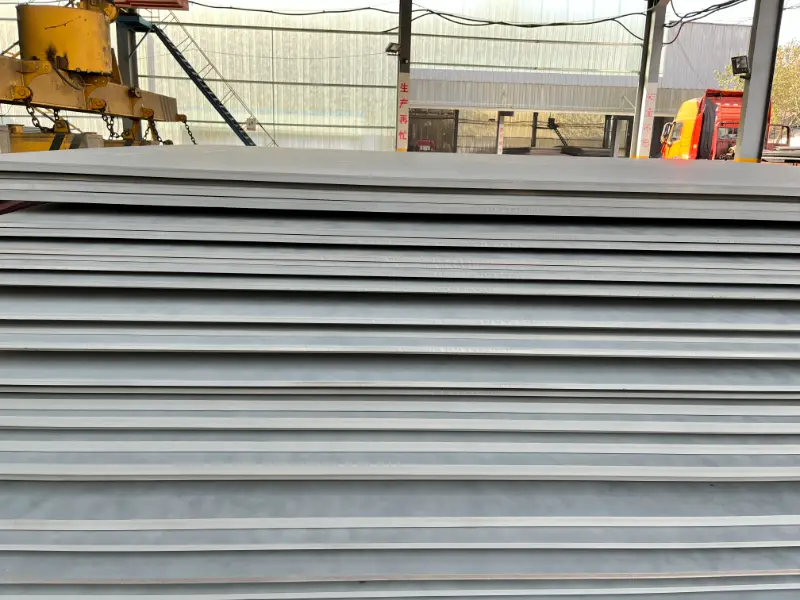
ASTM A573 Grade 70 High-Strength Carbon Steel Plate
ASTM A573 Grade 70 High-Strength Carbon Steel Plate for Structural Welded Applications
ASTM A573/A573M Grade 70 is a carbon and low-alloy high-strength steel supplied as plate or coil, featuring minimum yield strength of 70 ksi (485 MPa) and enhanced notch toughness for reliable welded structures.
Hot rolling, controlled rolling, normalizing (by agreement), quenching and tempering (by agreement)
- Phone : +8618037372205
- Email : [email protected]
- WhatsApp: Contact via Whtsapp
- WeChat: +8618037372205
ASTM A573 Grade 70 High-Strength Carbon Steel Plate Introduction
ASTM A573/A573M Grade 70 is a hot-rolled structural carbon steel plate with improved toughness, designed for welded bridges, buildings, and industrial equipment. It belongs to the ASTM A573 family of three grades (58, 65, 70), with Grade 70 offering the highest strength.
Key characteristics:
- Minimum yield strength of 70 ksi [485 MPa] and tensile strength between 90 and 110 ksi [620–760 MPa].
- Good formability and weldability under proper procedures.
- Available in as-rolled or normalized condition, with optional Charpy V-notch impact testing for low-temperature service.
- Commonly supplied in plate and coil form for ease of fabrication.
ASTM A573 Grade 70 High-Strength Carbon Steel Plate Chemical Composition
Chemical requirements according to ASTM A573/A573M for Grade 70. Silicon is optional and typically specified for killed steel. Other elements may be present only as residuals unless agreed between producer and purchaser.
| Chemical Element | Specified Value (wt%) | Remarks |
|---|---|---|
| Carbon (C) | 0.27 max | Heat analysis |
| Manganese (Mn) | 0.85 – 1.20 | Heat analysis |
| Phosphorus (P) | 0.035 max | Heat analysis |
| Sulfur (S) | 0.035 max | Heat analysis |
| Silicon (Si) | 0.15 – 0.40 (if required) | When silicon-killed steel is specified |
ASTM A573 Grade 70 High-Strength Carbon Steel Plate Thermal and Electrical Physical Properties
Physical properties are not specified in ASTM A573/A573M. The values below are typical for carbon steels of similar composition and density, provided for general reference only, and are not mandatory per the standard.
| Property | Typical Value | Unit | Test Condition / Remarks |
|---|---|---|---|
| Density (ρ) | 7.85 | g/cm³ | At room temperature |
| Elastic Modulus (E) | 205 | GPa | At room temperature |
| Shear Modulus (G) | 80 | GPa | Approximate |
| Poisson's Ratio (ν) | 0.29 | — | At room temperature |
| Thermal Expansion Coefficient (α) | 11.7 × 10⁻⁶ | K⁻¹ | 20–100 °C |
| Thermal Conductivity (λ) | 52 | W/(m·K) | At 100 °C |
| Specific Heat Capacity (c_p) | 486 | J/(kg·K) | At 20 °C |
| Electrical Resistivity (ρ_e) | 0.16 × 10⁻⁶ | Ω·m | At 20 °C |
ASTM A573 Grade 70 High-Strength Carbon Steel Plate Mechanical Properties
Tensile requirements per ASTM A573/A573M for Grade 70. Properties are measured on standard test specimens taken from the plate. Elongation values depend on plate thickness; values shown are for thicknesses ≤ 3⁄4 in. [20 mm].
| Property | Specified Value | Unit | Test Condition / Remarks |
|---|---|---|---|
| Yield Strength (ReH or Rp0.2) | 70 min / 485 min | ksi / MPa | Tensile test, specimen orientation transverse |
| Tensile Strength (Rm) | 90 – 110 / 620 – 760 | ksi / MPa | Tensile test |
| Elongation (A) in 200 mm (8 in.) | 17 min | % | Thickness ≤ 3⁄4 in. [20 mm] |
| Elongation (A) in 50 mm (2 in.) | 23 min | % | Thickness ≤ 3⁄4 in. [20 mm] |
ASTM A573 Grade 70 High-Strength Carbon Steel Plate Completely Equivalent Material Standards and Substitutable Grade Recommendations
| Country / Region | Standard | Grade | Remarks |
|---|
ASTM A573 Grade 70 High-Strength Carbon Steel Plate Application Introduction
ASTM A573 Grade 70 is designed for welded structural applications where higher strength and improved notch toughness are required. It is widely used in heavy civil construction, industrial machinery, and transportation equipment. Its combination of strength and formability makes it suitable for both primary and secondary structural members.
- Use in bridges: main girders, stiffeners, and floor systems.
- Use in building frames: columns, beams, and base plates.
- Use in heavy machinery: crane booms, chassis, and support structures.
- Use in storage tanks and pressure vessels (when additional code requirements are met).
Product Applications: Bridge girders and trusses, High-rise building columns and beams, Crane booms and lattice structures, Offshore platform deck plates, Heavy-duty trailer frames, Pressure vessel shells (with supplementary testing)
Processed into products: Cut-to-shape plates for welded assemblies, Stiffeners and brackets, Connector elements (cleats, gussets), Pinned or bolted structural connections, Machined parts such as crane wheels and housings (when heat-treated)
Application industries: Civil engineering and infrastructure, Offshore and marine engineering, Heavy equipment manufacturing, Pressure vessel and storage tank fabrication, Shipbuilding (structural components)
ASTM A573 Grade 70 High-Strength Carbon Steel Plate Similar / Alternative Material Recommendations
| Country / Region | Standard | Grade | Remarks |
|---|---|---|---|
| Europe | EN 10025-3 | S460N | Normalized structural steel with minimum 460 MPa yield; similar strength but lower yield, check toughness class (N, NL). |
| China | GB/T 1591 | Q460C / Q460D | High-strength low-alloy structural steel; Q460C/D offers comparable 460 MPa minimum yield; verify impact requirements. |
| Japan | JIS G3106 | SM570 | Welded structural steel; minimum yield 420–440 MPa depending on thickness, slightly lower than Grade 70; excellent weldability. |
| International | ISO 630-2 | S460Q | Structural steel with yield 460 MPa; quenched and tempered condition, comparable strength but different delivery condition. |
| USA | ASTM A572/A572M | Grade 65 | High-strength low-alloy structural steel; maximum yield 65 ksi (450 MPa); lower strength than Grade 70 but widely used. |
Notes:
Supplementary Requirements: ASTM A573/A573M offers supplementary requirement S5 for Charpy V-notch impact testing. When ordered, the test temperature and minimum energy absorption must be agreed upon (commonly 15 ft·lbf at -20 °F or -40 °F).
Coil Product: Plates can be supplied as coils and subsequently flattened; the mechanical properties apply to the finished plate. Coil-specific tolerances should be agreed with the supplier.
Welding: Grade 70 has carbon equivalent typically below 0.45, enabling welding without preheat for moderate thicknesses; however, welding procedure qualification is recommended for critical joints.
Certification: Mill test reports are provided per ASTM A6/A6M or EN 10204 type 3.1 on request.
- Share



