
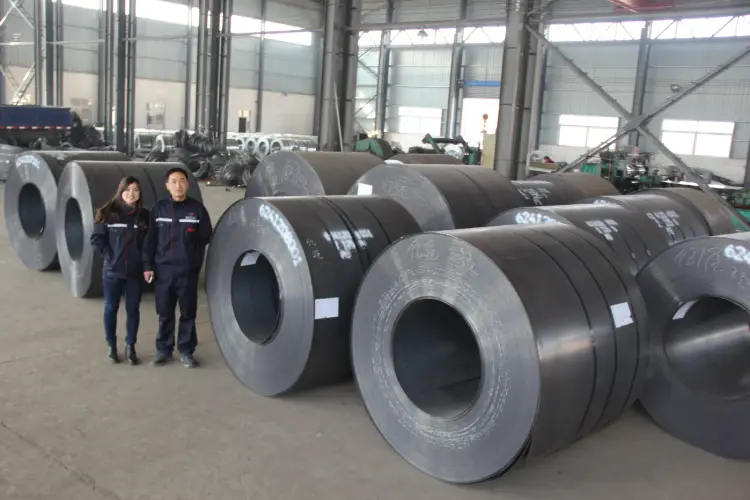
ASTM A709 Grade 100 HSLA Steel Coil
ASTM A709 Grade 100 HSLA Steel Coil - Composition, Properties & Applications
In-depth technical data for ASTM A709/A709M Grade 100 carbon and low-alloy high-strength steel coil: chemical composition, mechanical properties, thermal/electrical characteristics, and global equivalents.
Hot rolling, cold forming, welding (with preheat and interpass control), machining, flame cutting
- Phone : +8618037372205
- Email : [email protected]
- WhatsApp: Contact via Whtsapp
- WeChat: +8618037372205
ASTM A709 Grade 100 HSLA Steel Coil Introduction
ASTM A709/A709M Grade 100 is a high-strength low-alloy (HSLA) structural steel supplied in the quenched and tempered condition. It is primarily intended for use in bridge construction, where high yield strength (minimum 100 ksi [690 MPa]) permits weight reduction without sacrificing toughness. The steel exhibits good weldability and notch toughness when appropriate procedures are followed. This grade is typically produced as plate, strip, or coil and is available in several chemical composition types (Type A, B, C, H, F, Q etc.) derived from ASTM A514, allowing selection based on service requirements and thickness. The data below reflects the most widely applied Type Q composition and associated mechanical limits.
ASTM A709 Grade 100 HSLA Steel Coil Chemical Composition
The chemical requirements depend on the specific type selected (e.g., Type Q). The values below represent ASTM A709 Grade 100 Type Q (one of the most common options). The steel is designed to achieve high strength through alloying and heat treatment while maintaining adequate weldability. Maximum limits for impurities (P, S) are strictly controlled.
| Element | Standard Value | Remarks |
|---|---|---|
| Carbon (C) | 0.14 – 0.21 | Heat analysis |
| Manganese (Mn) | 0.95 – 1.30 | May be adjusted for thickness |
| Phosphorus (P) | ≤ 0.035 | Maximum |
| Sulfur (S) | ≤ 0.040 | Maximum; 0.010 max for improved formability |
| Silicon (Si) | 0.15 – 0.35 | Typical for QT steels |
| Chromium (Cr) | 1.00 – 1.50 | Contributes to hardenability |
| Molybdenum (Mo) | 0.40 – 0.60 | Enhances high-temperature strength and hardenability |
| Vanadium (V) | 0.03 – 0.08 | Grain refinement and precipitation strengthening |
| Copper (Cu) | ≤ 0.50 | Optional; may be added for weathering resistance |
| Nickel (Ni) | ≤ 0.50 | Optional |
| Aluminum (Al) | ≥ 0.020 (as fine grain practice) | Usually required for grain refinement |
| Nitrogen (N) | ≤ 0.020 | Typical maximum |
ASTM A709 Grade 100 HSLA Steel Coil Thermal and Electrical Physical Properties
The physical properties are representative for quenched and tempered high-strength low-alloy steels. Slight variations may occur depending on the exact chemical composition and heat treatment condition. These values are useful for design calculations involving heat transfer, thermal expansion, and electrical resistivity.
| Property | Typical Value | Unit | Test Condition |
|---|---|---|---|
| Density (ρ) | 7.85 | g/cm³ | Room temperature |
| Modulus of Elasticity (E) | 205 (29,700) | GPa (ksi) | Tension, room temperature |
| Shear Modulus (G) | 80 (11,600) | GPa (ksi) | Calculated from E and ν |
| Poisson's Ratio (ν) | 0.28 – 0.30 | – | Elastic range |
| Thermal Expansion Coefficient (α) | 11.7 (6.5) | ×10⁻⁶ /K (×10⁻⁶ /°F) | 20–100°C (68–212°F) |
| Thermal Conductivity (λ) | 42 (24) | W/m·K (Btu·ft/(ft²·h·°F)) | At 100°C (212°F) |
| Specific Heat Capacity | 480 (0.115) | J/kg·K (Btu/lb·°F) | Room temperature |
| Electrical Resistivity (ρₑ) | 0.20 | μΩ·m | At 20°C |
ASTM A709 Grade 100 HSLA Steel Coil Mechanical Properties
The mechanical properties are specified for the quenched and tempered condition. The values vary with thickness and product form. The data below applies to coil/plate up to 2.5 in. (63.5 mm) thick. Charpy V-notch impact requirements are optional (Supplementary Requirement S9) and are often specified for bridge applications.
| Property | Standard Requirement & Typical Value | Unit | Test Condition / Note |
|---|---|---|---|
| Yield Strength (ReH) | ≥ 100 (690) | ksi (MPa) | 0.2% offset, transverse |
| Tensile Strength (Rm) | 110 – 130 (760 – 895) | ksi (MPa) | Transverse |
| Elongation (A) | ≥ 18 | % | in 2 in. (50 mm) gauge length, transverse |
| Bend Test (180°) | d = 3t (bend diameter = 3 × thickness) | – | 180° bend, no cracks on the outside of the bent portion |
| Charpy Impact (KV) | Typically 20 – 80 at -20°F (-29°C) | ft·lb (J) | Longitudinal, when S9 is invoked (e.g., 20 ft·lb average, 15 ft·lb min) |
ASTM A709 Grade 100 HSLA Steel Coil Complete Equivalents – Direct Matching Standards and Substitutable Grades
| Country/Region | Standard / Specification | Grade / Designation | Remarks |
|---|---|---|---|
| USA | ASTM A514/A514M | Grade Q (or other A514 type matching the selected A709 Type) | Quenched and tempered; chemical and mechanical equivalence for the corresponding A709 Type. |
| Europe | EN 10025-6 | S690Q / S690QL | 690 MPa minimum yield; QT condition; suitable for similar structural applications. |
| Japan | JIS G 3128 | S690Q / SHY 685 | High yield strength steel for welded structures; comparable strength level. |
| Germany (historical) | DIN EN 10025-6 (former DIN 17102) | StE 690 / S690Q | Equivalent to current EN grade. |
| International | ISO 4950-2 | E690DD / E690E | High yield strength flat products; QT condition. |
ASTM A709 Grade 100 HSLA Steel Coil Application Introduction
ASTM A709 Grade 100 is predominantly used in bridge construction where its high strength-to-weight ratio allows longer spans and lighter girders. The excellent toughness and weldability make it suitable for highly stressed, dynamically loaded components. It also finds use in heavy machinery, pressure vessels, and offshore structures when the right compositional type is chosen for service conditions (e.g., Type with improved atmospheric corrosion resistance if uncoated exposure is required).
Product Applications: Bridge main girders, box girders, and stiffeners, Heavy-duty structural beams and columns, Piling, caissons, and support structures, Welded plate girders, Offshore platform decks and legs, Pressure vessel shells, Boom sections for cranes
Processed into products: Welded T- and Y-joints in bridge trusses, Bearing plates and splice plates, Stiffener rings and diaphragms, Bolt-on or welded connections for high-strength bolting assemblies, Flanges of hybrid girders, Transverse stiffeners and lateral bracing members, Lifting lugs and pad eyes
Application industries: Bridge and highway infrastructure, Heavy civil engineering, Offshore and marine structures, Mining and earth-moving equipment, Pressure vessel fabrication (when supplemented with appropriate code approvals), Crane and lifting equipment, Wind turbine towers
ASTM A709 Grade 100 HSLA Steel Coil Similar / Alternative Materials with Close Property Profiles
| Country/Region | Standard / Specification | Grade / Designation | Remarks |
|---|---|---|---|
| USA | ASTM A514 | Grades B, H, F, Q | All are quenched and tempered 100 ksi steels with varying chemical compositions; may be substituted provided the specific type satisfies the design requirements and A709 supplementary conditions. |
| USA | ASTM A710 | Grade A, Class 3 (age-hardening) | Similar strength but different strengthening mechanism; age-hardenable, good toughness; not a direct substitute but can be considered for some applications. |
| Europe | EN 10025-6 | S890Q | Higher strength (890 MPa); may be used where higher load capacity is needed, though weldability and ductility differ. |
| Japan | JIS G 3128 | S690QL / S690Q1 | Comparable to S690Q with additional low-temperature toughness guarantees. |
| China | GB/T 16270 | Q690D / Q690E | Quenched and tempered high strength structural steel plates; similar minimum yield strength. |
Notes:
Important: The user must select the appropriate A709 Grade 100 type (e.g., Type Q) based on the required thickness, welding procedure, and environmental exposure. Supplementary Requirement S9 (Charpy V-notch test) is mandatory for fracture-critical bridge members in the USA. When ordering, the specific type must be stated: e.g., "ASTM A709 Grade 100, Type Q". All welding should be performed in accordance with AWS D1.5 Bridge Welding Code. Data provided is based on ASTM A709/A709M-18 and A514/A514M-18. Proprietary variations not shown here may exist.
- Share



