
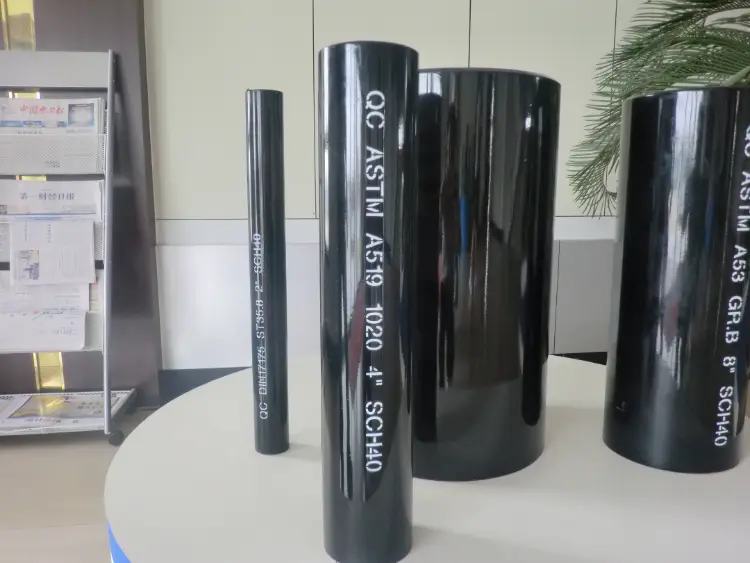
ASTM A519 1020 Seamless Carbon Steel Mechanical Tubing
ASTM A519 1020 Seamless Carbon Steel Mechanical Tubing | Properties and Applications
Explore ASTM A519 1020 seamless carbon steel tubing: chemical composition, mechanical properties, thermal data, equivalent grades, and applications in automotive, structural, and machinery industries.
Cold drawing, hot rolling, cold rolling, stress relieving, annealing, normalizing
- Phone : +8618037372205
- Email : [email protected]
- WhatsApp: Contact via Whtsapp
- WeChat: +8618037372205
ASTM A519 1020 Seamless Carbon Steel Mechanical Tubing Introduction
ASTM A519 1020 is a seamless carbon steel mechanical tubing grade defined under the ASTM A519 standard, primarily intended for mechanical and structural applications requiring moderate strength, good ductility, and excellent weldability. The designation "1020" corresponds to a nominal carbon content of 0.20%, placing it among low-carbon steels that offer a balanced combination of toughness and machinability. This grade is widely utilized in automotive, agricultural, and general machinery sectors due to its favorable response to carburizing or carbonitriding for surface hardening, as well as its reliable performance in as-drawn or stress-relieved conditions.
- Key characteristics: uniform seamless construction ensures consistent mechanical properties and pressure integrity; excellent machinability and weldability reduce fabrication costs.
- Delivery conditions: typically cold-drawn, stress-relieved, or annealed, with surface finishes such as pickled, oiled, or bright. The standard also permits hot-rolled and cold-rolled conditions.
- Versatile shapes: available in round, square, rectangular, and special cross-sections to meet diverse design requirements.
- Global equivalents: AISI 1020, SAE J403 1020, EN 1.0402 (C22), JIS S20C, and GB/T 699 20#, facilitating international sourcing and substitution.
- Typical uses: hydraulic cylinder barrels, driveshafts, axle tubes, structural supports, conveyor rolls, and machinery spindles.
The seamless manufacturing process gives ASTM A519 1020 tubes a refined, homogeneous microstructure, reliable mechanical performance, and suitability for critical parts that demand safety and durability.
ASTM A519 1020 Seamless Carbon Steel Mechanical Tubing Chemical Composition
The chemical composition of ASTM A519 grade 1020 is defined by the standard with limits on carbon, manganese, phosphorus, and sulfur. Silicon is not explicitly specified but may be present from deoxidation practices. The controlled carbon content ensures good weldability and response to surface hardening treatments. Both ladle and product analyses must conform to these ranges, guaranteeing consistent material properties.
| Element | Standard Value (wt. %) | Remarks |
|---|---|---|
| Carbon (C) | 0.18 – 0.23 | Primary strengthening element; ensures core hardness |
| Manganese (Mn) | 0.30 – 0.60 | Improves hardenability and tensile strength |
| Phosphorus (P) | ≤ 0.040 | Maximum limit to maintain ductility and toughness |
| Sulfur (S) | ≤ 0.050 | Maximum limit; higher sulfur can enhance machinability |
ASTM A519 1020 Seamless Carbon Steel Mechanical Tubing Thermal and Electrical Physical Properties
These physical properties are representative for 1020 carbon steel as referenced in standard engineering handbooks. They are not specified within ASTM A519 but are essential for design calculations involving heat transfer, thermal expansion, and electrical conductivity. Values are valid for the annealed condition at room temperature unless otherwise noted.
| Property | Typical Value | Unit | Test Condition |
|---|---|---|---|
| Density (ρ) | 7.85 | g/cm³ | 20 °C |
| Elastic Modulus (E) | 205 | GPa | 20 °C |
| Shear Modulus (G) | 80 | GPa | 20 °C |
| Poisson's Ratio (ν) | 0.29 | – | 20 °C |
| Thermal Expansion Coeff. (α) | 12.0 | µm/m·°C | 20–100 °C |
| Thermal Conductivity (λ) | 51.9 | W/m·K | 20 °C |
| Specific Heat (c) | 486 | J/kg·K | 20 °C |
| Electrical Resistivity (ρ_e) | 0.159 | µΩ·m | 20 °C |
ASTM A519 1020 Seamless Carbon Steel Mechanical Tubing Mechanical Properties
Mechanical properties vary with tube condition. ASTM A519 specifies minimum tensile strength, yield strength, and elongation for cold-drawn and stress-relieved carbon steel tubes. The values below are based on standard requirements and typical industry data. Elongation depends on wall thickness; the listed minimums apply to wall thickness ≤ 5/16 in. (7.9 mm). Hardness is not mandated but provided for reference.
| Property | Standard Required Value | Unit | Test Condition |
|---|---|---|---|
| Tensile Strength (Rm) | 379 (55,000) | MPa (psi) | Cold-drawn |
| Yield Strength (ReH) | 276 (40,000) | MPa (psi) | Cold-drawn |
| Elongation (A) | 15 | % | Cold-drawn, wall ≤ 5/16 in. |
| Tensile Strength (Rm) | 310 (45,000) | MPa (psi) | Stress-relieved |
| Yield Strength (ReH) | 207 (30,000) | MPa (psi) | Stress-relieved |
| Elongation (A) | 30 | % | Stress-relieved, wall ≤ 5/16 in. |
| Hardness (HBW) | 121 – 170 | – | As-drawn (typical) |
| Hardness (HRB) | 71 – 85 | – | As-drawn (typical) |
ASTM A519 1020 Seamless Carbon Steel Mechanical Tubing Completely Equivalent Standards and Substitutable Grades
| Country/Region | Standard | Grade | Remarks |
|---|---|---|---|
| USA | AISI/SAE J403 | 1020 | Direct carbon steel designation |
| USA | UNS | G10200 | Unified numbering system |
| European Union | EN 10277-2 / EN 10083-2 | 1.0402 (C22) | Nearly identical composition; minor P/S differences |
| Japan | JIS G4051 | S20C | Carbon range 0.18–0.23; Mn 0.30–0.60 |
| China | GB/T 699 | 20# | Chinese quality carbon structural steel |
| Germany | DIN 17200 | C22 | Historic equivalent; replaced by EN 1.0402 |
ASTM A519 1020 Seamless Carbon Steel Mechanical Tubing Application Introduction
Thanks to its balanced strength, weldability, and machinability, ASTM A519 1020 is a workhorse material for fabricated mechanical parts. It is frequently selected for hydraulic and structural applications where cost-effective performance is required. Surface hardening (carburizing) extends wear resistance for rotating parts.
Product Applications: Hydraulic cylinder barrels (honed or SR tube), Driveshaft and half‑shaft tubes, Steering column and axle tubes, Structural frame members and roll cages, Conveyor rollers and idler tubes, Machinery spindles and bushings, Couplings and collars, Bearing housings and adapter sleeves
Processed into products: Hydraulic cylinder tubes (stress‑relieved, honed ID), Automotive drive shaft tubes (cold‑drawn, stress relieved), Axle tubes for trucks and trailers, Bushings (optionally carburized for surface hardness), Conveyor belt rollers (machined from hollow bar), Machine tool headstock sleeves, Spacer tubes for structural assemblies
Application industries: Automotive and light truck, Agricultural machinery, Construction and earth‑moving equipment, Material handling and conveyor systems, Oil & gas (structural components), General manufacturing and machine tools
ASTM A519 1020 Seamless Carbon Steel Mechanical Tubing Comparable Alternative Materials
| Country/Region | Standard | Grade | Remarks |
|---|---|---|---|
| USA | ASTM A519 | 1018 | Lower carbon (~0.18%); slightly softer, better formability |
| USA | ASTM A519 | 1026 | Higher carbon (~0.26%); higher strength, lower ductility |
| USA | ASTM A513 | 1020 | ERW tube; identical chemistry but welded, not seamless |
| European Union | EN 10305-1 | C20E (1.1151) | Seamless cold drawn tube; carbon 0.17–0.24 |
| Japan | JIS G3445 | STKM 12A / 12C | Structural carbon steel tube; similar strength range |
Notes:
Heat treatment: The grade responds well to carburizing or carbonitriding for improved surface hardness while retaining a tough core. Through hardening is limited due to low carbon content. Welding: Excellent weldability by all common methods; preheat and post‑weld heat treatment are typically not required for thin sections. Machining: Cold‑drawn tubes offer good machinability; sulfur additions can further improve chip breaking. Corrosion protection: Coatings (paint, zinc plating) are recommended for corrosive environments. Ordering notes: Specify OD, wall thickness, length, condition (e.g., CD, SR), and any supplementary requirements (e.g., non‑destructive testing, special tolerances) per ASTM A519.
- Share



