
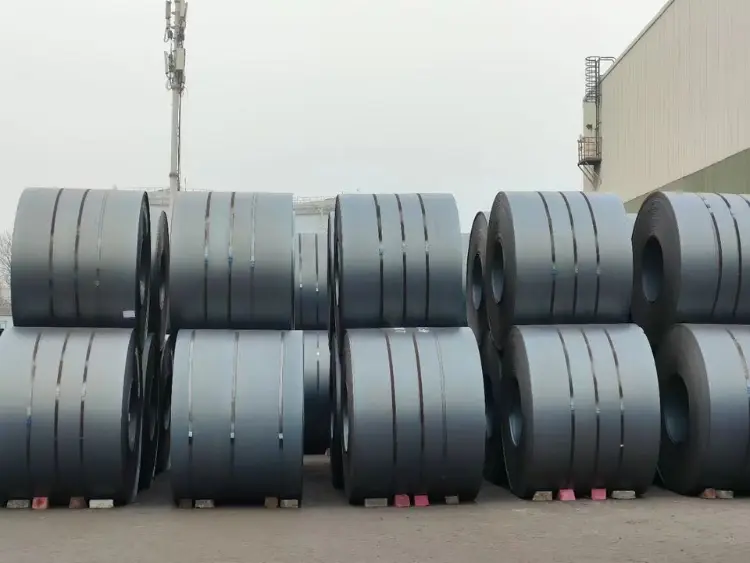
ASME SA656/SA656M Grade 60 High-Strength Low-Alloy Steel Coil
ASME SA656/SA656M Grade 60 High-Strength Low-Alloy Steel Coil - Properties & Equivalents
Comprehensive material data for ASME SA656/SA656M Grade 60 carbon and low-alloy high-strength steel coil: chemical composition, mechanical and physical properties, international equivalents, and application guidance.
Hot rolling, controlled rolling, normalizing (optional), cold forming, welding, shearing, punching, machining
- Phone : +8618037372205
- Email : [email protected]
- WhatsApp: Contact via Whtsapp
- WeChat: +8618037372205
ASME SA656/SA656M Grade 60 High-Strength Low-Alloy Steel Coil Introduction
ASME SA656/SA656M Grade 60 is a high-strength low-alloy (HSLA) steel produced as hot-rolled coils and cut lengths, intended primarily for pressure vessel and general structural applications where improved formability and weldability are required. With a minimum yield strength of 60 ksi (415 MPa), this grade offers a favourable balance of strength, ductility, and toughness. The controlled chemistry (carbon ≤0.18%, manganese up to 1.65%) with optional microalloying elements (e.g., Nb, V, Ti) enables grain refinement and precipitation strengthening while maintaining good weldability. It is typically supplied in the as-rolled or controlled-rolled condition and is widely used in welded pressure vessels, storage tanks, bridges, and heavy machinery components.
- Yield strength: ≥415 MPa (60 ksi)
- Tensile strength: 515–655 MPa (75–95 ksi)
- Excellent formability for its strength level
- Good weldability with standard procedures
ASME SA656/SA656M Grade 60 High-Strength Low-Alloy Steel Coil Chemical Composition
The chemical requirements are based on heat analysis per ASME SA656/SA656M. Grade 60 allows a maximum carbon content of 0.18% and manganese up to 1.65% to achieve strength. Microalloying elements such as niobium, vanadium, or titanium may be added singly or in combination at the manufacturer's discretion to obtain fine grain size and precipitation hardening. Silicon is restricted to 0.55% max to preserve weldability. Phosphorus and sulfur are kept low for toughness and formability.
| Element | Requirement (max, unless range) | Remarks |
|---|---|---|
| Carbon (C) | 0.18% | Max |
| Manganese (Mn) | 1.65% | Max |
| Phosphorus (P) | 0.025% | Max |
| Sulfur (S) | 0.025% | Max |
| Silicon (Si) | 0.55% | Max |
| Columbium (Niobium, Nb) | 0.005–0.10% (typical) | Optional grain refiner, producer's option |
| Vanadium (V) | 0.005–0.15% (typical) | Optional grain refiner, producer's option |
| Titanium (Ti) | 0.005–0.15% (typical) | Optional grain refiner, producer's option |
ASME SA656/SA656M Grade 60 High-Strength Low-Alloy Steel Coil Thermal and Electrical Physical Properties
The following physical properties are typical for carbon‑manganese HSLA steel at room temperature unless otherwise noted. They are provided for design and modelling purposes but are not mandatory requirements of SA656/SA656M. Values may vary slightly depending on exact composition and processing.
| Property | Typical Value | Unit | Condition / Remarks |
|---|---|---|---|
| Density (ρ) | 7.85 | g/cm³ | At 20°C |
| Modulus of Elasticity (E) | 200–210 | GPa | Room temperature |
| Shear Modulus (G) | 80 | GPa | Room temperature |
| Poisson's Ratio (ν) | 0.30 | – | Room temperature |
| Thermal Expansion Coefficient (α) | 11.7×10⁻⁶ | /K | 20–100°C |
| Thermal Conductivity (λ) | 50 | W/(m·K) | At 20°C |
| Specific Heat Capacity (cp) | 480 | J/(kg·K) | At 20°C |
| Electrical Resistivity (ρe) | 0.15×10⁻⁶ | Ω·m | Room temperature |
ASME SA656/SA656M Grade 60 High-Strength Low-Alloy Steel Coil Mechanical Properties
Mechanical properties are determined on test samples taken transverse to the rolling direction unless otherwise agreed. The values below represent the minimum requirements of ASME SA656/SA656M Grade 60 for thicknesses commonly supplied as hot-rolled coil (typically ≤25 mm). Yield strength is tested at 0.2% offset or lower yield, and elongation is measured on a 2 in. (50 mm) gauge length. Cold bend testing is mandatory to verify formability. Impact properties are not standard but may be specified by supplementary requirement.
| Property | Requirement | Unit | Test Condition |
|---|---|---|---|
| Yield Strength, min | 60 / 415 | ksi / MPa | 0.2% offset or lower yield, room temperature |
| Tensile Strength | 75–95 / 515–655 | ksi / MPa | Room temperature |
| Elongation (A), min | 18 | % | Gauge length 2 in. (50 mm), strip/transverse specimen. For thickness ≤ 1 in. (25 mm) some specifications may permit 17% for thinner gauges; 18% represents the conservative typical minimum. |
| Bend Test – Cold Bend (Bend Diameter) | 1.5t (for thickness ≤ 0.5 in.) | – | 180° bend, t = specimen thickness. No cracks on outer surface. |
| Bend Test – Cold Bend (Bend Diameter) | 2t (for thickness >0.5 in. to ≤1 in.) | – | 180° bend, t = specimen thickness. |
| Hardness (typical) | – (not specified) | HBW | Typical hardness typically 160–200 HBW in as-rolled condition, information only. |
ASME SA656/SA656M Grade 60 High-Strength Low-Alloy Steel Coil Complete Equivalent Standard and Substitutable Grade
| Country/Region | Standard | Grade | Remarks |
|---|---|---|---|
| USA | ASTM A656/A656M | Grade 60 [415] | Identical technical content; ASME SA656 is derived from ASTM A656. Interchangeable for all practical purposes. |
ASME SA656/SA656M Grade 60 High-Strength Low-Alloy Steel Coil Application Introduction
SA656 Grade 60 is designed for welded structures where higher strength permits weight reduction without sacrificing ductility and formability. It is easily fabricated by cutting, forming, and welding using common practices for HSLA steels. Preheating may be required for thick sections or low ambient temperatures.
Product Applications: ASME-code stamped pressure vessels, Large welded storage tanks, Bridge girders and box sections, Off-highway truck frames and chassis, Crane booms and mobile equipment booms, Railroad gondola and hopper cars, Spiral-welded pipe (when permitted by applicable standards)
Processed into products: Pressure vessel shells, heads, and nozzles, Tank bottom and annular plates, Welded H-beams and built-up sections, Frame rails and cross-members for heavy vehicles, Boom sections and outrigger boxes for cranes, Rail wagon body panels, Flanges and stiffeners
Application industries: Pressure vessel and boiler manufacturing, Storage tank fabrication (oil, water, chemicals), Bridge and highway construction, Heavy machinery and equipment, Shipbuilding (secondary structures), Railway freight cars, Wind tower (internal structural parts)
ASME SA656/SA656M Grade 60 High-Strength Low-Alloy Steel Coil Similar / Alternative Materials
| Country/Region | Standard | Grade | Remarks |
|---|---|---|---|
| USA | ASTM A572/A572M | Grade 60 [415] (Type 1–5) | Similar yield/tensile strength, but different chemical composition (C max 0.26, Mn 1.35 max for Grade 60). Used for structural applications; may have lower formability than SA656 Grade 60. |
| USA | ASTM A1011/A1011M | HSLAS Grade 60 [410] Class 1/2 | For hot-rolled sheet; similar strength. Chemistry and delivery conditions may differ; not identical for thickness > 6 mm. |
| European Union | EN 10025-3 | S420N, S420NL | Normalised/normalised rolled fine-grain steel, min yield 420 MPa. Chemical composition and toughness requirements differ; S420ML for TMCP also available. |
| International | ISO 4950-2 | FeE420 | High yield strength flat product, min yield 420 MPa. Can be considered for similar strength requirements but with different standard conditions. |
| Japan | JIS G3106 | SM490A/B/C (yield ≈325–365 MPa) | Lower yield strength but widely used for welded structures; not a direct substitute, only where design allows. |
Notes:
Weldability: SA656 Grade 60 typically has a carbon equivalent (CE) below 0.45%, allowing conventional welding processes without excessive preheat. Formability: Unlike higher carbon structural steels, this HSLA grade is intended for improved formability; minimum bend radii are guaranteed. Supplementary requirements: Impact testing (Charpy V-notch) may be specified using ASME SA6 supplementary requirements if toughness at low temperature is required. Thickness limitations: The standard covers coil and cut-to-length plate; maximum thickness is determined by coil production capability (usually up to approx. 16 mm). For thicker plates, alternative standards such as SA572 may be considered.
- Share



