
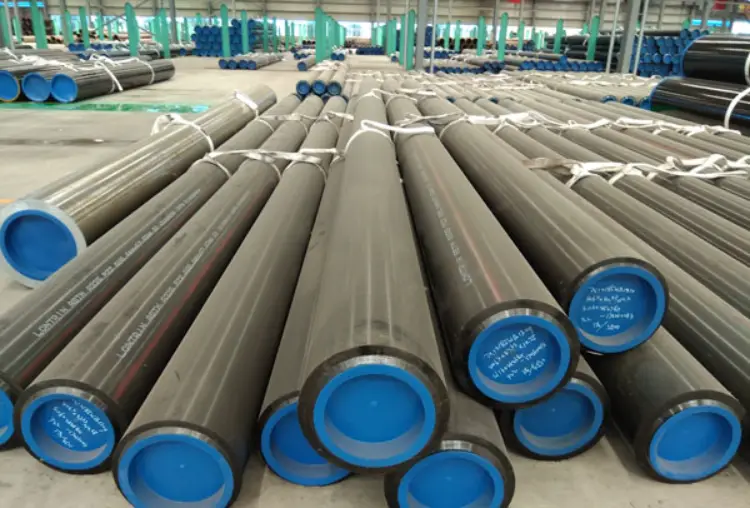
ASTM A588 Grade K Weathering Steel Pipe
ASTM A588 Grade K Weathering Steel Pipe: Superior Corrosion Resistance & High Strength for Structural Applications
Comprehensive data on ASTM A588 Grade K weathering steel pipe, including chemical composition, mechanical and thermal properties, international equivalents, and application guidance for structural and architectural projects.
Hot rolling, cold forming, welding (SAW, GMAW, SMAW), machining, cutting (oxy-fuel, plasma), bending
- Phone : +8618037372205
- Email : [email protected]
- WhatsApp: Contact via Whtsapp
- WeChat: +8618037372205
ASTM A588 Grade K Weathering Steel Pipe Introduction
ASTM A588 Grade K is a high-strength, low-alloy (HSLA) weathering steel primarily supplied as pipe, tubing, plates, and structural shapes. It is designed to provide significantly improved atmospheric corrosion resistance compared to plain carbon steels through the addition of alloying elements such as chromium, copper, and vanadium. When exposed to alternating wet and dry cycles, a dense, adherent protective oxide patina forms, eliminating the need for painting in many environments. Grade K offers a minimum yield strength of 345 MPa (50 ksi) and an ultimate tensile strength of 485 MPa (70 ksi), making it suitable for weight-sensitive and durability-critical structures. Its good weldability and formability allow for diverse fabrication processes. Typical applications include bridges, transmission poles, architectural façades, and structural frameworks where long-term, low-maintenance performance is required.
ASTM A588 Grade K Weathering Steel Pipe Chemical Composition
The chemical composition conforms to the requirements of ASTM A588/A588M. Alloying elements Cu, Cr, and V are intentionally added to enhance atmospheric corrosion resistance and strength. Note: Values are maximum unless a range is indicated. These elements contribute to the formation of a protective patina under cyclic wetting and drying.
| Element | Required Value (wt%) | Remarks |
|---|---|---|
| Carbon (C) | 0.10 – 0.20 | Key hardenability element |
| Manganese (Mn) | 0.50 – 1.20 | Contributes to strength and toughness |
| Phosphorus (P) | ≤ 0.04 | Residual element, maximum |
| Sulfur (S) | ≤ 0.050 | Residual element, maximum |
| Silicon (Si) | 0.15 – 0.50 | Deoxidizer, improves corrosion resistance |
| Nickel (Ni) | ≤ 0.40 | Optional, may enhance toughness |
| Chromium (Cr) | 0.40 – 0.70 | Promotes patina formation and corrosion resistance |
| Copper (Cu) | 0.30 – 0.50 | Key element for atmospheric corrosion resistance |
| Vanadium (V) | 0.01 – 0.10 | Microalloying for grain refinement and precipitation strengthening |
ASTM A588 Grade K Weathering Steel Pipe Thermal and Electrical Physical Properties
These physical properties are typical for high-strength low-alloy weathering steel at room temperature. They are not mandated by ASTM A588 but serve as engineering reference data. Values may vary slightly depending on the product form, processing, and temperature.
| Property | Typical Value | Unit | Test Condition / Remarks |
|---|---|---|---|
| Density (ρ) | 7.85 | g/cm³ | At 20 °C |
| Modulus of Elasticity (E) | 200 | GPa | At room temperature |
| Shear Modulus (G) | 80 | GPa | Estimated from E and ν |
| Poisson's Ratio (ν) | 0.30 | – | Elastic deformation range |
| Coefficient of Thermal Expansion (α) | 12.2 × 10⁻⁶ | K⁻¹ | Between 20 °C and 100 °C |
| Thermal Conductivity (λ) | 50 | W/(m·K) | At room temperature |
| Specific Heat Capacity (c) | 460 | J/(kg·K) | At room temperature |
| Electrical Resistivity (ρₑ) | 0.25 × 10⁻⁶ | Ω·m | At room temperature |
ASTM A588 Grade K Weathering Steel Pipe Mechanical Properties
Mechanical properties are determined according to ASTM A588/A588M. Values apply to structural products in the as-rolled or normalized condition. Elongation requirements vary with product thickness. Note that for pipe and tubing, requirements may follow ASTM A847 (for cold-formed welded and seamless HSLA tubing) when fabricated; here we present the base ASTM A588 requirements that are typically referenced.
| Property | Required Value | Unit | Test Condition / Remarks |
|---|---|---|---|
| Yield Strength (ReH) | ≥ 345 (50) | MPa (ksi) | Plate/Shape thickness ≤ 100 mm (4 in.) |
| Tensile Strength (Rm) | ≥ 485 (70) | MPa (ksi) | Plate/Shape thickness ≤ 100 mm (4 in.) |
| Elongation (A) in 200 mm (8 in.) | ≥ 18 | % | For plates ≤ 20 mm (¾ in.) thickness |
| Elongation (A) in 200 mm (8 in.) | ≥ 21 | % | For plates > 20 mm to 40 mm (¾ to 1.5 in.) thickness |
| Elongation (A) in 50 mm (2 in.) | ≥ 18 | % | For shapes and bars; consult standard for exact gage/thickness correlation |
ASTM A588 Grade K Weathering Steel Pipe Direct Equivalents and Substitute Grades Worldwide
| Country/Region | Standard | Grade/Designation | Remarks |
|---|---|---|---|
| United States | ASTM A588/A588M | Grade K | Original specification for weathering steel plates, shapes, and welded structural tubing |
| United States | ASTM A847/A847M | Grade similar to A588 Grade K | Cold-formed welded and seamless HSLA structural tubing – often considered equivalent for pipes when manufactured to A847 |
| Europe | EN 10025-5 | S355J2W (1.8965) | Closest European weathering steel grade with similar strength (355 MPa yield) and corrosion resistance; compositional differences exist (higher Cu, Cr) |
| China | GB/T 4171 | Q355GNH | Chinese weathering steel with comparable yield strength and atmospheric corrosion resistance; minor alloy differences |
| Japan | JIS G3114 | SMA490AW | Hot-rolled atmospheric corrosion resisting steel for welded structures; comparable strength level and patina formation |
ASTM A588 Grade K Weathering Steel Pipe Application Introduction
ASTM A588 Grade K weathering steel pipe is widely employed where durability, reduced maintenance, and high strength-to-weight ratio are critical. The protective rust-like patina, which develops after exposure to the elements, acts as a barrier against further corrosion, allowing unpainted use in many atmospheric environments. Typical usage includes structural frameworks, architectural features, and transportation infrastructure.
Product Applications: Weather-resistant structural hollow sections (pipe and tube), Bridge girders and structural beams, Transmission pole shafts and cross arms, Architectural cladding panels and sunscreens, Freight container frames and corner castings, Excavator booms and heavy equipment chassis, Planters, fire pits, and outdoor furniture
Processed into products: Welded and seamless pipe sections for trusses and bracing, Cold-formed tubular columns and beams, Flitch plates and gussets for connections, Rolled angle and channel members for frameworks, Bent and formed plates for architectural features, Slotting and perforating for decorative screening elements
Application industries: Bridge construction and highway infrastructure, Building and construction (structural frames, columns, canopies), Electrical transmission and distribution (poles, towers) , Architectural and landscape design (façades, sculptures, planters), Railway and rolling stock manufacturing, Industrial equipment and machinery (conveyor supports, ducting), Offshore and marine (deck structures, splash zone components) with appropriate design
ASTM A588 Grade K Weathering Steel Pipe Similar Weathering Steels with Comparable Strength and Corrosion Resistance
| Country/Region | Standard | Grade | Remarks |
|---|---|---|---|
| USA | ASTM A588/A588M | Grade B | Similar weathering steel often used for structural shapes; slightly different alloy balance but comparable mechanical properties |
| USA | ASTM A242/A242M | Type 1 | Lower strength (yield 345 MPa typical) but excellent corrosion resistance; suitable when high strength is not critical |
| Europe | EN 10025-5 | S355J0W (1.8959) | Lower impact toughness variant of S355J2W; otherwise comparable in strength and corrosion resistance |
| India | IS 11587 | Fe 540 WR | Weathering structural steel with minimum yield of 380–540 MPa; applicable if higher strength required |
| International | ISO 4952 | Fe 510 CW | Not truly weathering but with improved atmospheric corrosion resistance; may be considered for less aggressive environments |
Notes:
Welding considerations: Use low-hydrogen welding consumables (e.g., AWS A5.28 ER80S-G or E80C-G) for SMAW, GMAW, and SAW processes to match the weathering characteristics. Preheating and interpass temperature control may be needed for heavier sections. Patina development: Uniform exposure to weather is essential; avoid sheltered or continuously wet areas to promote stable oxide formation. If required, accelerated wet/dry cycling can be applied to speed up patina. Design: Provide adequate drainage and avoid crevices to prevent localized corrosion. For painted applications, the patina can be removed by abrasive blasting, and a suitable primer system must be applied promptly.
- Share



