
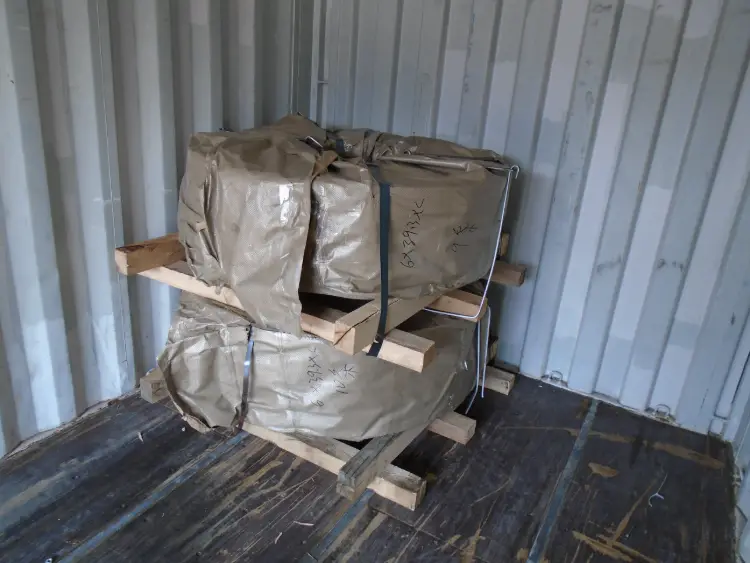
S460QL High-Strength Quenched & Tempered Steel Coil
S460QL High-Strength Quenched & Tempered Steel Coil - EN 10025-6
In-depth material guide for S460QL low-alloy high-strength steel coil: chemical composition, mechanical and physical properties, international equivalents, and application fields according to EN 10025-6.
Hot rolling, cold forming, welding, machining (after appropriate heat treatment)
- Phone : +8618037372205
- Email : [email protected]
- WhatsApp: Contact via Whtsapp
- WeChat: +8618037372205
S460QL High-Strength Quenched & Tempered Steel Coil Introduction
S460QL is a low-alloy, quenched and tempered fine-grain structural steel defined by EN 10025-6. The designation "S" denotes structural steel, "460" indicates a minimum yield strength of 460 MPa for thicknesses up to 50 mm, "Q" stands for quenching and tempering, and "L" specifies impact toughness at temperatures as low as -50°C (minimum 27 J).
This steel offers an excellent combination of high strength, good weldability, and outstanding low-temperature notch toughness. Its fine-grained microstructure is achieved through controlled rolling and heat treatment, ensuring uniform mechanical properties even in heavy sections. Typical delivery condition is quenched and tempered (Q+T).
Key advantages include:
- High yield and tensile strength, enabling lightweight designs
- Guaranteed impact energy at -50°C for demanding structural safety
- Good bending and forming capacity
- Consistent quality across a wide thickness range
These attributes make S460QL a preferred choice for heavy machinery, offshore structures, bridges, and pressure vessels.
S460QL High-Strength Quenched & Tempered Steel Coil Chemical Composition
The chemical composition of S460QL is carefully controlled to achieve the desired mechanical properties, weldability, and low-temperature toughness. Maximum limits for impurity elements are low. Carbon equivalent (CEV) is restricted to ensure good weldability. The following table gives the limiting values as per EN 10025-6.
| Element | Standard Value (max, unless range) | Remarks |
|---|---|---|
| C | ≤ 0.20 | Carbon |
| Si | ≤ 0.80 | Silicon |
| Mn | ≤ 1.70 | Manganese |
| P | ≤ 0.025 | Phosphorus |
| S | ≤ 0.015 | Sulfur |
| N | ≤ 0.015 | Nitrogen |
| B | ≤ 0.005 | Boron |
| Cr | ≤ 1.50 | Chromium |
| Cu | ≤ 0.50 | Copper |
| Mo | ≤ 0.70 | Molybdenum |
| Nb | ≤ 0.06 | Niobium |
| Ni | ≤ 2.0 | Nickel |
| Ti | ≤ 0.05 | Titanium |
| V | ≤ 0.12 | Vanadium |
| Zr | ≤ 0.15 | Zirconium |
| Al | ≥ 0.015 (total) | Aluminium (total) |
| CEV | ≤ 0.53 | Carbon equivalent: C+Mn/6+(Cr+Mo+V)/5+(Ni+Cu)/15 |
S460QL High-Strength Quenched & Tempered Steel Coil Thermal and Electrical Physical Properties
The physical properties of S460QL are similar to those of other low-alloy structural steels. The data below are approximate values valid at room temperature unless a temperature range is specified. They serve as guidance for engineering calculations.
| Property | Standard Requirement Value | Unit | Test Condition |
|---|---|---|---|
| Density (ρ) | ~7.85 | g/cm³ | 20 °C |
| Modulus of elasticity (E) | ~210 | GPa | 20 °C |
| Shear modulus (G) | ~80 | GPa | 20 °C |
| Poisson's ratio (ν) | 0.29 – 0.30 | 20 °C | |
| Thermal expansion coefficient (α) | 11.1 | 10⁻⁶/K | 20 – 100 °C |
| Thermal expansion coefficient (α) | 11.9 | 10⁻⁶/K | 20 – 200 °C |
| Thermal expansion coefficient (α) | 12.5 | 10⁻⁶/K | 20 – 300 °C |
| Thermal expansion coefficient (α) | 13.0 | 10⁻⁶/K | 20 – 400 °C |
| Thermal conductivity (λ) | ~50 | W/(m·K) | 20 °C |
| Specific heat capacity | ~460 – 500 | J/(kg·K) | 20 °C |
| Electrical resistivity (ρₑ) | ~0.23 – 0.25 | μΩ·m | 20 °C |
S460QL High-Strength Quenched & Tempered Steel Coil Mechanical Properties
The mechanical properties of S460QL are guaranteed in the quenched and tempered condition. Values vary with product thickness. The following data is based on EN 10025-6 for flat products (transverse test pieces). Impact energy is determined on longitudinal Charpy-V specimens at -50°C.
| Property | Standard Requirement | Unit | Test Condition / Thickness |
|---|---|---|---|
| Yield strength (ReH) | ≥ 460 | MPa | t ≤ 50 mm |
| Yield strength (ReH) | ≥ 440 | MPa | 50 < t ≤ 100 mm |
| Yield strength (ReH) | ≥ 400 | MPa | 100 < t ≤ 150 mm |
| Tensile strength (Rm) | 550 – 720 | MPa | t ≤ 50 mm |
| Tensile strength (Rm) | 530 – 700 | MPa | 50 < t ≤ 100 mm |
| Tensile strength (Rm) | 500 – 670 | MPa | 100 < t ≤ 150 mm |
| Elongation after fracture (A) | ≥ 17 | % | Longitudinal, L₀=5.65√S₀, t ≤ 100 mm |
| Elongation after fracture (A) | ≥ 16 | % | Longitudinal, L₀=5.65√S₀, 100 < t ≤ 150 mm |
| Impact energy (KV₂) | ≥ 27 (longitudinal) | J | -50 °C |
| Bend test (mandrel diameter) | 2t | 180° bend, t ≤ 16 mm | |
| Bend test (mandrel diameter) | 2t | 180° bend, 16 < t ≤ 40 mm | |
| Bend test (mandrel diameter) | 3t | 180° bend, 40 < t ≤ 63 mm | |
| Bend test (mandrel diameter) | 4t | 180° bend, 63 < t ≤ 100 mm |
S460QL High-Strength Quenched & Tempered Steel Coil Exact Equivalent Material Standards and Replaceable Grades
| Country / Region | Standard | Grade | Remarks |
|---|---|---|---|
| Europe (EU) | EN 10025-6 | S460QL | Original standard; directly equivalent throughout CEN member states |
| United Kingdom | BS EN 10025-6 | S460QL | Identical to EN version |
| Germany | DIN EN 10025-6 | S460QL | Identical to EN version |
| France | NF EN 10025-6 | S460QL | Identical to EN version |
| Italy | UNI EN 10025-6 | S460QL | Identical to EN version |
| International (historical) | ISO 4950-2 | FeE460CF | Chemical and mechanical properties closely match; S460QL supersedes this ISO grade |
S460QL High-Strength Quenched & Tempered Steel Coil Application Introduction
S460QL is specifically designed for heavy-duty structural applications where high strength, excellent weldability, and superior low-temperature toughness are essential. It is used in thick-walled components and highly stressed welded structures exposed to dynamic loads and cold environments.
Product Applications: Welded structural steel beams and columns, Sections for crane booms and chassis, Offshore platform nodes and braces, Bridge deck plates and stiffeners, High-pressure piping and pressure vessel shells, Mining machinery frames and buckets
Processed into products: Crane telescopic booms segments, Heavy truck chassis rails, Excavator arms and undercarriages, Wind turbine tubular tower sections, Bridge bearing supports, Hydraulic cylinder barrels (thick-walled)
Application industries: Heavy machinery and equipment manufacturing (mobile cranes, excavators, mining trucks), Offshore and marine engineering (platform structures, jack-up legs, shipbuilding), Bridge construction (orthotropic decks, box girders), Pressure vessel and storage tank fabrication, Transportation (trailers, railcar underframes), Renewable energy (wind turbine towers, foundations)
S460QL High-Strength Quenched & Tempered Steel Coil Similar / Alternative Materials Recommendation
| Country / Region | Standard | Grade | Remarks |
|---|---|---|---|
| Europe | EN 10025-6 | S500QL | Higher strength (500 MPa min) with similar toughness; substitutes with design adjustments |
| Europe | EN 10025-6 | S550QL | Even higher strength; suitable when weight reduction is critical |
| Europe | EN 10025-6 | S460Q | Same strength but lower toughness (0°C or -20°C); use where -50°C is not required |
| Europe | EN 10025-4 | S460M | Thermomechanical rolled steel, similar yield strength but less stringent low-temperature toughness |
| USA | ASTM A514/A517 | Grade B | Higher yield strength (~690 MPa), requires careful matching of design and welding procedures |
| China | GB/T 16270 | Q460E | Quenched and tempered, similar strength, -40°C impact; slight difference in low-temperature requirement |
Notes:
- Welding: Preheating and interpass temperatures should be controlled according to the welding procedure specification; low-hydrogen processes are recommended.
- Cold forming: Due to the high strength, adequate bending radii and stress-relief heat treatment after severe forming may be necessary.
- The steel can be supplied with additional options such as ultrasonic testing (UT) to Class EN 10160 or other NDE requirements.
- Always refer to the latest edition of EN 10025-6 for the exact specification of the ordered product.
- Share



