
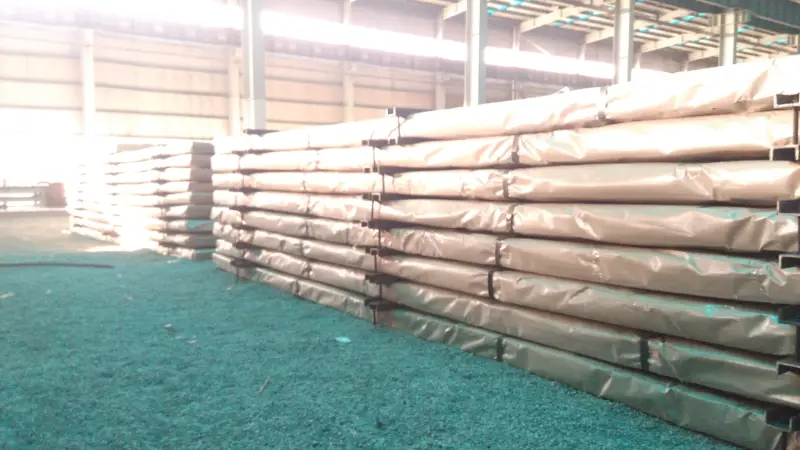
EN10025-3 S420N High-Strength Structural Steel
EN10025-3 S420N High-Strength Structural Steel: Properties, Equivalents & Typical Uses
Detailed material guide for EN10025-3 S420N carbon and low-alloy high-strength steel. Includes chemical composition, mechanical and thermal properties, international equivalents, and application examples for heavy welded structures.
Hot rolling, normalizing, normalizing rolling, cold forming (bending, flanging), welding (all common processes), thermal cutting, machining (after suitable heat treatment)
- Phone : +8618037372205
- Email : [email protected]
- WhatsApp: Contact via Whtsapp
- WeChat: +8618037372205
EN10025-3 S420N High-Strength Structural Steel Introduction
S420N is a weldable fine-grain structural steel delivered in the normalized or normalized-rolled condition according to EN 10025-3. It belongs to the family of low‑alloy high‑strength steels with minimum specified yield strengths up to 420 MPa (for thickness ≤ 16 mm). The 'N' designation indicates normalizing rolling or normalizing heat treatment, which refines the grain structure and notably improves toughness, especially at low temperatures. Typical properties include:
- High yield and tensile strength with good ductility
- Reliable notch toughness down to −20 °C (longitudinal 40 J minimum)
- Excellent weldability using all common processes (low carbon equivalent CEV)
- Good cold-forming characteristics and uniform mechanical properties
These characteristics make S420N an ideal choice for heavy‑duty welded structures in civil engineering, bridge building, offshore equipment, mobile cranes and machinery. It is supplied as hot‑rolled plates, sheets, wide flats, sections and bars, often with ultrasonic testing and specific impact requirements agreed at the time of order.
EN10025-3 S420N High-Strength Structural Steel Chemical Composition
The table lists the maximum (or range) limits for each element according to EN 10025-3:2019. The steel is fully killed and contains grain‑refining elements (Nb, V, Ti, Al). Carbon equivalent (CEV) is restricted to guarantee field weldability; typical CEV values depend on thickness and are agreed between purchaser and manufacturer, usually not exceeding 0.43–0.45 %.
| Element | Content (max %) | Remarks |
|---|---|---|
| Carbon, C | ≤ 0.20 | For thickness ≤ 150 mm |
| Silicon, Si | ≤ 0.60 | |
| Manganese, Mn | 1.00 – 1.70 | Ladle analysis range |
| Phosphorus, P | ≤ 0.025 | |
| Sulfur, S | ≤ 0.015 | |
| Aluminium, Al (total) | ≥ 0.015 | Minimum for fine grain practice |
| Niobium, Nb | ≤ 0.05 | |
| Vanadium, V | ≤ 0.12 | |
| Titanium, Ti | ≤ 0.05 | |
| Chromium, Cr | ≤ 0.30 | |
| Nickel, Ni | ≤ 0.80 | |
| Molybdenum, Mo | ≤ 0.10 | |
| Copper, Cu | ≤ 0.55 | |
| Nitrogen, N | ≤ 0.015 | |
| CEV | 0.43 – 0.45 (typical max) | Depending on thickness; formula: C+Mn/6+(Cr+Mo+V)/5+(Ni+Cu)/15 |
EN10025-3 S420N High-Strength Structural Steel Thermal & Electrical Physical Properties
Physical constants are not part of EN 10025‑3 mandatory requirements but are representative for low‑alloy structural steels. These values are suitable for engineering calculations and design. The thermal expansion and conductivity change with temperature; the table includes average values for the important temperature ranges.
| Property | Typical Value | Unit | Test Condition / Remarks |
|---|---|---|---|
| Density, ρ | 7.85 | g/cm³ | At 20 °C |
| Modulus of Elasticity, E | 210 | GPa | At 20 °C |
| Shear Modulus, G | ≈ 81 | GPa | At 20 °C (calculated from E and ν) |
| Poisson's Ratio, ν | 0.3 | Within elastic range | |
| Thermal Expansion Coefficient, α | 11.1 × 10⁻⁶ /K | K⁻¹ | Between 20 °C and 100 °C |
| Thermal Expansion Coefficient, α | 12.1 × 10⁻⁶ /K | K⁻¹ | Between 20 °C and 200 °C |
| Thermal Expansion Coefficient, α | 12.9 × 10⁻⁶ /K | K⁻¹ | Between 20 °C and 300 °C |
| Thermal Expansion Coefficient, α | 13.5 × 10⁻⁶ /K | K⁻¹ | Between 20 °C and 400 °C |
| Thermal Expansion Coefficient, α | 13.9 × 10⁻⁶ /K | K⁻¹ | Between 20 °C and 500 °C |
| Thermal Conductivity, λ | ≈ 50 | W/(m·K) | At 20 °C |
| Specific Heat Capacity, cp | ≈ 460 | J/(kg·K) | At 20 °C |
| Electrical Resistivity, ρe | ≈ 0.25 × 10⁻⁶ | Ω·m | At 20 °C |
EN10025-3 S420N High-Strength Structural Steel Mechanical Properties
Values are guaranteed in the normalized or normalized‑rolled condition (+N). The minimum yield strength (ReH) and tensile strength (Rm) are thickness‑dependent. Elongation is measured on a gauge length of 5.65√So. Impact testing is carried out on Charpy‑V specimens taken in the longitudinal direction at −20 °C (N quality). Bending test is performed with the mandrel diameters indicated.
| Property | Required Value | Unit | Test Condition / Remarks |
|---|---|---|---|
| Yield Strength, ReH | ≥ 420 | MPa | Thickness ≤ 16 mm |
| Yield Strength, ReH | ≥ 400 | MPa | 16 mm < thickness ≤ 40 mm |
| Yield Strength, ReH | ≥ 390 | MPa | 40 mm < thickness ≤ 63 mm |
| Yield Strength, ReH | ≥ 370 | MPa | 63 mm < thickness ≤ 80 mm |
| Yield Strength, ReH | ≥ 360 | MPa | 80 mm < thickness ≤ 100 mm |
| Yield Strength, ReH | ≥ 340 | MPa | 100 mm < thickness ≤ 150 mm |
| Tensile Strength, Rm | 500 – 680 | MPa | Thickness ≤ 100 mm |
| Tensile Strength, Rm | 480 – 660 | MPa | 100 mm < thickness ≤ 150 mm |
| Elongation, A (Lo = 5.65√So) | ≥ 19 | % | Thickness ≤ 40 mm, longitudinal |
| Elongation, A | ≥ 19 | % | 40 mm < thickness ≤ 63 mm, longitudinal |
| Elongation, A | ≥ 18 | % | 63 mm < thickness ≤ 100 mm, longitudinal |
| Elongation, A | ≥ 18 | % | 100 mm < thickness ≤ 150 mm, longitudinal |
| Bend Test (Mandrel Diameter / Thickness) | 2 t | Thickness ≤ 16 mm, 180 ° bend | |
| Bend Test | 3 t | 16 mm < thickness ≤ 100 mm | |
| Bend Test | 4 t | 100 mm < thickness ≤ 150 mm | |
| Charpy Impact Energy, KV2 | ≥ 40 | J | −20 °C, longitudinal, average of three specimens |
EN10025-3 S420N High-Strength Structural Steel Fully Equivalent Material Standards & Substitute Grades
| Country / Region | Standard | Grade Designation | Remarks |
|---|---|---|---|
| Europe | EN 10025-3 | S420N | Original specification; normalized or normalized rolled condition |
| International | ISO 630-3 | S420N | Identical technical requirements; EN and ISO grades are harmonized |
| China | GB/T 1591-2018 | Q420ND | Normalized delivery, impact energy at −20 °C (≥ 47 J); close match for S420N |
EN10025-3 S420N High-Strength Structural Steel Application Introduction
S420N steel is engineered for heavy, welded constructions where high static and dynamic loads must be carried safely and where good low‑temperature toughness is essential. The normalized fine‑grain microstructure ensures consistent properties through thick sections, making it a preferred material in the following fields:
Product Applications: Hot‑rolled steel plates (thicknesses up to 150 mm, widths up to 4500 mm) – the most common form, Wide flats and strip mill plate (coil) for spiral‑welded pipes and fabricated box sections, Sections: H‑beams, I‑beams, channels, angles, and sheet piles in EN 10025‑3 quality upon agreement, Bars and hollow sections (when specially ordered with fine‑grain practice)
Processed into products: Bridge girders, box girders, and orthotropic deck plates, Welded I‑ and H‑columns for high‑rise buildings, Crane main booms, jibs and structural nodes, Offshore module frames, nodes and jackets, Wind turbine tower shells and door frames, Tubular structures for heavy lifting appliances, Load‑bearing parts in mining shovels and draglines, Welded fabrications for pressure vessel shells (with additional PED or ASME qualification when required)
Application industries: Civil engineering and infrastructure (bridges, flyovers, stadiums, high‑rise buildings), Offshore and marine engineering (jacket platforms, helidecks, ship stiffeners), Heavy machinery and crane manufacturing (mobile cranes, excavator booms, lifting equipment), Wind energy (tower sections, transition pieces, foundations), Mining and quarrying (large dump bodies, conveyor structures), Pressure vessels and storage tanks (where moderate strength and toughness are needed)
EN10025-3 S420N High-Strength Structural Steel Similar / Closely Matching Steels for Possible Substitution
| Country / Region | Standard | Grade Designation | Remarks |
|---|---|---|---|
| Europe | EN 10025-3 | S420M | Thermomechanical rolled (M); comparable strength but different delivery condition and impact temperature option |
| Europe | EN 10025-2 | S420J2 | Non‑normalized structural steel; higher impurity level, impact at −20 °C; verify notch toughness for critical applications |
| USA | ASTM A572/A572M | Grade 60 [415] / Grade 65 [450] | Similar yield strength range; as‑rolled or normalized; compare CEV and toughness requirements |
| Japan | JIS G3106 | SM570 | Higher tensile strength (570 MPa class); suitable for welded structures but higher CEV; check matching |
| China | GB/T 1591-2018 | Q420D | Hot‑rolled or TMCP; impact at −20 °C; may substitute after review of delivery condition |
Notes:
Additional information:
- When ordering, the impact test temperature (‑20 °C for N grade) and sampling direction must be confirmed. Transverse impact values are typically 27 J minimum but need to be agreed.
- Ultrasonic testing to EN 10160 (or equivalent) is frequently specified for thick plates used in critical welded joints.
- For applications requiring improved atmospheric corrosion resistance, consider the companion grade S420 J4W or S420 K2W under EN 10025‑5.
- The steel can be galvanized without risk of liquid metal embrittlement when proper practices are followed.
- Weldability: preheating recommendations depend on thickness and CEV; typically, no preheat is required for thicknesses below 30 mm when using low‑hydrogen processes.
- Share



