
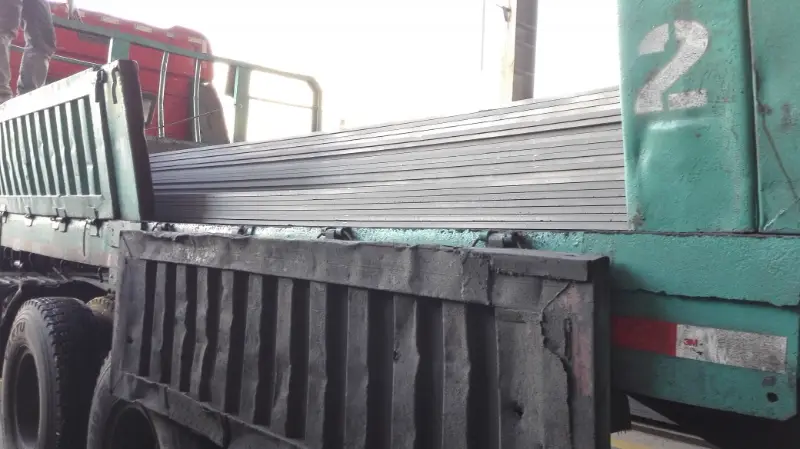
EN10025-6 S620QL Steel
EN10025-6 S620QL Steel: High-Strength Quenched & Tempered Structural Steel for Heavy Engineering
Comprehensive material data for S620QL steel per EN 10025-6, including chemical composition, mechanical properties, thermal and electrical characteristics, international equivalents, and application guidance for heavy machinery and structural engineering.
Hot rolling followed by quenching and tempering, Cold forming (limited), Machining, Welding (with precautions due to high strength level).
- Phone : +8618037372205
- Email : [email protected]
- WhatsApp: Contact via Whtsapp
- WeChat: +8618037372205
EN10025-6 S620QL Steel Introduction
S620QL is a high-strength, quenched and tempered structural steel grade defined in EN 10025-6. It is designed for heavy-duty applications requiring excellent weldability and low-temperature impact toughness. Characterized by a minimum yield strength of 620 MPa, this low-alloy steel offers a balanced combination of high strength, good formability, and resistance to brittle fracture. The 'L' in its designation specifies its suitability for use at low temperatures, with guaranteed impact energy values at -40°C. This makes S620QL an ideal choice for weight-saving, high-stress structures in challenging environments, such as mobile cranes, bridges, and offshore components.
EN10025-6 S620QL Steel Chemical Composition
The chemical composition of S620QL steel is carefully controlled to achieve its high strength and toughness after quenching and tempering. Key elements like carbon (C), manganese (Mn), and chromium (Cr) provide hardenability, while micro-alloying elements such as niobium (Nb), vanadium (V), and titanium (Ti) refine the grain structure. Phosphorus (P) and sulfur (S) are strictly limited to ensure high cleanliness and excellent notch toughness.
- Values are per EN 10025-6 for heat analysis.
- For product analysis, permissible deviations apply as specified in the standard.
| Chemical Element | Standard Value (max %) | Remarks |
|---|---|---|
| Carbon (C) | 0.20 | For thicknesses ≤ 50 mm; max 0.22 for >50 mm |
| Silicon (Si) | 0.80 | Deoxidizer |
| Manganese (Mn) | 1.70 | Primary strengthener and hardenability agent |
| Phosphorus (P) | 0.020 | Low level for toughness |
| Sulfur (S) | 0.010 | Very low for cleanliness and lamellar tearing resistance |
| Chromium (Cr) | 1.50 | Hardenability element |
| Molybdenum (Mo) | 0.70 | Improves hardenability and high-temperature strength |
| Nickel (Ni) | 2.0 | Improves toughness, especially at low temperatures |
| Niobium (Nb) | 0.06 | Micro-alloy, grain refiner |
| Vanadium (V) | 0.12 | Micro-alloy, precipitation strengthener |
| Titanium (Ti) | 0.05 | Micro-alloy, grain refiner and nitrogen scavenger |
| Boron (B) | 0.005 | Strong hardenability enhancer |
| Zirconium (Zr) | 0.15 | Optional, sulfide shape control |
| Copper (Cu) | 0.50 | Optional, improves atmospheric corrosion resistance |
| *Additional elements | * | The sum of Cr+Mo+Ni shall not exceed a defined limit based on thickness, specified in the standard. |
EN10025-6 S620QL Steel Thermal & Electrical Physical Properties
The physical properties are typical values for quenched and tempered low-alloy structural steel and are not part of the mandatory certification per EN 10025-6. These values are crucial for engineering calculations involving heat transfer, thermal stress, and electrical conductivity. Properties can vary slightly with exact chemical composition and heat treatment condition.
- Values are representative for the S620QL grade at ambient temperature (20°C).
- Thermal expansion coefficient will increase with temperature.
| Property | Typical Value | Unit | Test Condition |
|---|---|---|---|
| Density (ρ) | Approx. 7.85 | kg/dm³ | 20°C |
| Elastic Modulus (E) | 210 | GPa | 20°C |
| Shear Modulus (G) | Approx. 80 | GPa | 20°C |
| Poisson's Ratio (ν) | Approx. 0.3 | — | 20°C |
| Thermal Expansion Coefficient (α) | 11.5 - 13.0 | x10⁻⁶/K | 20°C to 100°C range |
| Thermal Conductivity (λ) | Approx. 35 | W/(m·K) | 20°C |
| Specific Heat Capacity | Approx. 460 | J/(kg·K) | 20°C |
| Electrical Resistivity (ρ_e) | Approx. 0.25 | Ω·mm²/m | 20°C |
EN10025-6 S620QL Steel Mechanical Properties
The specified mechanical properties are achieved after the quenching and tempering heat treatment. These values are mandatory per EN 10025-6 and verified by tensile and impact testing. The high yield and tensile strengths allow for lighter designs, while the guaranteed elongation ensures sufficient ductility. The Charpy V-notch impact energy (KV) at -40°C confirms the 'L' low-temperature quality designation.
- Property values are valid for products with thicknesses ≤ 50 mm unless otherwise noted.
- For thicknesses > 50 mm, minimum strength values may be slightly reduced as per the standard.
| Property | Standard Requirement Value | Unit | Test Condition |
|---|---|---|---|
| Minimum Yield Strength (ReH) | ≥ 620 | MPa | t ≤ 50 mm |
| Tensile Strength (Rm) | 700 - 890 | MPa | t ≤ 50 mm |
| Minimum Elongation after fracture (A) | ≥ 15 | % | Gauge length L0=5.65√S0, t ≤ 50 mm |
| Elongation after fracture (A) | ≥ 14 | % | Gauge length L0=5.65√S0, 50 < t ≤ 100 mm |
| Elongation after fracture (A) | ≥ 13 | % | Gauge length L0=5.65√S0, 100 < t ≤ 150 mm |
| Impact Energy (KV, longitudinal) | ≥ 40 | J | At -40°C, t ≤ 50 mm |
| Bend Test (Mandrel diameter) | No cracks | — | 180° bend around a mandrel of diameter 3*t (t = plate thickness), nominal requirements |
EN10025-6 S620QL Steel Completely Equivalent Material Standards & Substitutable Grade Recommendations
| Country/Region | Standard | Grade | Remarks |
|---|---|---|---|
| Europe (EU) | EN 10025-6 | S620QL | Original standard grade |
| Italy | UNI EN 10025-6 | S620QL | EU harmonized standard |
| Germany | DIN EN 10025-6 | S620QL | EU harmonized standard |
| France | NF EN 10025-6 | S620QL | EU harmonized standard |
| United Kingdom | BS EN 10025-6 | S620QL | EU harmonized standard, post-Brexit dual numbering |
EN10025-6 S620QL Steel Application Introduction
S620QL is engineered for the most demanding structural applications where reducing dead weight is a primary design goal. Its high strength-to-weight ratio allows for the construction of massive, mobile, or slender structures without compromising payload or stability. The guaranteed low-temperature toughness is critical for safety in outdoor and cold climate applications. Special welding consumables and procedures, with controlled heat input and preheating, are essential to maintain the properties of the heat-affected zone (HAZ).
Product Applications: All-terrain and crawler crane telescopic booms, Heavy-duty truck chassis rails and cross-members, Steel bridge box girders and main support arches, Offshore wind turbine installation vessel legs, High-pressure water penstocks and bifurcations, Large mining haul truck dump bodies, Industrial autoclaves and high-pressure containers
Processed into products: Single-piece formed boom profiles, Welded hollow box-sections for structural arms, Machined and welded connector pins and lugs, Heavy-duty slewing rings and bearing housings, Cut, folded, and welded structural brackets, Precision-machined flanges for piping systems, Circular-welded storage tank shell courses
Application industries: Heavy Mobile Crane Manufacturing, Commercial Vehicle and Trailer Construction (Chassis, Subframes), Bridge Engineering (Orthotropic decks, truss members), Offshore & Marine Engineering (Jack-up rig legs, crane pedestals), Hydropower Engineering (Penstocks, spiral cases), Mining Machinery (Dump truck bodies, excavator buckets and booms), Pressure Vessel and Storage Tank Construction
EN10025-6 S620QL Steel Similar/Comparable Substitute Material Recommendations
| Country/Region | Standard | Grade | Remarks |
|---|---|---|---|
| USA | ASTM A514/A514M | Grade S | Close match, also a Q&T steel with min 620 MPa yield. Check detailed chemical composition for weldability differences. |
| Japan | JIS G 3128 | SHY 685 / SHY 685N | High yield strength steel plates. The 'N' variant indicates a specific toughness grade. Requires careful comparison of mechanical and chemical properties. |
| China | GB/T 16270 | Q620D / Q620E | Chinese standard for high-strength structural steels in the quenched and tempered condition. The 'E' and 'D' suffixes denote impact test temperatures of -40°C and -20°C, respectively. |
| Germany (legacy) | SEW 092 | N-A-XTRA 63 | Historical West German standard, Voestalpine designation. A very close technical equivalent, commonly referenced before EN 10025-6 unified European grades. |
Notes:
Welding Considerations: S620QL requires strict welding procedures. Preheating and interpass temperatures (typically 150-200°C, but dependent on thickness and heat input) are critical to prevent hydrogen-induced cold cracking. Use low-hydrogen consumables with matching or undermatching strength levels.
Post-Weld Heat Treatment (PWHT): Generally not recommended as it will reduce the strength achieved by the original quenching and tempering process. If unavoidable due to code requirements, the tempering temperature must be significantly lower than the original tempering temperature.
Cold Forming: The high strength of S620QL limits its cold formability. Tight radius bending requires careful calculation to avoid cracking, often requiring edge grinding and intermediate heat treatment for heavy bending operations. Hot forming is typically not advised as it will alter the carefully engineered microstructure.
- Share



