
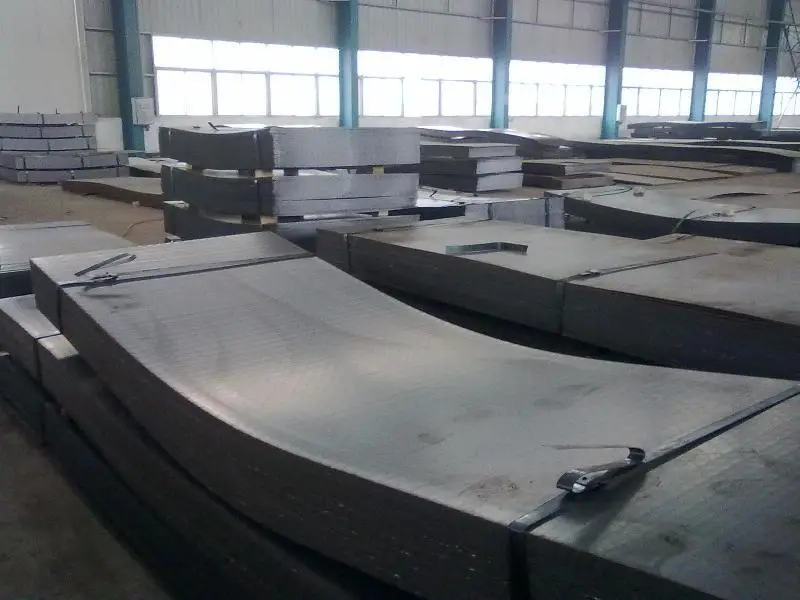
JIS G3101 SS330 Carbon Structural Steel
JIS G3101 SS330 Carbon Structural Steel: Properties, Equivalents & Applications
Detailed analysis of JIS G3101 SS330 carbon and low-alloy high-strength steel coil including chemical composition, mechanical properties, physical data, international equivalents, and application guide.
Hot Rolling, Cold Forming, Bending, Welding, Machining, Shearing
- Phone : +8618037372205
- Email : [email protected]
- WhatsApp: Contact via Whtsapp
- WeChat: +8618037372205
JIS G3101 SS330 Carbon Structural Steel Introduction
JIS G3101 SS330 is a carbon structural steel specified by the Japanese Industrial Standards. It is classified as a general structural rolled steel for building, engineering, and structural applications. SS330 is characterized by its good weldability, machinability, and a balanced combination of strength and ductility. The designation 'SS' stands for 'Structural Steel', and '330' refers to the minimum tensile strength of 330 N/mm². This grade is commonly supplied in the hot-rolled condition and is widely used for constructing steel structures, bridges, vehicles, and ships where moderate strength is required. It is not typically subjected to heat treatment by the user but can be processed using standard cold forming operations due to its formability.
JIS G3101 SS330 Carbon Structural Steel Chemical Composition
The chemical composition of JIS G3101 SS330 is specified to ensure the required mechanical properties and weldability. The standard defines maximum limits for phosphorus and sulfur to minimize brittleness and improve surface quality. Carbon and manganese are not mandated by the standard but are typically controlled by the manufacturer to meet strength requirements. Key elements: Carbon (C) is usually kept low to enhance ductility and weldability. Manganese (Mn) is added to improve strength. Silicon (Si) is minimal as it is an aluminum-killed steel type.
| Element | Typical/Standard Value | Remarks |
|---|---|---|
| Carbon (C) | ≤ 0.15 (Typical) | Not specified in standard, adjusted for strength |
| Manganese (Mn) | ≤ 1.40 (Typical) | Not specified in standard, adjusted for strength |
| Silicon (Si) | ≤ 0.40 (Typical) | Not specified in standard |
| Phosphorus (P) | ≤ 0.050 | Max limit as per standard |
| Sulfur (S) | ≤ 0.050 | Max limit as per standard |
| Iron (Fe) | Balance | Remainder |
JIS G3101 SS330 Carbon Structural Steel Thermal and Electrical Physical Properties
These physical properties are typical for structural carbon steel grades like SS330. They are not specified by the JIS G3101 standard but are essential reference values for engineering calculations involving thermal load, heat treatment, structural analysis, and electrical resistivity. Properties include: Density (ρ) for weight calculation, Elastic modulus (E) for stiffness analysis, and thermal expansion coefficient (α) for thermal stress evaluation. These values are temperature-dependent and provided at standard reference temperatures.
| Property | Typical Value | Unit | Test Condition / Temperature |
|---|---|---|---|
| Density (ρ) | 7.85 | g/cm³ | At 20°C |
| Elastic Modulus (E) | 210 | GPa | At 20°C |
| Shear Modulus (G) | 81 | GPa | At 20°C |
| Poisson's Ratio (ν) | 0.3 | - | At 20°C |
| Thermal Expansion Coefficient (α) | 11.7 | 10⁻⁶/K | 20-100°C |
| Thermal Expansion Coefficient (α) | 12.5 | 10⁻⁶/K | 20-200°C |
| Thermal Conductivity (λ) | 53 | W/m·K | At 20°C |
| Specific Heat Capacity | 470 | J/kg·K | At 20°C |
| Electrical Resistivity (ρ_e) | 0.16 | Ω·mm²/m | At 20°C |
JIS G3101 SS330 Carbon Structural Steel Mechanical Properties
The mechanical properties of JIS G3101 SS330 are the primary criteria for acceptance. These tests are typically conducted on test pieces taken in the rolling direction. Key properties include: Tensile strength (Rm) must be a minimum of 330 N/mm² for the material to be classified as SS330. The yield point or proof stress (ReH) and elongation (A) values vary based on the nominal thickness of the steel product. Bendability is confirmed by a bending test where the specimen must withstand 180° bending without cracking on the outer surface.
| Property | Standard Requirement Value | Unit | Test Condition / Thickness (t) |
|---|---|---|---|
| Yield Point (ReH) | ≥ 205 | MPa (N/mm²) | t ≤ 16 mm |
| Yield Point (ReH) | ≥ 195 | MPa (N/mm²) | 16 mm < t ≤ 40 mm |
| Yield Point (ReH) | ≥ 175 | MPa (N/mm²) | 40 mm < t ≤ 100 mm |
| Tensile Strength (Rm) | 330 – 430 | MPa (N/mm²) | t ≤ 16 mm |
| Tensile Strength (Rm) | 330 – 430 | MPa (N/mm²) | 16 mm < t ≤ 100 mm |
| Elongation (A) | ≥ 26 | % | t ≤ 5 mm, Test Piece No. 5 |
| Elongation (A) | ≥ 25 | % | 5 mm < t ≤ 16 mm, Test Piece No. 1A |
| Elongation (A) | ≥ 22 | % | 16 mm < t ≤ 50 mm, Test Piece No. 1A |
| Elongation (A) | ≥ 24 | % | t > 40 mm, Test Piece No. 10 |
| Bendability (180°) | d = 2.0a | - | t ≤ 16 mm, No cracks on outer surface |
| Bendability (180°) | d = 2.5a | - | t > 16 mm and t ≤ 100 mm, No cracks on outer surface |
JIS G3101 SS330 Carbon Structural Steel Completely Equivalent Material Standards and Replaceable Grades
| Country/Region | Standard | Grade | Remarks |
|---|---|---|---|
| Japan | JIS G3101 | SS330 | Original specification |
| International | ISO 630-2 | E235B | Mechanical properties highly comparable |
| China | GB/T 700 | Q235B | Widely accepted commercial equivalent |
| European Union | EN 10025-2 | S235JR | Matches strength and weldability requirements |
| USA | ASTM A36/A36M | A36 | Slightly higher typical tensile range but functionally equivalent |
| Russia | GOST 380 | St3sp | Traditional structural steel equivalent |
JIS G3101 SS330 Carbon Structural Steel Application Introduction
JIS G3101 SS330 is a versatile structural steel that bridges the gap between mild commercial quality and higher-strength low-alloy grades. Its excellent weldability and formability make it suitable for a wide range of construction and engineering applications. Industries value this grade for its consistent mechanical properties and cost-effectiveness. It performs well in static loading conditions and can be easily integrated into welded assemblies without pre-heating for thin and medium sections. The steel is often used in its hot-rolled, descaled, or primed condition.
Product Applications: Steel framework for high-rise buildings and warehouses, Bridge girders and arches, Hulls and decks for small to medium vessels, Truck chassis frames and vehicle body parts, Railway wagon underframes and bogies, Welded pipes for structural purposes and fluid transport, Oil and water storage tanks
Processed into products: I-beams, H-beams, channels, and angles, Steel plates for gussets and stiffeners, Flanges and flanged joints, Brackets and supports, Frames and enclosures, Cold-formed sections like purlins and rails, Base plates and connection plates
Application industries: Building and Construction, Bridge Engineering, Shipbuilding, Automotive and Railway Vehicle Manufacturing, General Heavy Machinery, Storage Tank and Pressure Vessel (non-critical parts), Structural Pipe and Tube Manufacturing
JIS G3101 SS330 Carbon Structural Steel Similar/Closest Alternative Material Recommendations
| Country/Region | Standard | Grade | Remarks |
|---|---|---|---|
| USA | ASTM A283/A283M | Grade C | Slightly lower tensile strength, similar structural applications |
| European Union | EN 10025-2 | S275JR | Higher strength grade, commonly used as an upgrade alternative |
| China | GB/T 700 | Q195 | Lower strength, suitable for forming where SS330 strength is not critical |
| India | IS 2062 | E250 | Fe 410W equivalent, widely used in general engineering |
| Japan | JIS G3101 | SS400 | Higher strength version in the same standard, tensile ≥400 MPa |
Notes:
Welding: SS330 has excellent weldability by all standard methods including SMAW (stick), GMAW (MIG), and SAW. Preheating is not generally required for sections under 30 mm thickness, but local standard practices for carbon equivalent should be followed. Forming: The steel can be cold bent or pressed to a radius of 2.0a (twice the thickness) in the as-rolled condition. For more severe forming, annealing may be required. Corrosion Protection: As a plain carbon steel, SS330 requires protective coatings such as painting, galvanizing, or metallizing for use in corrosive environments. No significant resistance to atmospheric corrosion.
- Share



