
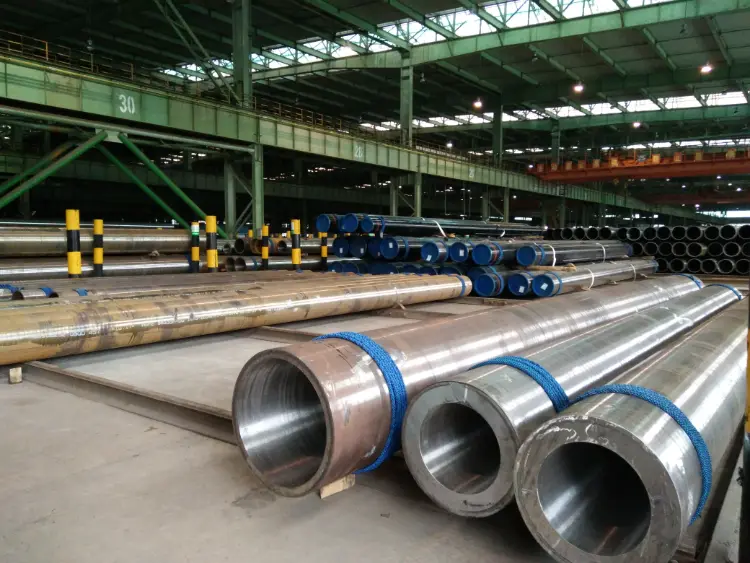
GB/T 9711-2011 L175P LSAW Pipe Material
L175P LSAW Pipe Material Data per GB/T 9711-2011 - Low Carbon Line Pipe for Oil & Gas
Complete material properties, chemical composition, mechanical and thermal data for L175P grade longitudinal submerged arc welded (LSAW) pipe according to Chinese standard GB/T 9711-2011 PSL1.
Hot strip rolling, forming, submerged arc welding (SAW), followed by optional sizing and straightening. Can be supplied in as-welded or stress-relieved condition.
- Phone : +8618037372205
- Email : [email protected]
- WhatsApp: Contact via Whtsapp
- WeChat: +8618037372205
GB/T 9711-2011 L175P LSAW Pipe Material Introduction
The L175 (often designated L175P in the context of PSL1) steel grade is a low carbon, non-expanding line pipe material designed for the transportation of oil, gas, water and other low-pressure fluids. As specified in GB/T 9711-2011, it belongs to the PSL1 product specification level, offering basic quality requirements without stringent toughness testing. Key features include excellent weldability, moderate strength, and economic competitiveness. Typical supply condition is hot-rolled or normalized for the base plate, subsequently formed and welded by the longitudinal submerged arc welding process. The material is suitable for a wide range of ambient temperatures and general service environments, where high strength and extreme low-temperature toughness are not required.
GB/T 9711-2011 L175P LSAW Pipe Material Chemical Composition
The chemical composition requirements for L175 (L175P) PSL1 according to GB/T 9711-2011 are limited to carbon, manganese, phosphorus and sulfur. No intentional addition of microalloying elements such as Nb, V or Ti is required. The carbon equivalent is typically very low, ensuring excellent field weldability. Silicon, aluminium and residual elements are not specified but are commonly present at levels typical of fully killed low carbon steel.
| Chemical Element | Standard Value (max, wt%) | Remarks |
|---|---|---|
| Carbon (C) | 0.21 | Maximum value; typical range 0.05–0.18 |
| Manganese (Mn) | 0.60 | Maximum value; contributes to strength and deoxidation |
| Phosphorus (P) | 0.030 | Maximum; restricted for weldability and formability |
| Sulfur (S) | 0.030 | Maximum; controlled for low inclusion content |
| Silicon (Si) | Not specified | Typically 0.10–0.35 for fully killed steel |
| Aluminium (Al) | Not specified | Usually ≥0.015 for grain refinement |
GB/T 9711-2011 L175P LSAW Pipe Material Thermal and Electrical Physical Properties
Physical property data provided below are typical for low carbon steel in the hot-rolled condition and are not directly specified in GB/T 9711-2011. They serve as general design guidelines for L175 steel. Values can vary slightly depending on exact chemistry, grain size and temperature. Thermal conductivity and electrical resistivity are given at room temperature unless noted otherwise.
| Property | Typical Value | Unit | Condition / Temperature |
|---|---|---|---|
| Density (ρ) | ≈7850 | kg/m³ | 20°C |
| Elastic Modulus (E) | ≈205 – 210 | GPa | 20°C |
| Shear Modulus (G) | ≈80 – 82 | GPa | 20°C |
| Poisson's Ratio (ν) | ≈0.29 – 0.30 | - | 20°C |
| Thermal Expansion Coefficient (α) | ≈11.7 ×10⁻⁶ | 1/K | 20 – 100°C |
| Thermal Conductivity (λ) | ≈50 – 54 | W/(m·K) | 20°C |
| Specific Heat Capacity (c) | ≈465 – 485 | J/(kg·K) | 20°C |
| Electrical Resistivity (ρ_e) | ≈0.14 – 0.18 | µΩ·m | 20°C |
GB/T 9711-2011 L175P LSAW Pipe Material Mechanical Properties
Mechanical properties for L175 PSL1 LSAW pipe are determined on the base metal away from the weld. The yield strength is the minimum 175 MPa, and the tensile strength at least 310 MPa. Elongation is calculated by a formula depending on specimen cross-sectional area and actual tensile strength. Bend test requirement is a guided bend around a former of diameter 6 times the wall thickness (6t). Impact toughness testing is not required for PSL1 grade; values are provided as typical for reference only.
| Property | Specified Value | Unit | Test Condition |
|---|---|---|---|
| Yield Strength (Rt0.5) | ≥175 | MPa | Transverse strip specimen, room temperature |
| Tensile Strength (Rm) | ≥310 | MPa | Transverse strip specimen, room temperature |
| Elongation after fracture (A) | Calculated: A=1940·S₀^0.2 / Rm^0.9 (≥ 23% typical for S₀=130 mm², Rm=310 MPa) | % | Transverse specimen, gauge length 50 mm (or proportional) |
| Bend Test (Weld & Base Metal) | No crack or rupture when bent 180° around former (6t for wall thickness ≤19.1 mm) | - | Face and root bend for weld; base metal optional |
| Impact Toughness (KV₂) | Not required for PSL1 | J | Typical Charpy V-notch values at 0°C may be >27 J for such low carbon steel, but not mandatory |
GB/T 9711-2011 L175P LSAW Pipe Material Equivalent Material Grades
| Country/Region | Standard | Grade | Remarks |
|---|---|---|---|
| International | ISO 3183 | L175 | PSL1 equivalent; same strength level |
| USA/International | API 5L | A25 (PSL1) | A25 is identical to L175; widely used globally |
| Russia/CIS | GOST 3262 | 10 (or St2sp) | Approximate match, often requires verification of mechanical properties |
| Europe | EN 10208-1 | L210GA | Slightly higher yield strength but often used as a substitute |
| China | GB/T 9711-2011 | L175 (L175P) | Original specification |
GB/T 9711-2011 L175P LSAW Pipe Material Application Introduction
L175 (L175P) LSAW pipe is predominantly used in low- to medium-pressure fluid transmission systems. Thanks to its low carbon content, field welding does not require preheat, and it can be bent and formed easily. Typical applications span across oil, gas, water and structural industries.
Product Applications: Gathering and trunk line pipelines, Flowlines at well sites, Low pressure gas distribution networks, Heating network piping, Structural columns and trusses (with end connections)
Processed into products: Pipe spools and pup pieces, Induction bends (manufactured from parent pipe), Tees and reducers (fabricated from welded pipe), Flanged connectors, Clamp and support brackets (rolled from pipe sections)
Application industries: Oil & Gas (downstream and gathering lines), Water treatment and supply networks, District heating systems, Chemical and petrochemical (general non-corrosive service), Construction and civil engineering (structural pipe piles, bracing), Agriculture (irrigation systems)
GB/T 9711-2011 L175P LSAW Pipe Material Similar Materials for Alternative Selection
| Country/Region | Standard | Grade | Remarks |
|---|---|---|---|
| China | GB/T 9711-2011 | L210 | Same standard, next higher strength level (yield 210 MPa), similar chemistry |
| International | API 5L | A25 PSL2 | Higher quality level with mandatory toughness testing; chemistry similar |
| International | ISO 3183 | L210 | Slightly higher strength, still excellent weldability |
| Europe | EN 10208-1 | L235GA | Higher strength, but still a common alternative for low pressure lines |
| Japan | JIS G3454 | STPG 370 | Carbon steel pipe for pressure service (tensile ≥370 MPa); different application scope but comparable weldability |
Notes:
For PSL1 pipes, hydrostatic testing or non-destructive inspection of the weld seam is required. The pipe may be ordered in lengths up to 12 m or random lengths. The LSAW process produces a longitudinal weld that is 100% radiographically or ultrasonically tested in most cases. Carbon equivalent (CE) typically falls below 0.40, ensuring excellent weldability without preheating under normal conditions. Contact the manufacturer for precise CE values and supplementary testing if required for sour service or other special environments.
- Share



