
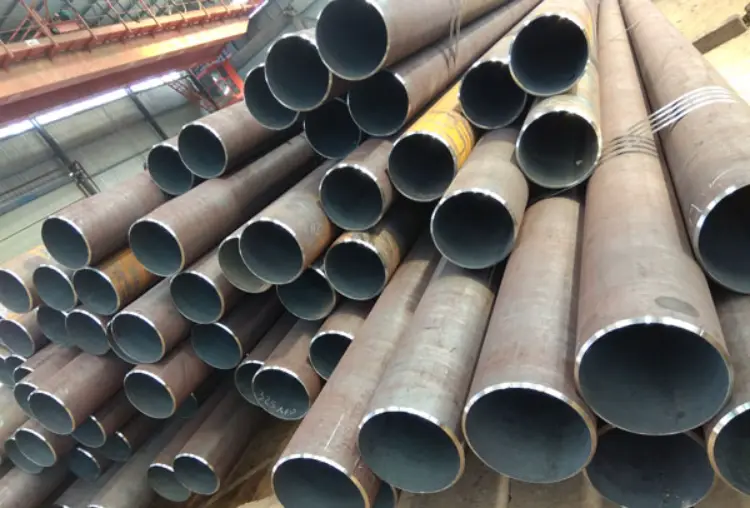
API 5L X56 PSL2 LSAW Pipe
API 5L X56 PSL2 LSAW Pipe: Grade L390 Steel Properties & Equivalent Materials
Comprehensive material data for API 5L X56 PSL2 LSAW pipe including chemical composition, mechanical properties, thermal and electrical properties, international equivalents, equivalent grades, and application guide.
The plate is cold formed using UOE, JCOE or roll-bending processes, then welded by longitudinal submerged arc welding (inside and outside). Post-weld mechanical expansion may be applied for improved roundness and stress relief. Suitable for hot induction bending, cold bending, and welding with low-hydrogen consumables.
- Phone : +8618037372205
- Email : [email protected]
- WhatsApp: Contact via Whtsapp
- WeChat: +8618037372205
API 5L X56 PSL2 LSAW Pipe Introduction
API 5L X56 PSL2 LSAW pipe is a high-strength low-alloy (HSLA) steel line pipe manufactured according to the American Petroleum Institute (API) Specification 5L. The designation "X56" indicates a minimum yield strength of 56,000 psi (approximately 390 MPa), and the material is also referred to as L390 in ISO standards. PSL2 (Product Specification Level 2) imposes stricter requirements on chemical composition, mechanical properties, and non-destructive testing compared to PSL1, ensuring higher integrity for critical applications. LSAW (Longitudinal Submerged Arc Welding) is the manufacturing process that uses hot-rolled plate or coil formed into a pipe and welded longitudinally, providing excellent dimensional accuracy and structural performance. This grade is widely used for long-distance oil and gas transmission pipelines, high-pressure fluid transport, and offshore structural applications due to its good combination of strength, toughness, and weldability.
API 5L X56 PSL2 LSAW Pipe Chemical Composition for X56 PSL2 per API 5L
The chemical composition is according to API 5L 46th Edition, Table 5 and Table 6 for PSL2. Maximum limits apply unless otherwise agreed. Microalloying elements such as Nb, V, Ti may be added singly or in combination to achieve the required mechanical properties. The carbon equivalent (CEIIW or CEPcm) shall be restricted per supplementary requirements when specified.
| Element | Max Value (wt%) | Notes |
|---|---|---|
| C (Carbon) | 0.22 | Heat analysis; max reduced to 0.18 if CEIIW ≤ 0.43 is specified. |
| Mn (Manganese) | 1.40 | For PSL2, max 1.40%; higher Mn possible by agreement. |
| P (Phosphorus) | 0.025 | Max |
| S (Sulfur) | 0.015 | Max |
| Si (Silicon) | 0.45 | Max; typical range 0.15–0.35 |
| V (Vanadium) | 0.06 | Typically present if microalloyed; max per heat 0.10% for PSL2 |
| Nb (Niobium) | 0.06 | Typically present; max 0.06% for PSL2 (or Nb+V+Ti ≤ 0.15%) |
| Ti (Titanium) | 0.06 | Typically ≤0.04%; max 0.06% |
| N (Nitrogen) | 0.012 | Max unless sufficient Al or other grain refiners present |
| Al (Aluminum) | N.A. | Usually 0.015–0.06% for grain refinement and deoxidation |
| Cu (Copper) | 0.50 | Max residual |
| Ni (Nickel) | 0.50 | Max residual |
| Cr (Chromium) | 0.50 | Max residual |
| Mo (Molybdenum) | 0.50 | Max residual |
| B (Boron) | 0.0005 | Residual unless intentionally added for quenched pipe |
API 5L X56 PSL2 LSAW Pipe Thermal and Electrical Physical Properties
These values are typical for low-alloy carbon steel and are not mandatory per API 5L. They are provided for engineering calculations. Thermal conductivity and thermal expansion vary slightly with temperature; the values below are representative for ambient to 100°C.
| Property | Typical Value | Unit | Test Condition / Remarks |
|---|---|---|---|
| Density (ρ) | 7850 | kg/m³ | At 20°C |
| Elastic Modulus (E) | 205 | GPa | At 20°C; decreases with rising temperature |
| Shear Modulus (G) | 80 | GPa | Calculated; G = E/[2(1+ν)] |
| Poisson's Ratio (ν) | 0.3 | - | Typical for steel within elastic range |
| Thermal Expansion Coefficient (α) | 11.7 × 10⁻⁶ | K−1 | Mean coefficient between 20°C and 100°C |
| Thermal Conductivity (λ) | 50 | W/(m·K) | At 20°C; decreases with increasing temperature |
| Specific Heat Capacity (cp) | 486 | J/(kg·K) | At 20°C |
| Electrical Resistivity (ρe) | 0.18 | μΩ·m | At 20°C; increases with temperature and alloy content |
API 5L X56 PSL2 LSAW Pipe Mechanical Properties
The mechanical properties apply to the pipe body (transverse or longitudinal specimens) in the as-delivered condition. Flattened tensile test and Charpy V-notch impact test are mandatory for PSL2. Elongation is determined per API 5L using a 2-inch (50 mm) gauge length. Actual values depend on pipe dimensions and manufacturing process.
| Property | Specified Value | Unit | Test Condition / Remarks |
|---|---|---|---|
| Yield Strength (Rt0.5) | 390 – 550 (min 56.6 ksi) | MPa | Transverse strip test; upper limit only for PSL2 |
| Tensile Strength (Rm) | 490 – 760 (min 71.1 ksi) | MPa | Transverse strip test |
| Yield to Tensile Ratio (Rt0.5 / Rm) | ≤ 0.93 | - | PSL2 requirement; materials with Rm > 690 MPa may have limit 0.93 |
| Elongation (A50mm) | Min : 22% (typical for wall ≤ 25 mm) | % | 50 mm gauge length; exact min calculated per API 5L formula Af = 1940 × Axc0.2/UTS0.9 (SI units) |
| Charpy V-notch Impact Energy | Min average 27 J (single 20 J) at 0°C | J | Full-size 10x10 mm specimen; other test temperatures (−20°C, −40°C) by agreement |
| Bend Test (Guided Bend) | No cracks > 3 mm in any direction after 180° bend | - | For LSAW pipe, weld and HAZ bend tests; former diameter depends on wall thickness (typically 90° bend: 3 × wall thickness for ≤12.7 mm) |
| Hardness | Max 345 HV10 or 250 HRC (weld & HAZ) | - | PSL2 requirement for sour service or by agreement; base metal typically HV10 180–230 |
API 5L X56 PSL2 LSAW Pipe Completely Equivalent Material Standards & Substitute Grades
| Country/Region | Standard | Grade/Designation | Notes |
|---|---|---|---|
| International | ISO 3183 | L390M / X56M (PSL2) | Identical technical delivery conditions, M indicates thermomechanically rolled, PSL2 equivalent. |
| European Union | EN 10208-2 | L390MB | Steel grade for pipelines for combustible fluids; B denotes PSL2 level requirements, similar to API X56. |
| China | GB/T 9711 | L390M / X56M (PSL2) | Adopted from ISO 3183; fully equivalent. |
| Canada | CSA Z245.1 | Grade 386 or 414 | Grade 386 has min YS 55.6 ksi (383 MPa), but Grade 414 (min 60 ksi) can be used as substitute; technical agreement required for welding details. |
| Russia / CIS | GOST R ISO 3183 | L390 | Direct adoption of ISO 3183; X56 equivalent. |
| Australia / NZ | AS 2885.1 | Grade L390 (referenced to API 5L) | Follows API 5L grades; X56/L390 accepted. |
API 5L X56 PSL2 LSAW Pipe Application Introduction
API 5L X56 PSL2 LSAW pipe is preferred for medium-to-high-pressure transmission of oil, gas, and water, as well as for structural applications requiring high toughness and good weldability. The PSL2 classification ensures stringent limits on sulfur and phosphorus, mandatory impact testing, and non-destructive evaluation of the weld seam, making the pipe reliable under harsh service conditions, including low-temperature and sour environments (when supplementarily specified). LSAW process yields a tight tolerance on wall thickness, diameter, and straightness, facilitating on-site welding and coating.
Product Applications: Onshore and offshore cross-country pipelines, Gathering lines and flowlines, Riser pipes and subsea tiebacks, Large-diameter water mains, Piling pipes for bridges and buildings, Offshore wind turbine foundation monopiles, Pressure vessel shells (when certified to ASME material specifications)
Processed into products: Straight pipe segments (primary use), Long-radius hot induction bends (typically required toughness at low temperature), Cold field bends (up to 3° per diameter per API RP 5L3), Branch connections (welded on), Flanges (by forging from plate material), Reducers and tees (by welding and forming), Pipeline repair sleeves and clamps
Application industries: Oil and gas exploration & production (upstream, midstream), Petrochemical and refining, Water transmission and distribution, Power generation (cooling water lines, penstock), Civil and marine construction (offshore platforms, jacket legs, piling), Mining (slurry pipelines)
API 5L X56 PSL2 LSAW Pipe Near-Equivalent / Similar Strength Grades for Reference
| Country/Region | Standard | Grade | Remarks |
|---|---|---|---|
| USA / Global | API 5L | X52 (L360) | Lower strength grade (min YS 360 MPa); may substitute where strength requirements are slightly lower but cost or availability is a factor. Weldability and toughness are comparable. |
| USA / Global | API 5L | X60 (L415) | Higher strength grade (min YS 415 MPa); can be used as an upgrade if higher strength is acceptable but may require adjustment of welding procedures and qualification. |
| European | EN 10025-3 | S355M / ML | Fine grain structural steel with min YS 355 MPa; not specifically designed for pipes but sometimes used for rolled and welded circular hollow sections. Not a direct substitute without requalification. |
| European | EN 10208-2 | L360MB | Equivalent to X52 PSL2; often considered together with L390 for piping system design; similar chemical composition with lower Mn and C. |
| Japanese | JIS G 3444 | STK 540 | Carbon steel tube for general structural purposes with min YS 355 MPa; not a line pipe grade but can be used in low-demand structural applications. |
Notes:
API 5L X56 PSL2 LSAW pipes can be ordered with supplementary requirements to enhance performance in specific environments, such as HIC (Hydrogen Induced Cracking) and SSC (Sulfide Stress Cracking) testing for sour service (designated as NACE MR0175/ISO 15156 compliant), DWTT (Drop Weight Tear Test) for fracture toughness assessment, and CTOD (Crack Tip Opening Displacement) testing for critical offshore applications. The carbon equivalent CE≤0.43% (CEIIW) or CEPcm≤0.25% is commonly specified to guarantee field weldability without preheating. LSAW pipe may be supplied with external coating (3LPE, 3LPP, FBE) and internal lining (epoxy, cement mortar) as per end-user requirements.
- Share



