
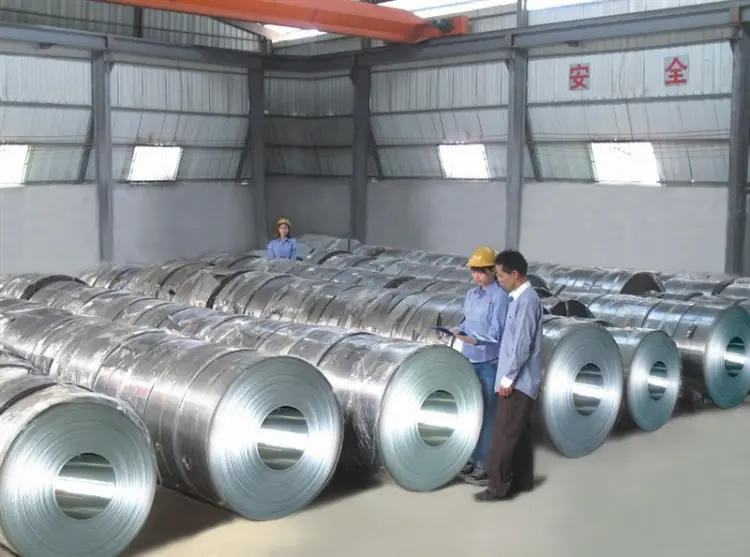
StE285 Carbon and Low-alloy High-strength Steel Coil per DIN 17102
StE285 Carbon and Low-alloy High-strength Steel Coil per DIN 17102 |
Complete material data for StE285 structural steel according to DIN 17102. Explore chemical composition, mechanical properties, thermal & electrical characteristics, international equivalents, and typical applications of this fine-grain low-alloy high-strength steel coil.
Welding, bending, cold forming, hot forming, machining, thermal cutting
- Phone : +8618037372205
- Email : [email protected]
- WhatsApp: Contact via Whtsapp
- WeChat: +8618037372205
StE285 Carbon and Low-alloy High-strength Steel Coil per DIN 17102 Introduction
StE285 is a weldable fine-grain structural steel with a minimum yield strength of 285 MPa, originally standardized under DIN 17102 (withdrawn, superseded by EN 10025-3). It belongs to the low-alloy, high-strength normalized steel grades suitable for welded structures subjected to static and dynamic loads. The material offers good toughness, excellent weldability, and reliable cold formability, making it ideal for structural components in mechanical engineering, steel construction, bridge building, and vehicle manufacturing. The designation StE285 reflects a minimum upper yield strength of 285 N/mm² in the hot-rolled and normalized condition. Its fine-grain microstructure ensures uniform mechanical properties and enhanced resistance to brittle fracture.
- Typical delivery condition: normalized rolled or normalized
- Available as coils, plates, strips, and wide flats
- Suitable for welding according to standard procedures
StE285 Carbon and Low-alloy High-strength Steel Coil per DIN 17102 Chemical Composition
The chemical composition of StE285 per DIN 17102 ensures fine-grain structure and weldability. The values listed are maximum limits unless a range is indicated. For thicknesses >100 mm, slightly higher alloying may be agreed. Phosphorus and sulfur are kept low for improved cleanliness and toughness.
- All elements contribute to the specified mechanical properties after normalization.
- Fine-grain elements (Al, Nb, V, Ti) are added singly or in combination.
| Element | Value (max %) | Remarks |
|---|---|---|
| Carbon (C) | 0.18 | Ladle analysis; for thickness >100 mm, max 0.20 agreed |
| Silicon (Si) | 0.50 | |
| Manganese (Mn) | 1.00–1.60 | Range guaranteed |
| Phosphorus (P) | 0.025 | For all product thicknesses |
| Sulfur (S) | 0.020 | |
| Aluminium (Al, total) | ≥0.02 | Soluble aluminium or equivalent fine-grain practice |
| Niobium (Nb) | 0.05 | Optional grain-refining element |
| Vanadium (V) | 0.10 | Optional grain-refining element |
| Titanium (Ti) | 0.03 | Optional grain-refining element |
| Nitrogen (N) | 0.012 | If high N is used, binding by nitride formers required |
| Copper (Cu) | 0.30 | Residual element (not deliberately added) |
| Chromium (Cr) | 0.30 | Residual element |
| Nickel (Ni) | 0.30 | Residual element |
| Molybdenum (Mo) | 0.10 | Residual element |
StE285 Carbon and Low-alloy High-strength Steel Coil per DIN 17102 Thermal and Electrical Physical Properties
Physical properties are representative for low-alloy structural steels of this class. Actual values may vary slightly depending on exact composition and heat treatment. Temperature dependency is given for key properties.
- The alloy is primarily designed for structural integrity, not for electrical or thermal conduction applications.
- Values below are derived from EN literature and typical data for normalized fine-grain steels.
| Property | Value | Unit | Test Condition |
|---|---|---|---|
| Density (ρ) | 7.85 | g/cm³ | at 20°C |
| Elastic modulus (E) | 210 | GPa | at 20°C (tensile) |
| Shear modulus (G) | 81 | GPa | at 20°C (calculated from E, ν) |
| Poisson's ratio (ν) | 0.3 | – | in elastic range |
| Coefficient of thermal expansion (α) | 11.1 | 10⁻⁶/K | 20–100°C |
| Coefficient of thermal expansion (α) | 12.0 | 10⁻⁶/K | 20–200°C |
| Coefficient of thermal expansion (α) | 13.0 | 10⁻⁶/K | 20–400°C |
| Thermal conductivity (λ) | 55 | W/(m·K) | at 20°C |
| Thermal conductivity (λ) | 51 | W/(m·K) | at 100°C |
| Specific heat capacity (cp) | 460 | J/(kg·K) | at 20°C |
| Electrical resistivity (ρ_e) | 0.18 | 10⁻⁶ Ω·m | at 20°C (≈ 0.18 µΩ·m) |
StE285 Carbon and Low-alloy High-strength Steel Coil per DIN 17102 Mechanical Properties
Tensile properties are based on the normalized condition (+N) at ambient temperature. Impact energy values are guaranteed for fine-grain steels and measured on Charpy-V specimens. The yield strength is the upper yield point (ReH). For thicknesses not listed, linear interpolation is permitted.
- At elevated temperatures up to 200°C, yield strength reduction approx. 10% per 100°C rise is typical.
- Bend test: mandrel diameter = 3t (tensile face until 180° without cracks).
| Property | Value | Unit | Test Condition |
|---|---|---|---|
| Upper yield strength (ReH) | ≥285 | MPa | nominal thickness (t) ≤ 16 mm |
| Upper yield strength (ReH) | ≥275 | MPa | 16 < t ≤ 35 mm |
| Upper yield strength (ReH) | ≥265 | MPa | 35 < t ≤ 50 mm |
| Upper yield strength (ReH) | ≥255 | MPa | 50 < t ≤ 70 mm |
| Tensile strength (Rm) | 440 – 570 | MPa | t ≤ 50 mm |
| Tensile strength (Rm) | 420 – 550 | MPa | 50 < t ≤ 70 mm |
| Tensile strength (Rm) | 400 – 540 | MPa | 70 < t ≤ 100 mm |
| Elongation after fracture (A) | ≥22 | % | t ≤ 16 mm, L₀ = 5.65√S₀ |
| Elongation after fracture (A) | ≥21 | % | 16 < t ≤ 35 mm, L₀ = 5.65√S₀ |
| Elongation after fracture (A) | ≥20 | % | 35 < t ≤ 50 mm, L₀ = 5.65√S₀ |
| Elongation after fracture (A) | ≥18 | % | 50 < t ≤ 70 mm, L₀ = 5.65√S₀ |
| Impact energy (KV₂) | ≥27 | J | longitudinal, at -20°C |
| Impact energy (KV₂) | ≥27 | J | longitudinal, at -50°C (when -50°C option required) |
| Bend test (180°) | No cracks | – | Mandrel diameter = 3t (t ≤ 50 mm); tensile face |
StE285 Carbon and Low-alloy High-strength Steel Coil per DIN 17102 Directly Equivalent Material Standards and Substitutions
| Country / Region | Standard | Grade | Remarks |
|---|---|---|---|
| Europe | EN 10025-3 | S275N | Normalized fine-grain steel; minimum RₑH = 275 MPa when t≤16 mm; impact 27 J at -20°C (N) or -50°C (NL) |
| Europe | EN 10025-3 | S275NL | Low-temperature variant; impact at -50°C; identical mechanical properties |
| International | ISO 4950-2 | E 285 | High yield strength flat products; normalized delivery; similar chemical and mechanical requirements |
| Germany (obsolete) | SEw 092 | StE 285 | Former technical delivery conditions; precursor of DIN 17102 |
StE285 Carbon and Low-alloy High-strength Steel Coil per DIN 17102 Application Introduction
StE285 steel is designed for load-bearing welded structures requiring high strength-to-weight ratios and reliable toughness at sub-zero temperatures. It is favored in applications where normalized fine-grain structure ensures homogeneous mechanical properties and freedom from internal defects. The steel is readily processed by hot and cold forming, flame cutting, and all common arc welding methods.
- Preheating usually not required for thicknesses up to 30 mm, but recommended for thicker sections.
- Post-weld heat treatment (PWHT) may be applied for stress relief.
Product Applications: Welded I‑beams, H‑beams, box girders, Bridge decks and truss structures, Mobile crane telescopic booms and chassis, Excavator buckets, arms, and frames, Offshore platform structural modules, Pressure vessel shells (non-high temperature), Wind turbine tower sections and flanges, Railway vehicle underframes and bogies
Processed into products: Flanges and webs in plate girders, Gusset plates and stiffeners, Welded tubular columns and truss chords, Pinned connections and eye‑bars, Load‑bearing base plates and brackets, Frame rails for heavy trucks, Turntable rings and slewing bearings housings, Adapter plates and transition pieces in welded nodes
Application industries: Steel and bridge construction, Heavy machinery and earth-moving equipment, Shipbuilding and offshore platforms, Wind turbine towers and components, Pressure vessel and boiler fabrication, Vehicle and railcar manufacturing, Agricultural and forestry machinery, Crane and lifting equipment
StE285 Carbon and Low-alloy High-strength Steel Coil per DIN 17102 Similar / Alternative Materials
| Country / Region | Standard | Grade | Remarks |
|---|---|---|---|
| United States | ASTM A572 / A572M | Grade 50 [345] or 42 [290] | Grade 42 is close in strength (ReH ≥290 MPa for t≤100 mm); requires normalization for comparable toughness |
| Japan | JIS G3106 | SM490A | ReH≥325 MPa (t≤16 mm); higher Mn, similar weldability; often used as substitute for StE285 |
| China | GB/T 1591 | Q345C or D | Higher yield strength (345 MPa); normalizing optional; impact temperature C=0°C, D=-20°C |
| United Kingdom (obsolete) | BS 4360 | Grade 50 C or D | ReH≥355 MPa; comparable fine-grain practice; requires detailed thickness match |
| Russia | GOST 19281 | 17G1S | Mn-Si low-alloy; normalized; ReH≥245-265 MPa depending on thickness; often used in bridges |
Notes:
Important note: DIN 17102 has been withdrawn and replaced by EN 10025-3. The closest modern designation is S275N, which offers nearly identical chemical and mechanical properties. When ordering StE285, it is recommended to use the EN 10025-3 specification and request S275N or S275NL, optionally with +N condition. For improved atmospheric corrosion resistance, consider fine-grain steels of Fe‑grades or weathering types. All data provided are for information and typical values; for design purposes, refer to the latest applicable standards and approved material certificates.
- Share



