
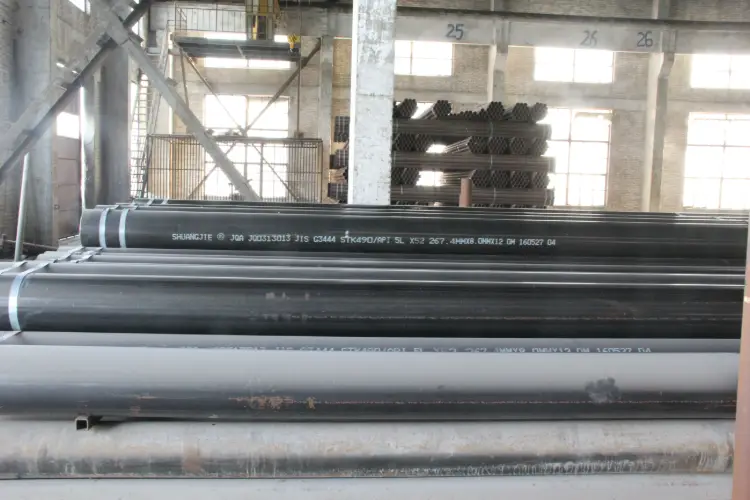
API 5L X52 PSL2 LSAW Pipe: HSLA Steel for Energy Pipelines
API 5L X52 PSL2 LSAW Pipe: HSLA Steel for Energy Pipelines - Data & Equivalents
Technical data sheet for API 5L X52 PSL2 LSAW pipe. Includes chemical composition, mechanical and physical properties, international equivalents, and application guidance.
Longitudinal Submerged Arc Welding (LSAW) using UOE/JCOE forming, followed by mechanical expansion, hydrostatic testing, and NDT. Can be supplied in Normalized or Thermo-Mechanically Controlled Processed (TMCP) condition.
- Phone : +8618037372205
- Email : [email protected]
- WhatsApp: Contact via Whtsapp
- WeChat: +8618037372205
API 5L X52 PSL2 LSAW Pipe: HSLA Steel for Energy Pipelines Introduction
API 5L X52 PSL2 LSAW pipe is a high-strength low-alloy (HSLA) steel product manufactured in accordance with the American Petroleum Institute specification 5L, Product Specification Level 2. The designation 'X52' indicates a minimum yield strength of 52,000 psi (359 MPa), and 'LSAW' refers to Longitudinal Submerged Arc Welded pipe, a fabrication method ideal for large-diameter, thick-wall pipelines. PSL2 imposes stricter requirements than PSL1 for chemical composition, notch toughness, and non-destructive testing, making this grade essential for critical oil and gas transportation systems. Its balanced chemistry allows superior weldability and resistance to brittle fracture in low-temperature environments.
API 5L X52 PSL2 LSAW Pipe: HSLA Steel for Energy Pipelines Chemical Composition
The chemical composition of API 5L X52 PSL2 LSAW pipe is tightly controlled to ensure mechanical properties and weldability. The carbon equivalent (CEIIW) is limited to a maximum of 0.43% to prevent cold cracking during installation welding. Low sulfur and phosphorus contents enhance resistance to sulfide stress cracking.
| Element | Composition (max %) | Notes |
|---|---|---|
| C | 0.22 | Carbon, essential for strength but limited for weldability |
| Si | 0.45 | Silicon, deoxidizer |
| Mn | 1.40 | Manganese, contributes to strength and toughness |
| P | 0.025 | Phosphorus, controlled to avoid embrittlement |
| S | 0.015 | Sulfur, controlled for sulfide stress cracking resistance |
| V | 0.05 | Vanadium, micro-alloying element |
| Nb | 0.05 | Niobium, micro-alloying element |
| Ti | 0.06 | Titanium, micro-alloying element |
| CE(IIW) | 0.43 (typical limit) | Carbon Equivalent = C + Mn/6 + (Cr+Mo+V)/5 + (Ni+Cu)/15 |
| V+Nb+Ti | ≤ 0.15 | Total micro-alloying limit for PSL2 |
API 5L X52 PSL2 LSAW Pipe: HSLA Steel for Energy Pipelines Physical, Thermal and Electrical Properties
These physical properties are representative of HSLA X52 pipeline steel at ambient and elevated temperatures. The values are critical for pipeline design calculations involving thermal expansion loops, heat transfer, and cathodic protection system design.
| Property | Typical Value | Unit | Condition |
|---|---|---|---|
| Density (ρ) | 7.85 | g/cm³ | At 20°C |
| Modulus of Elasticity (E) | 205 | GPa | At 20°C, static/dynamic |
| Shear Modulus (G) | 80 | GPa | At 20°C, calculated |
| Poisson 's Ratio (ν) | 0.30 | - | Elastic range at 20°C |
| Thermal Expansion Coefficient (α) | 11.7 × 10⁻⁶ | /K | Between 20 and 100°C |
| Thermal Expansion Coefficient (α) | 12.5 × 10⁻⁶ | /K | Between 20 and 200°C |
| Thermal Conductivity (λ) | 52 | W/(m·K) | At 100°C |
| Specific Heat Capacity | 486 | J/(kg·K) | Between 20 and 100°C |
| Electrical Resistivity (ρ_e) | 0.22 × 10⁻⁶ | Ω·m | At 20°C |
API 5L X52 PSL2 LSAW Pipe: HSLA Steel for Energy Pipelines Mechanical Properties
Mechanical properties are tested on the pipe body (transverse direction) according to API 5L 46th Edition. Tensile and impact tests are mandatory for PSL2 qualification. The yield to tensile (Y/T) ratio is limited to ensure sufficient plastic strain capacity for strain-based design applications.
| Property | Required Value | Unit | Test Condition |
|---|---|---|---|
| Yield Strength (Rt0.5) | 359 - 530 | MPa | 0.5% total extension, transverse strip specimen, room temperature |
| Tensile Strength (Rm) | 455 - 758 | MPa | Transverse strip specimen, room temperature |
| Yield to Tensile Ratio (Rt0.5/Rm) | 0.93 max | - | As measured |
| Elongation (A) | ≥ 22 (typical for common WT) | % | Gauge length 50 mm, transverse; calculated by API formula |
| Charpy V-notch Impact (KV) | ≥ 27 (average of 3) | J | Transverse specimen, 0°C (32°F), single min 22 J |
| Shear Area (DWTT) | ≥ 85 (if specified) | % | For large diameter gas pipes (optional requirement) |
| Maximum Hardness | ≤ 235 (22 HRC) | HBW | Applicable for sour service per NACE MR0175, if ordered |
API 5L X52 PSL2 LSAW Pipe: HSLA Steel for Energy Pipelines Exact Equivalent International Standards & Substitute Grades
| Country/Region | Standard | Designation | Notes |
|---|---|---|---|
| International | ISO 3183 | L360 (PSL 2) | Dimensionally and chemically identical to API 5L X52 |
| Europe | EN 10208-2 | L360MB | TMCP/deoxidized equivalent; PSL2 corresponds to Annex M requirements |
| China | GB/T 9711 | L360 | Equivalent to ISO 3183 and API 5L; widely used in West-East Gas Pipeline |
| Canada | CSA Z245.1 | Grade 359 Cat II | Harmonized with API 5L PSL2 for sour/non-sour service |
| Russia | GOST R 52079 | K52 | Russian maritime/gas pipeline standard equivalent |
API 5L X52 PSL2 LSAW Pipe: HSLA Steel for Energy Pipelines Application Introduction
API 5L X52 PSL2 LSAW pipe is the backbone of midstream energy infrastructure. Its high strength-to-weight ratio and excellent low-temperature ductility make it the preferred choice for high-pressure transmission networks crossing remote and harsh environments. The LSAW process ensures precise geometry and reliable weld quality for critical girth welds during field construction.
Product Applications: Cross-country onshore trunk pipelines (gas and liquids), Subsea flowlines and export pipelines, High-pressure gas distribution spools, Oil gathering and injection lines, Station piping in compressor and pump stations, Deep-water risers (sweet service)
Processed into products: Straight pipe bodies and longitudinal weld seams, Hot induction bends (matching grade: X52 or equivalent), Welded split tees and hot tap fittings, Anchor flanges, swivel ring flanges, and insulation joints, Cold-formed elbows (radius ≥ 5D per API 5L limitations), Line pipe reducers and end caps, Manifold trunnions and scraper trap barrels
Application industries: Onshore and Offshore Oil & Gas Transportation, Petrochemical Refineries, Long-Distance Water Supply Systems, Offshore Platform Engineering, Structural Piling and Construction
API 5L X52 PSL2 LSAW Pipe: HSLA Steel for Energy Pipelines Similar or Closely Related Materials
| Country/Region | Standard | Designation | Notes |
|---|---|---|---|
| USA | ASTM A106 / A53 | Grade B | Seamless carbon steel pipe with similar tensile (415 MPa min) but higher C content; not PSL2 certified, lacks mandatory CVN testing |
| EU | EN 10217-1 | P355N | Structural pressure vessel steel with similar yield but different delivery conditions and chemical restrictions |
| Global | API 5L | X60 (L415) | Higher strength alternative (415 MPa min yield); suitable for upgrading flow capacity or reducing wall thickness |
| USA | ASTM A333 | Grade 6 | Low-temperature service carbon steel with similar toughness but lower tensile strength, used for cryogenic piping |
Notes:
Special Requirements: For sour service (H₂S containing environments), the material must comply with NACE MR0175 / ISO 15156 with supplementary HIC (Hydrogen Induced Cracking) and SSC (Sulfide Stress Cracking) testing. A hardness maximum of 22 HRC (235 HBW) applies. The LSAW pipe must be 100% inspected by ultrasonic or radiographic methods for the weld seam. PSL2 standard requires a minimum average Charpy value of 27 J at the design temperature (typically 0°C for standard projects, lower for Arctic grades).
- Share



