
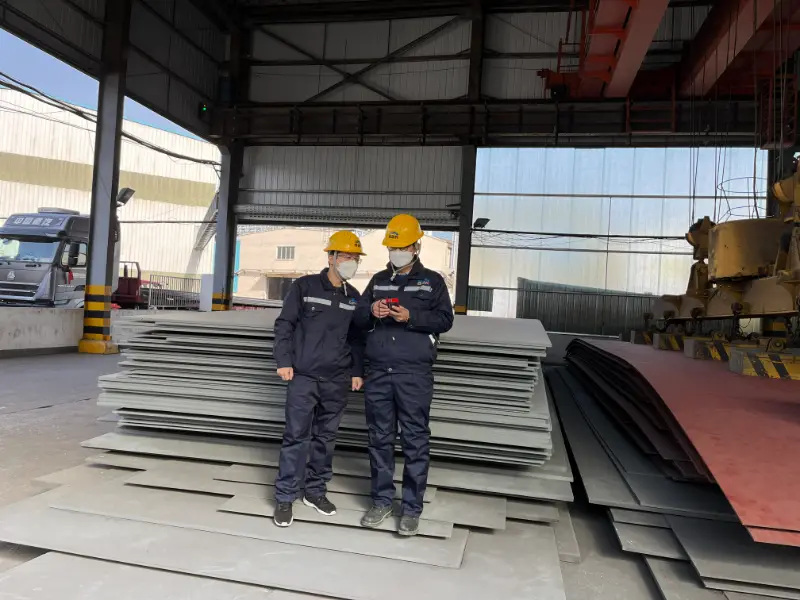
EStE255 Automobile Structure Steel Plate
EStE255 Automobile Structure Steel Plate: DIN 17102 Fine Grain Steel
In-depth data sheet of EStE255 steel according to DIN 17102: chemical composition, mechanical & thermal properties, international equivalents, and application in automotive structural components.
Hot rolling, normalizing, cold forming, welding, flame/plasma/laser cutting
- Phone : +8618037372205
- Email : [email protected]
- WhatsApp: Contact via Whtsapp
- WeChat: +8618037372205
EStE255 Automobile Structure Steel Plate Introduction
EStE255 is a weldable normalized fine grain structural steel defined by the German standard DIN 17102, specifically tailored for automobile structure applications. It features a minimum yield strength of 255 MPa (for thickness ≤16 mm) combined with excellent weldability, good cold formability, and reliable toughness at sub-zero temperatures. The fine grain structure, achieved through aluminum deoxidation and controlled rolling/normalizing, ensures high resistance to brittle fracture. This grade is widely used in chassis frames, longitudinal beams, and other load-bearing parts of commercial vehicles, offering a balanced performance profile. Key characteristics:
- Minimum yield strength 255 MPa
- Tensile strength 360–480 MPa
- Good impact toughness at -20 °C
- Excellent suitability for welding and forming
EStE255 Automobile Structure Steel Plate Chemical Composition
The chemical composition conforms to DIN 17102 for EStE255. Fine grain treatment is ensured by a sufficient amount of aluminum or other grain-refining elements. Key aspects:
- Low carbon content for good weldability.
- Controlled sulfur and phosphorus levels to enhance cleanliness.
- Optional microalloying with niobium, vanadium, or titanium for strength and toughness.
Values shown are maximum unless a range is specified. Aluminum content is given as total aluminum.
| Element | Standard Value (wt%) | Remarks |
|---|---|---|
| Carbon (C) | ≤ 0.20 | Ladle analysis |
| Silicon (Si) | ≤ 0.50 | |
| Manganese (Mn) | 0.50 – 1.50 | |
| Phosphorus (P) | ≤ 0.035 | For thickness ≤ 63 mm |
| Sulfur (S) | ≤ 0.030 | For thickness ≤ 63 mm |
| Aluminum (Al_total) | ≥ 0.020 | Fine grain element, typical |
| Niobium (Nb) | ≤ 0.05 | Optional, microalloyed grades |
| Vanadium (V) | ≤ 0.05 | Optional, microalloyed grades |
| Titanium (Ti) | ≤ 0.03 | Optional, microalloyed grades |
| Nitrogen (N) | ≤ 0.012 | Typical, not always specified |
| Chromium (Cr) | ≤ 0.30 | Residual |
| Nickel (Ni) | ≤ 0.30 | Residual |
| Copper (Cu) | ≤ 0.35 | Residual |
| Molybdenum (Mo) | ≤ 0.08 | Residual |
EStE255 Automobile Structure Steel Plate Thermal and Electrical Physical Properties
Physical properties at room temperature (20 °C) unless otherwise indicated. These values are typical for low‑carbon fine grain structural steel and are suitable for engineering calculations. Note:
- Thermal expansion coefficient is given as a mean value between 20 °C and the specified temperature.
- Specific heat capacity increases with temperature; values shown are for room temperature.
- Electrical resistivity is for reference at 20 °C.
| Property | Typical Value | Unit | Test Condition / Temperature |
|---|---|---|---|
| Density (ρ) | 7.85 | g/cm³ | 20 °C |
| Modulus of Elasticity (E) | 210 | GPa | 20 °C |
| Shear Modulus (G) | approx. 81 | GPa | 20 °C |
| Poisson's Ratio (ν) | 0.3 | — | Within elastic range |
| Thermal Expansion Coefficient (α) | 12.0×10⁻⁶ | 1/K | 20–100 °C |
| Thermal Expansion Coefficient (α) | 12.5×10⁻⁶ | 1/K | 20–200 °C |
| Thermal Expansion Coefficient (α) | 13.0×10⁻⁶ | 1/K | 20–300 °C |
| Thermal Conductivity (λ) | approx. 50 | W/(m·K) | 20 °C |
| Specific Heat Capacity (c) | approx. 460 | J/(kg·K) | 20 °C |
| Electrical Resistivity (ρ_e) | approx. 0.22×10⁻⁶ | Ω·m | 20 °C |
EStE255 Automobile Structure Steel Plate Mechanical Properties
Mechanical properties according to DIN 17102 at room temperature, measured on transverse test pieces for plates and wide flats. Impact energy values are based on Charpy-V longitudinal specimens. Conditions:
- All values apply to normalized condition.
- Elongation measured with proportional gauge length L₀ = 5.65√S₀.
- Impact test temperature: -20 °C (KV₂ ≥ 27 J).
Data are typical for thickness ranges as indicated.
| Property | Standard Required Value | Unit | Testing Condition |
|---|---|---|---|
| Yield Strength (ReH) | ≥ 255 | MPa | Thickness ≤ 16 mm |
| Yield Strength (ReH) | ≥ 245 | MPa | 16 mm < thickness ≤ 40 mm |
| Yield Strength (ReH) | ≥ 235 | MPa | 40 mm < thickness ≤ 63 mm |
| Tensile Strength (Rm) | 360 – 480 | MPa | Thickness ≤ 63 mm |
| Elongation (A) | ≥ 24 | % | L₀ = 5.65√S₀, thickness ≤ 16 mm |
| Elongation (A) | ≥ 23 | % | L₀ = 5.65√S₀, 16 < t ≤ 40 mm |
| Elongation (A) | ≥ 22 | % | L₀ = 5.65√S₀, 40 < t ≤ 63 mm |
| Impact Energy (KV₂) | ≥ 27 (longitudinal) | J | At -20 °C |
EStE255 Automobile Structure Steel Plate Full Equivalent Material Standards and Substitute Grades
| Country / Region | Standard | Grade | Remarks |
|---|---|---|---|
| Europe | EN 10025-3 | S275N (1.0490) | Normalized fine grain steel; yield 275 MPa min. at t≤16 mm, covers EStE255 requirements. S275NL for low temperature. |
| International | ISO 630-3 | S275N | Same as EN 10025-3. |
| USA | ASTM A572 / A572M | Grade 42 (Gr. 42) | Yield 290 MPa, tensile 415 MPa, similar application but slightly higher strength; for replacement consider overmatching strength. |
| USA | ASTM A572 / A572M | Grade 50 (Gr. 50) | Yield 345 MPa, may be an economical upgrade when higher strength is permissible. |
EStE255 Automobile Structure Steel Plate Application Introduction
EStE255 combines moderate strength with excellent toughness and weldability, making it suitable for load-bearing automotive components that are welded and subjected to dynamic stresses. Guidelines:
- Intended for normalized or normalized rolled condition.
- Excellent suitability for cold bending, roll forming, and stamping.
- Welding processes: all conventional methods (MAG, manual arc, submerged arc). Low carbon equivalent ensures minimal preheating for thicknesses up to ~30 mm.
- Galvanizing and painting provide good corrosion protection.
Product Applications: Truck chassis frames, Longitudinal and transversal beams, Axle housings and suspension brackets, Support profiles for containers, Welded structural tubing
Processed into products: Frame side members and cross members, Engine subframes, Tow bars and hitch components, Spring hangers, Stamped body reinforcements, Welded brackets and gussets, Chassis mounting plates
Application industries: Automotive (heavy trucks, trailers, buses), Agricultural machinery, Earthmoving and construction equipment, Railway wagon components, Material handling (forklifts, cranes)
EStE255 Automobile Structure Steel Plate Similar / Alternative Material Recommendations
| Country / Region | Standard | Grade | Remarks |
|---|---|---|---|
| Europe | EN 10149-3 | S260NC | Thermomechanically rolled steel for cold forming, min. yield 260 MPa; similar strength level, often used for automotive parts. |
| Germany | DIN 17102 | EStE285 | Higher strength variant (285 MPa min.) from the same standard; direct upgrade. |
| China | GB/T 1591 | Q275B | Low alloy structural steel, mechanical properties close but not fine grain guaranteed; check toughness requirements. |
| China | GB/T 3273 | B510L | Automobile structural steel with similar tensile range, often used for frames. |
| Japan | JIS G 3113 | SAPH400 | Hot-rolled automobile structural steel, tensile ≥400 MPa, higher strength alternative. |
| Japan | JIS G 3134 | SPFH490 | High strength hot-rolled steel sheet for automobile use, higher strength but good formability. |
Notes:
Additional information:
- DIN 17102 is withdrawn and replaced by EN 10025-3. For new designs, S275N should be specified. However, EStE255 may still be supplied for spare parts or existing specifications.
- The steel can be delivered with increased copper content (e.g., 0.25–0.35%) for improved atmospheric corrosion resistance.
- Impact test temperature can be agreed upon; -20 °C is standard; -40 °C can be achieved with a fine grain practice and controlled impurity levels.
- Ultrasonic testing (UT) to EN 10160 or equivalent is often required for safety‑critical parts.
- Share



