
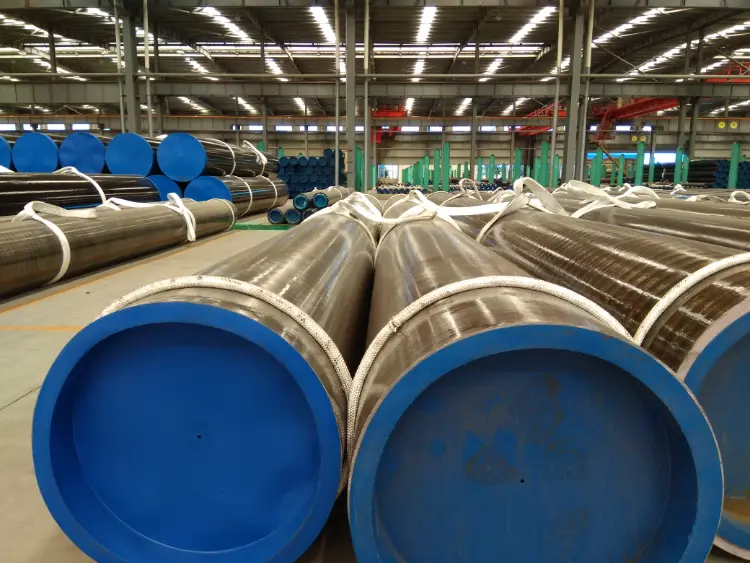
API 5L PSL1 X70 (L485) Pipeline Steel
API Spec 5L PSL1 X70 (L485) Pipeline Steel Plate – High-Strength Line Pipe Material
Detailed technical data for API 5L PSL1 X70 (L485) pipeline steel plate including chemical composition, mechanical properties, thermal properties, international equivalents and application guide.
Hot rolling, controlled rolling (TMCP), normalizing, quenching and tempering (for heavy wall), welding fabrication
- Phone : +8618037372205
- Email : [email protected]
- WhatsApp: Contact via Whtsapp
- WeChat: +8618037372205
API 5L PSL1 X70 Pipeline Steel Introduction
API Spec 5L PSL1 X70, also designated as L485, is a high-strength low-alloy (HSLA) steel grade specifically developed for oil and gas transmission pipelines. With a specified minimum yield strength of 485 MPa (70 ksi), it offers an optimum balance of strength, toughness and weldability under standard PSL1 quality requirements. Key features:
- Good formability and field weldability
- Reliable fracture resistance for large-diameter pipes
- Available in seamless and welded pipe forms
- Widely adopted in long-distance, high-pressure gas transmission systems
API 5L PSL1 X70 Pipeline Steel Chemical Composition
The chemical composition for API 5L PSL1 X70 (L485) is defined in Table 4 of the standard. Maximum limits are specified for most elements; actual production chemistry is tailored to achieve mechanical properties.
- Typical additions of Nb, V, Ti are used for grain refinement and precipitation strengthening.
- Carbon equivalent (CE) is often controlled to ensure field weldability.
| Element | Maximum, % (PSL1) | Remarks |
|---|---|---|
| C (Carbon) | 0.26 | For seamless pipe, max. C may be 0.26; for welded pipe max. 0.22 commonly used |
| Si (Silicon) | 0.45 | Specified maximum; typical 0.15–0.35 |
| Mn (Manganese) | 1.65 | Specified maximum; typical range 1.40–1.65 for X70 |
| P (Phosphorus) | 0.030 | PSL1 max. |
| S (Sulfur) | 0.030 | PSL1 max. |
| Nb (Niobium) | 0.08* | Sum Nb+V+Ti ≤ 0.15% for PSL1; individual not specified but limited by practice |
| V (Vanadium) | 0.10* | Typically controlled to avoid excessive hardening |
| Ti (Titanium) | 0.06* | Used for grain refinement; included in sum limit |
| Cu (Copper) | 0.35* | Not mandatory but commonly reported; for hydrogen-induced cracking resistance |
| Ni (Nickel) | 0.30* | Usually residual; may be specified for toughness |
| Cr (Chromium) | 0.30* | Usually residual; controlled for corrosion resistance |
| Mo (Molybdenum) | 0.15* | Residual; may be added for strength in heavy wall |
| N (Nitrogen) | 0.012* | Max. not specified but limited by steelmaking practice |
| Al (Aluminum) | 0.060* | Total Al; typical from deoxidation |
| B (Boron) | 0.0005* | Not intentionally added; residual from scrap |
| CE IIW | 0.43 typical | Not a specification limit but generally controlled for welding; CE = C+Mn/6+(Cr+Mo+V)/5+(Ni+Cu)/15 |
API 5L PSL1 X70 Pipeline Steel Thermal and Electrical Physical Properties
The following physical properties are not specified in API 5L but represent typical values for HSLA X70 steel at room temperature.
- Values may vary with actual chemical composition, heat treatment, and temperature.
- No standard specification; provided as engineering reference.
- Density and elastic modulus are essential for stress analysis and flow calculations.
| Property | Typical Value | Unit | Test Condition / Reference |
|---|---|---|---|
| Density (ρ) | 7.85 | g/cm³ | Room temperature (20°C) |
| Elastic Modulus (E) | 205 – 210 | GPa | At 20°C, longitudinal |
| Shear Modulus (G) | 80 – 82 | GPa | Calculated from E and Poisson's ratio |
| Poisson's Ratio (ν) | 0.28 – 0.30 | - | Elastic range |
| Thermal Expansion Coefficient (α) | 11.7 – 12.5 | 10⁻⁶/K | 20–200°C range |
| Thermal Conductivity (λ) | 42 – 46 | W/(m·K) | At 20°C |
| Specific Heat Capacity (cp) | 460 – 500 | J/(kg·K) | At 20°C |
| Electrical Resistivity (ρe) | 0.22 – 0.28 | μΩ·m | At 20°C |
API 5L PSL1 X70 Pipeline Steel Mechanical Properties
Mechanical properties are specified according to API 5L Table 7 for PSL1 pipe.
- Values apply to plate/skelp used for pipe (before forming) and finished pipe.
- Elongation is formula-based: A50 = 1940 * A0.2/Rm0.9, with minimum 17% for base metal.
- Toughness (Charpy V-notch) is not mandatory for PSL1 but may be required by supplementary agreement.
| Property | Requirement | Unit | Test Condition |
|---|---|---|---|
| Yield Strength (Rt0.5) | 485 – 635 | MPa | Transverse, at room temperature |
| Tensile Strength (Rm) | 570 – 760 | MPa | Transverse, at room temperature |
| Elongation after fracture (A50) | ≥ 17 (formula) | % | On 50 mm gauge length, formula in API 5L 10.2.4; typical 22–28% |
| Elongation after fracture (A200) | ≥ 21 (formula) | % | On 200 mm gauge length, for plate/strip |
| Yield-to-Tensile Ratio (Rt0.5/Rm) | ≤ 0.93 (by agreement) | - | For strain-based design applications; not mandatory for PSL1 |
| Bend Test (Mandrel diameter) | No cracks | - | 180° bend over 4t (t = specimen thickness) for thickness ≤ 19.1 mm |
| Charpy V-Notch Impact (KV) | Per purchase agreement | J | PSL1 does not mandate; typical values at 0°C: ≥ 40 J average single |
API 5L PSL1 X70 Pipeline Steel Internationally Equivalent Standards and Substitute Grades for API 5L PSL1 X70
| Country/Region | Standard | Grade | Remarks |
|---|---|---|---|
| International | ISO 3183:2019 | L485 | Identical to API 5L PSL1, same chemical and mechanical requirements |
| Europe | EN 10208-2 | L485MB | TMCP delivery condition; slight difference in CE and impact; generally interchangeable |
| China | GB/T 9711-2017 | L485M | Equivalent to PSL1; M stands for thermomechanical rolling; properties closely match |
| Russia | GOST R 55429 | К70 | Similar strength level; chemical composition may differ; need technical review |
| Norway | DNVGL-ST-F101 | S485 | For submarine pipelines; PSL1 equivalent with supplementary toughness requirements |
| Brazil | ABNT NBR 12655 | X70 | Adopts API 5L directly; same X70 designation |
API 5L PSL1 X70 Pipeline Steel Application Introduction
API 5L X70 (L485) PSL1 steel is a workhorse material for onshore pipelines. Its high strength reduces wall thickness and material cost while maintaining good field weldability and fracture resistance. Typical applications:
- Long-distance natural gas transmission lines (Class 1-3 locations)
- Crude oil and refined product pipelines
- Water injection and CO2 pipelines (when dry)
- Structural pipe for offshore jackets and piles
Product Applications: Line pipes (Spiral welded, Longitudinal welded, Seamless), Bends and elbows (hot induction bends), Tees and reducers, Flanges and fittings, Structural tubular columns
Processed into products: Main pipeline sections (buried or above ground), Offshore riser sections (when PSL2 not mandatory), Compressor and pump station yard piping, Tie-in spools and pup pieces, Casing pipes for road/rail crossings
Application industries: Oil and Gas Transmission, Pipeline Construction, Structural Engineering (Pipe Piling), Water Transport, Hydrocarbon Processing (onshore)
API 5L PSL1 X70 Pipeline Steel Comparable/Similar Steel Grades for Performance Reference
| Country/Region | Standard | Grade | Remarks |
|---|---|---|---|
| USA | API 5L PSL1 | X65 (L450) | Lower strength grade (450 MPa YS); suitable for less demanding pressure; higher ductility |
| USA | API 5L PSL1 | X80 (L555) | Higher strength grade (555 MPa YS); used in very high-pressure lines; requires stricter welding control |
| Europe | EN 10208-2 | L450MB | Similar to X65; can replace X70 with increased wall thickness; also thermomechanical |
| Europe | EN 10208-2 | L555MB | X80 equivalent; offers higher strength but lower fracture toughness than X70; check design codes |
| China | GB/T 9711 | L450M | X65 counterpart; widely available; use when pressure design allows lower strength |
| International | API 5L PSL2 | X70Q/X70M | PSL2 level provides mandatory notch toughness and lower impurity limits; direct upgrade for sour service or low temperature |
Notes:
Additional remarks:
- PSL1 ordering is based on chemical and tensile properties only; supplementary requirements (e.g., Charpy, DWTT, hardness) must be negotiated in the purchase order.
- Welding consumables should match the strength and toughness of X70; preheat may be required depending on wall thickness and carbon equivalent.
- For sour service (H2S), PSL1 X70 is generally not recommended; upgrade to PSL2 with HIC/SSC testing is advised.
- Dimensional tolerances and non-destructive testing (NDT) follow API 5L PSL1 general requirements.
- Share



