
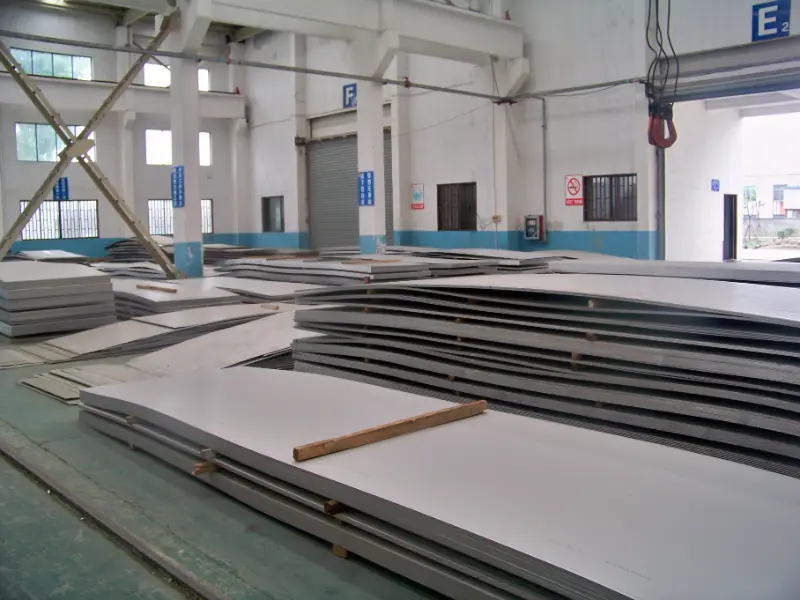
API 5L PSL1 X65 (L450) Pipeline Steel Plate
API Spec 5L PSL1 X65 (L450) Pipeline Steel Plate: Properties, Equivalents & Applications
Explore the chemical composition, mechanical properties, and equivalent grades of API 5L PSL1 X65 (L450) pipeline steel plate. Discover its applications in oil and gas transmission pipelines and structural projects.
Hot rolling, thermo-mechanical controlled rolling (TMCP), normalizing rolling, forming into welded or seamless pipes
- Phone : +8618037372205
- Email : [email protected]
- WhatsApp: Contact via Whtsapp
- WeChat: +8618037372205
API 5L PSL1 X65 Pipeline Steel Plate Introduction
API Spec 5L PSL1 X65 (L450) is a high-strength low-alloy (HSLA) steel grade designed for pipeline transportation systems in the oil and gas industry. As per API Specification 5L, it features a minimum yield strength of 450 MPa (65 ksi) and is classified under PSL 1, which represents standard quality requirements without mandatory impact testing. The material offers a balanced combination of strength, weldability, and toughness, making it suitable for both onshore and offshore line pipes. It is typically supplied in hot-rolled, normalized or thermo-mechanically controlled rolled conditions, ensuring consistent mechanical properties and good resistance to ductile fracture.
API 5L PSL1 X65 Pipeline Steel Plate Chemical Composition
The chemistry of X65 PSL 1 restricts carbon and manganese to ensure weldability and field performance. Micro-alloying elements like Nb, V, and Ti may be added individually or in combination to achieve the required strength. The phosphorus and sulfur levels are controlled for improved cleanliness and low-temperature toughness. The composition is determined by ladle analysis; product analysis tolerances are given in the standard.
| Chemical Element | Standard Values (Max, %) | Remarks |
|---|---|---|
| Carbon (C) | 0.26% | For heat analysis; for carbon equivalent see CEV & PCM limits |
| Manganese (Mn) | 1.40% | Higher Mn content is permitted if carbon equivalent is controlled |
| Phosphorus (P) | 0.030% | Low P improves resistance to brittle fracture |
| Sulfur (S) | 0.030% | Low S ensures good weldability and reduces hot tearing |
| Silicon (Si) | Reported value only (not specified as mandatory limit) | Typically 0.10–0.50% |
| Niobium (Nb) / Vanadium (V) / Titanium (Ti) | Individually ≤ 0.15% (Nb), ≤ 0.15% (V), ≤ 0.06% (Ti); sum of Nb+V+Ti ≤ 0.15% | Micro-alloying elements may be used singly or in combination |
| Copper (Cu) | Reported value only (max typically ≤ 0.50%) | Not specified as a requirement |
| Nickel (Ni) | Reported value only (max typically ≤ 0.50%) | Not specified as a requirement |
| Chromium (Cr) | Reported value only (max typically ≤ 0.50%) | Not specified as a requirement |
| Molybdenum (Mo) | Reported value only (max typically ≤ 0.15%) | Not specified as a requirement |
| Nitrogen (N) | Reported value only (if required by agreement) | Typically ≤ 0.012% |
| Boron (B) | ≤ 0.001% unless otherwise agreed | Not intentionally added unless permitted |
| Carbon Equivalent (CEV) | Not specified in PSL 1; typical < 0.45 (dependent on thickness and practice) | CEV = C + Mn/6 + (Cr+Mo+V)/5 + (Ni+Cu)/15 |
| Pcm (cold cracking parameter) | Not specified in PSL 1; typical ≤ 0.25 for low carbon equivalent variants | Pcm = C + Si/30 + (Mn+Cu+Cr)/20 + Ni/60 + Mo/15 + V/10 + 5B |
API 5L PSL1 X65 Pipeline Steel Plate Thermal and Electrical Physical Properties
These physical properties are typical for low-alloy carbon-manganese steel similar to X65 and are not specified by API 5L. They are provided for design calculations such as thermal expansion, heat conduction, and weight estimation. Values are valid in the temperature range 20°C–400°C unless stated otherwise.
| Property | Typical Value | Unit | Test Conditions / Remarks |
|---|---|---|---|
| Density (ρ) | 7.85 | g/cm³ | Room temperature |
| Elastic Modulus (E) | 210 | GPa | At 20°C |
| Shear Modulus (G) | 80 | GPa | Calculated from E and ν |
| Poisson's Ratio (ν) | 0.3 | - | Elastic range |
| Thermal Expansion Coefficient (α) | 12.0 × 10⁻⁶ | K⁻¹ | 20°C to 100°C |
| Thermal Expansion Coefficient (α) | 13.5 × 10⁻⁶ | K⁻¹ | 20°C to 300°C |
| Thermal Conductivity (λ) | 45.0 | W/(m·K) | At 20°C |
| Thermal Conductivity (λ) | 40.0 | W/(m·K) | At 200°C |
| Specific Heat Capacity | 460 | J/(kg·K) | At 20°C |
| Specific Heat Capacity | 500 | J/(kg·K) | At 200°C |
| Electrical Resistivity (ρ_e) | 0.22 | µΩ·m | At 20°C |
API 5L PSL1 X65 Pipeline Steel Plate Mechanical Properties
The mechanical properties are determined on transverse strip specimens or taken from pipe body. Yield strength (ReH) is the 0.5% total extension under load for plate and longitudinal specimens. Tensile strength (Rm) ensures high strength, and minimum elongation reflects ductility. No mandatory Charpy impact test for PSL 1; however, guidance is given for toughness requirements when specified by purchaser.
| Property | Value | Unit | Test Conditions |
|---|---|---|---|
| Yield Strength (ReH or Rt0.5) | 450 – 600 | MPa | Transverse strip, room temperature; for pipe body |
| Tensile Strength (Rm) | 535 – 760 | MPa | Transverse strip, room temperature; for pipe body |
| Elongation after fracture (A) | Minimum 18 – 22% (depending on specimen gauge length and cross-section) | % | Gauge length 50 mm (2 in) or 5.65√So; transverse strip |
| Yield to Tensile Ratio (ReH/Rm) | ≤ 0.93 (commonly observed) | - | Not a mandatory requirement, but often required for pipe forming |
| Charpy V-notch Impact Energy (KV) | Not mandatory for PSL 1 (agreed value if required) | J | Temperature as agreed; typical minimum 27 J at 0°C for supplementary requirement |
| Hardness | ≤ 22 HRC or equivalent (typical for base metal) | HRC | Not specified in API 5L PSL 1; for sour service higher toughness may apply |
| Bend Test (180° guided bend) | No cracking; diameter based on thickness (e.g., 3t for t ≤ 12.7 mm) | - | For pipe weld procedure qualification; not mandatory for plate |
API 5L PSL1 X65 Pipeline Steel Plate Completely Equivalent Material Standards and Substitutable Grade Designations
| Country/Region | Standard | Grade | Remarks |
|---|---|---|---|
| International/ISO | ISO 3183 | L450, PSL 1 | Identical technical delivery conditions |
| China | GB/T 9711 | L450 (PSL 1) | Equivalent to API 5L X65 |
| Europe | EN 10208-2 | L450MB (with some qualification differences for PSL 1 concept) | Mechanically equivalent, though EN standard has separate requirements |
| USA | API 5L (identical) | X65 (PSL 1) or L450 | Original designation |
| Russia/CIS | GOST R 53380 | K65 (if comparable to L450) | Depending on specification level |
| India | IS 10577 | X65 (if harmonized with API 5L) | National standard adopting API grade |
API 5L PSL1 X65 Pipeline Steel Plate Application Introduction
API 5L X65 (L450) PSL 1 steel plate is widely employed in longitudinal or spiral welded pipes for conveying liquid and gaseous hydrocarbons. The material's high strength-to-weight ratio allows for thinner wall pipes, reducing material and transportation costs. It is suitable for moderate sour service if additional HIC/SSC testing is performed. Common applications span from gathering lines to transmission mains in both onshore and offshore environments.
Product Applications: Long-distance crude oil and natural gas transmission pipelines, High-pressure gas distribution networks, Subsea flowlines and risers, Gas gathering systems, Water injection lines, Structural piping for bridges and buildings
Processed into products: Line pipe (SAW, ERW, seamless) up to X65 grade, Pipe fittings (elbows, tees, reducers) bent or welded from plate, Flanges and connectors machined from plate according to ASTM A694 F65, Pressure vessel shells when fabricated from plate with supplementary requirements, Caisson pipes and structural tubular members, Anchor flanges and pile sleeves in offshore jackets
Application industries: Oil & Gas Exploration and Production, Pipeline Infrastructure Construction, Petrochemical and Refinery Plants, Water Transportation and Distribution, Mining Slurry Pipelines, Offshore Platform Structures
API 5L PSL1 X65 Pipeline Steel Plate Similar or Close Alternative Material Recommendations
| Country/Region | Standard | Grade | Remarks |
|---|---|---|---|
| International | ISO 3183 | L450 (PSL 2) | Stronger chemical and toughness requirements but similar yield strength |
| USA | ASTM A694 | F65 (forged flanges and fittings) | Comparable mechanical properties but different product form |
| Europe | EN 10028-3 | P460NL2 (similar strength, normalized fine grain steel for pressure purposes) | Not a pipeline steel but can be considered for structural applications |
| China | GB/T 1591 | Q460C/D/E (HSLA structural steel with min yield 460 MPa) | Different chemistry and intended use, but similar strength level |
| Japan | JIS G 3106 | SM570 (yield ≥460 MPa for thicker plates) | Weldable structural steel with comparable strength range |
Notes:
Additional Information:
- PSL 1 vs. PSL 2: PSL 1 has less stringent requirements for chemistry and mechanical properties compared to PSL 2, which includes mandatory Charpy impact testing, carbon equivalent limits, and stricter sulfur/phosphorus control. X65 PSL 1 is often used where codes do not require low-temperature toughness guarantees.
- Delivery Conditions: Plates are typically supplied in the as-rolled or thermo-mechanically controlled rolled (TMCP) condition to achieve fine grain size and enhanced toughness.
- Weldability: X65 has good weldability using conventional arc welding processes, though preheat and interpass temperature control may be needed for thick sections to avoid hydrogen-induced cracking.
- Sour Service: For H2S-containing environments, additional qualification according to NACE MR0175/ISO 15156 is required; PSL 1 materials are not pre-qualified for sour service unless specifically tested.
- Certificates: Mill test certificates according to EN 10204 type 3.1 or 3.2 are usually supplied.
- Share



