
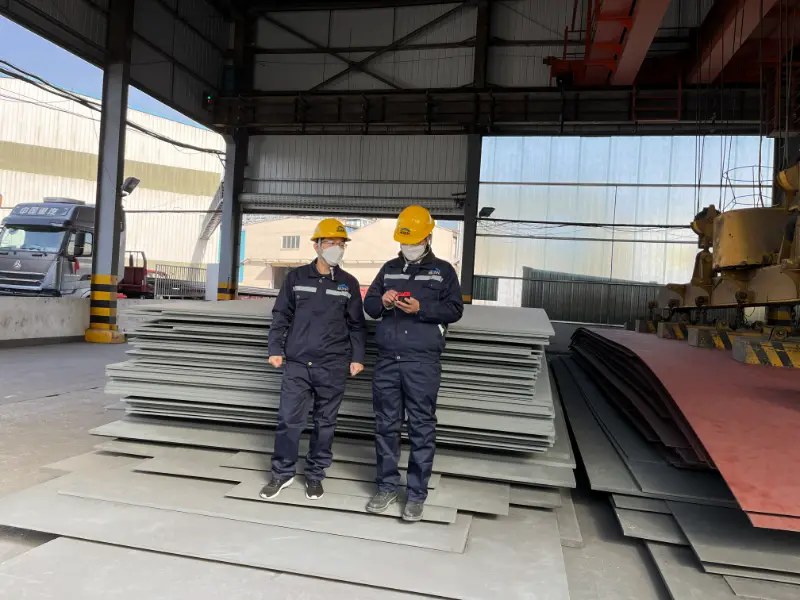
API 5L X60 (L415) PSL1 Pipeline Steel Plate
API 5L X60 (L415) PSL1 Pipeline Steel Plate - Properties & Specifications
Comprehensive material data for API 5L X60 (L415) PSL1 pipeline steel plate, including chemical composition, mechanical and thermal properties, equivalent grades, and applications.
Hot Rolling, Thermomechanical Controlled Processing (TMCP), Normalizing, Normalizing and Tempering
- Phone : +8618037372205
- Email : [email protected]
- WhatsApp: Contact via Whtsapp
- WeChat: +8618037372205
API 5L X60 PSL1 Pipeline Steel Plate Introduction
API 5L X60 (L415) PSL1 is a high-strength low-alloy steel designed for welded line pipe used in oil, gas and water transmission systems. It is manufactured according to the American Petroleum Institute's Specification 5L, Product Specification Level 1 (PSL1), which defines basic requirements for chemical composition, tensile properties and dimensions. The designation "L415" directly indicates the minimum yield strength of 415 MPa (60 ksi). This grade offers an optimal combination of strength, weldability and cost-effectiveness for moderate service environments.
- Nominal minimum yield strength of 415 MPa
- Good toughness for ambient and elevated temperatures
- Weldable by standard arc welding processes
- Available in plate, coil and pipe forms
- Used extensively in onshore and offshore pipeline projects
Typical delivery conditions include as‑rolled, thermomechanically rolled or normalized. Supplementary requirements, such as restricted chemistry or additional impact testing, may be agreed between manufacturer and purchaser.
API 5L X60 PSL1 Pipeline Steel Plate Chemical Composition
Chemical limits are in accordance with API Spec 5L, 46th Edition, Table 2, for PSL 1 pipe with wall thickness t ≤ 25.0 mm. Only the elements specified below have maximum limits; other elements may be present but must be agreed between manufacturer and purchaser. Microalloying additions (Nb, V, Ti) are often used to refine grain size, and their sum is controlled when agreed.
| Chemical Element | Standard Value (wt.%) | Remarks |
|---|---|---|
| Carbon (C) | ≤ 0.26% | Maximum; for improved weldability, lower carbon variants may be supplied |
| Manganese (Mn) | ≤ 1.40% | Maximum |
| Phosphorus (P) | ≤ 0.030% | Maximum |
| Sulfur (S) | ≤ 0.030% | Maximum |
| Niobium (Nb) + Vanadium (V) + Titanium (Ti) | ≤ 0.06% | By agreement; total microalloy limit for grades > X52 |
API 5L X60 PSL1 Pipeline Steel Plate Thermal and Electrical Physical Properties
Physical properties listed below are generic for low‑alloy carbon‑manganese steel grades such as X60 and are not stipulated by API 5L. They are provided as engineering reference values at room temperature unless otherwise noted.
| Property | Standard Required Value | Unit | Test Condition |
|---|---|---|---|
| Density (ρ) | 7.85 | g/cm³ | Room temperature |
| Elastic Modulus (E) | 200 | GPa | Room temperature |
| Shear Modulus (G) | 77 | GPa | Calculated from E and ν |
| Poisson's Ratio (ν) | 0.30 | — | Room temperature |
| Thermal Expansion Coefficient (α) | 12.0 × 10⁻⁶ | /K | 20–100 °C |
| Thermal Conductivity (λ) | 50 | W/m·K | Room temperature |
| Specific Heat Capacity | 460 | J/kg·K | Room temperature |
| Electrical Resistivity (ρe) | 0.15 | μΩ·m | Room temperature |
API 5L X60 PSL1 Pipeline Steel Plate Mechanical Properties
Mechanical properties are determined on specimens taken from the pipe body or from a test plate of the same heat. Requirements follow API 5L for PSL1. Only tensile properties are mandatory; bend and impact tests are not required by the base specification but can be specified by supplementary agreement. Elongation is calculated using the API 5L formula: Amin = 1940 · S0.2 / U0.9, where S is the actual tensile strength (MPa) and U is the specified minimum tensile strength (520 MPa).
| Property | Standard Required Value | Unit | Test Condition |
|---|---|---|---|
| Yield Strength (ReH) | ≥ 415 | MPa | Transverse specimen, 0.5% total extension under load |
| Tensile Strength (Rm) | 520 – 760 | MPa | Transverse specimen, full‑thickness strip or round bar |
| Elongation (A) | ≥ 22 (typical) | % | 50 mm gauge length; exact minimum per API 5L formula |
| Yield to Tensile Ratio (ReH/Rm) | ≤ 0.93 (indicative) | — | Not required by PSL1; reported for information |
API 5L X60 PSL1 Pipeline Steel Plate Fully Equivalent Material Standards and Replaceable Grades
| Country/Region | Standard | Grade | Remarks |
|---|---|---|---|
| International | ISO 3183 | L415 | PSL 1 (or single PSL) equivalent to X60 |
| Europe | EN 10208-2 | L415MB | For gas pipelines; L415NB may also be available |
| China | GB/T 9711 | L415 | Line pipe for petroleum and natural gas industries |
| Russia | GOST R 52079 | K60 | Strength class K60 matches X60 |
| Norway | DNV OS-F101 | S415 | Submarine pipeline systems |
| Brazil | ABNT NBR 15185 | X60 | Line pipe steel |
API 5L X60 PSL1 Pipeline Steel Plate Application Introduction
API 5L X60 (L415) PSL1 steel is extensively employed in the construction of welded line pipe for transporting crude oil, natural gas and water over long distances. Its balanced mechanical properties allow reliable use in moderate environments, both onshore and offshore.
Product Applications: Welded line pipes (ERW, SAW, SSAW), Seamless line pipes, Pipe fittings (elbows, tees, reducers), Flanges, Forged valve bodies (when appropriately heat treated)
Processed into products: Long‑distance transmission pipeline segments, Gathering and distribution lines, Offshore risers and flowlines, Compressor and pump station piping, Fuel gas and instrument air piping, Structural tubular members in pipe racks and bridges
Application industries: Oil & Gas (Upstream, Midstream, Downstream), Water & Wastewater, Slurry Transport, Structural Engineering, Offshore & Marine, Power Generation (cooling water systems)
API 5L X60 PSL1 Pipeline Steel Plate Similar/Nearby Substitute Material Recommendations
| Country/Region | Standard | Grade | Remarks |
|---|---|---|---|
| USA/International | API 5L | X52 (L360) | Lower yield strength (360 MPa min); suitable for less demanding pressures |
| USA/International | API 5L | X65 (L450) | Higher yield strength (450 MPa min); for higher pressure pipelines |
| International | ISO 3183 | L450 | Higher strength grade analogous to API X65 |
| Europe | EN 10208-2 | L360MB / L450MB | Neighbouring strength levels for distribution and transmission pipelines |
| Japan | JIS G 3445 | STKM 18C | Carbon steel tube for machine structural purposes with similar strength range (typ. 440 MPa tensile) |
Notes:
PSL1 Limitations: This specification level does not mandate impact testing, normalized chemistry limits for carbon equivalent, or non‑destructive inspection to the same extent as PSL2. For critical or sour service applications, PSL2 should be considered.
Supplementry Requirements: Additional testing (e.g., Charpy V‑notch, hydrogen‑induced cracking resistance) can be specified by agreement.
Always refer to the latest edition of API Spec 5L for complete, legally binding requirements. The information provided here is for general reference and should not be used for design without consulting the original standard.
- Share



