
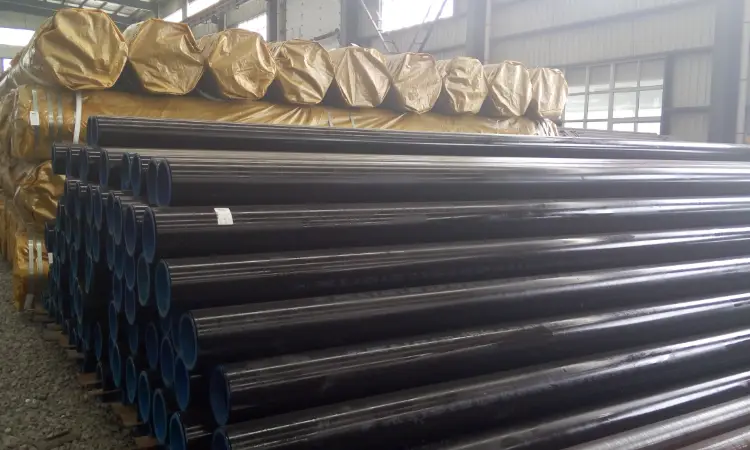
API 5L PSL2 Grade B (L245) Pipeline Steel Plate
API 5L PSL2 Grade B (L245) Pipeline Steel Plate: Properties, Equivalents & Applications
Comprehensive data sheet for API 5L PSL2 Grade B (L245) pipeline steel plate, including chemical composition, mechanical and physical properties, international equivalents, and application guidance.
Hot rolling, thermomechanical rolling, normalizing, welding, forming
- Phone : +8618037372205
- Email : [email protected]
- WhatsApp: Contact via Whtsapp
- WeChat: +8618037372205
API 5L PSL2 Grade B Pipeline Steel Plate Introduction
API 5L PSL2 Grade B (L245) is a low-carbon pipeline steel designed for high-pressure transmission of oil, gas, and water. It belongs to the PSL2 category, which imposes stricter requirements on chemical composition, mechanical properties, and non-destructive testing compared to PSL1. With a minimum yield strength of 245 MPa, it offers good weldability, reliable toughness, and suitable formability for line pipe manufacturing. Typical delivery conditions include as-rolled, normalized, or thermomechanical rolled, tailored to service conditions. The steel meets international standards and is widely used in onshore and offshore pipeline projects.
API 5L PSL2 Grade B Pipeline Steel Plate Chemical Composition
The chemical limits conform to API Spec 5L PSL2 Grade B. Maximum values are specified for carbon, manganese, phosphorus, and sulfur to ensure weldability and toughness. Silicon is controlled for welded pipe. Microalloying elements (Nb, V, Ti) may be added for grain refinement and strength, with a combined limit for seamless pipe. Carbon equivalent (CEIIW) is restricted to maintain field weldability.
| Element | Standard Value (max) | Remarks |
|---|---|---|
| Carbon (C) | 0.22 % | Seamless and welded pipe |
| Manganese (Mn) | 1.20 % | Maximum |
| Phosphorus (P) | 0.025 % | Maximum |
| Sulfur (S) | 0.015 % | Maximum |
| Silicon (Si) | 0.45 % | For welded pipe; may be agreed for seamless |
| Niobium (Nb) | sum ≤0.15 % | Total Nb+V+Ti for seamless pipe, unless otherwise agreed |
| Vanadium (V) | sum ≤0.15 % | |
| Titanium (Ti) | sum ≤0.15 % | |
| Carbon Equivalent (CEIIW) | 0.43 % | For thickness ≤25 mm; higher values for thicker sections |
API 5L PSL2 Grade B Pipeline Steel Plate Thermal & Electrical Physical Properties
The following values are typical for low‑carbon steel of this type and are not specified in API 5L. They serve as general engineering approximations and may vary slightly with exact composition and processing history.
| Property | Standard Requirement Value | Unit | Test Condition |
|---|---|---|---|
| Density (ρ) | 7.85 | g/cm³ | Room temperature |
| Elastic Modulus (E) | 205 | GPa | Room temperature |
| Shear Modulus (G) | 80 | GPa | Room temperature |
| Poisson's Ratio (ν) | 0.3 | — | Room temperature |
| Thermal Expansion Coefficient (α) | 11.7×10⁻⁶ | /K | 0–100 °C |
| Thermal Conductivity (λ) | 50 | W/(m·K) | 20 °C |
| Specific Heat Capacity | 486 | J/(kg·K) | Room temperature |
| Electrical Resistivity (ρe) | 0.16 | μΩ·m | 20 °C |
API 5L PSL2 Grade B Pipeline Steel Plate Mechanical Properties
Mechanical testing is performed on pipe body specimens according to API Spec 5L PSL2. Tensile properties are determined transverse to the pipe axis; yield strength is based on 0.5% total extension. Impact toughness is measured by Charpy V-notch tests at 0 °C. For plate intended for pipe manufacture, the same requirements apply to the final pipe.
| Property | Standard Requirement Value | Unit | Test Condition |
|---|---|---|---|
| Yield Strength (ReH) | 245–450 | MPa | Transverse, 0.5% total extension, pipe body |
| Tensile Strength (Rm) | 415–760 | MPa | Transverse, pipe body |
| Y/T Ratio (ReH/Rm) | ≤0.93 | — | Maximum |
| Elongation after fracture (A) | ≥22 | % | 2 in (50.8 mm) gauge length, longitudinal strip, typical for t ≤20 mm |
| Charpy V-notch Impact (KV) | ≥27 (average), ≥20 (single) | J | Full-size specimen, 0 °C, transverse to pipe axis |
API 5L PSL2 Grade B Pipeline Steel Plate Full Equivalent Material Standards & Replaceable Grades
| Country/Region | Standard | Grade | Remarks |
|---|---|---|---|
| International | ISO 3183 | L245 (PSL2) | Mechanical and chemical equivalence, pipe standard |
| Europe | EN 10208-2 | L245GA | Gas transmission pipelines, Charpy impact requirements aligned |
| China | GB/T 9711 | L245 (PSL2) | Petroleum and natural gas industry pipeline steel |
| Canada | CSA Z245.1 | Grade 245 Cat II | Line pipe for oil and gas industry |
| Russia | GOST 10705 | 17G1S-U | Close mechanical properties, often used for comparison |
API 5L PSL2 Grade B Pipeline Steel Plate Application Introduction
API 5L PSL2 Grade B (L245) steel plate is predominantly used for manufacturing welded line pipe for oil, gas, and water transport. The PSL2 designation ensures enhanced safety and reliability. It is suitable for sour service if ordered with supplementary requirements (e.g., HIC testing). Plates can be cut, formed, and welded into pipe, fittings, and flanges.
Product Applications: Long-distance onshore pipelines, Subsea flowlines, Pressure-containing manifolds, Pipe fittings (elbows, tees, reducers), Tanks and pressure vessels (non‑boiler)
Processed into products: Welded line pipe (spiral or longitudinal seam), Flanges and blind flanges, Valve bodies (lower pressure classes), Structural support members for pipelines, Pig launchers / receivers
Application industries: Oil & gas transmission, Petrochemical refining, Water treatment and distribution, Structural engineering (secondary applications), Offshore platform piping
API 5L PSL2 Grade B Pipeline Steel Plate Similar / Alternative Material Recommendations
| Country/Region | Standard | Grade | Remarks |
|---|---|---|---|
| International | API 5L | PSL2 X42 (L290) | Slightly higher strength (YS 290 MPa), improved toughness |
| International | API 5L | PSL1 Grade B | Relaxed chemistry and testing, suitable for less critical service |
| Europe | EN 10025‑2 | S235JR / S235J0 | Structural steel with similar strength, not for pressurised pipeline service |
| China | GB/T 1591 | Q345B | Higher strength, structural grade, weldable |
Notes:
- For sour service applications, additional testing such as HIC (Hydrogen Induced Cracking) and SSC (Sulphide Stress Cracking) per NACE MR0175 is required.
- Plates are usually supplied with mill test certificates according to EN 10204 type 3.1 or 3.2.
- The maximum yield‑to‑tensile ratio (≤0.93) ensures adequate capacity for plastic deformation before fracture, a key safety requirement.
- Typical welding procedures employ low‑hydrogen electrodes and preheating to avoid hydrogen cracking; PWHT is normally not required for this grade.
- Share



