
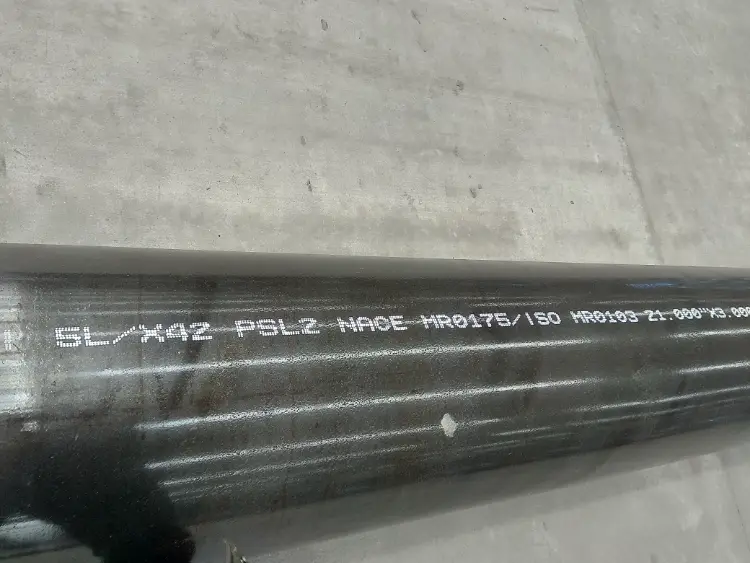
API 5L PSL2 X42 (L290) Pipeline Steel Plate
API 5L PSL2 X42 (L290) Pipeline Steel Plate – Properties, Equivalents and Applications
Comprehensive technical data for API Spec 5L PSL2 X42 (L290) pipeline steel plate including chemical composition, mechanical properties, thermal and electrical physical properties, international equivalents, and application guidance.
Hot rolling, thermomechanical controlled processing (TMCP), normalizing, cold forming (for pipes), welding (ERW, SAW, etc.)
- Phone : +8618037372205
- Email : [email protected]
- WhatsApp: Contact via Whtsapp
- WeChat: +8618037372205
API 5L PSL2 X42 Pipeline Steel Plate Introduction
API 5L PSL2 X42 (L290) is a low-alloy, high-strength pipeline steel designed for use in welded line pipes for oil and gas transmission. The designation X42 indicates a minimum yield strength of 42,000 psi (290 MPa), while L290 denotes the metric strength grade. PSL2 (Product Specification Level 2) imposes stricter chemical composition limits, mandatory notch toughness (CVN impact test), and tighter non-destructive inspection requirements compared to PSL1. The steel offers excellent weldability, good low-temperature toughness, and reliable performance under high-pressure service conditions. Typical delivery conditions include hot-rolled, thermomechanically rolled, or normalized, depending on wall thickness and end-use requirements.
API 5L PSL2 X42 Pipeline Steel Plate Chemical Composition
The chemical composition limits for API 5L PSL2 X42 (L290) are established by API Spec 5L. Carbon equivalent (CEIIW) is controlled to ensure weldability. Maximum allowed CEIIW for X42 is 0.43%. Elements not listed are subject to agreement or residual limits. All values are maximum unless a range is specified.
| Element | Maximum Value (Weight %) | Remarks |
|---|---|---|
| Carbon (C) | 0.22 | Heat analysis; for product analysis add tolerance per standard |
| Manganese (Mn) | 1.30 | |
| Phosphorus (P) | 0.025 | PSL2 limit; PSL1 allows 0.030% |
| Sulfur (S) | 0.015 | PSL2 limit; PSL1 allows 0.030% |
| Silicon (Si) | 0.45 | |
| Vanadium (V) | 0.05 | Sum V+Nb+Ti max 0.15% (if added) |
| Niobium (Nb) | 0.05 | |
| Titanium (Ti) | 0.04 | |
| Aluminum (Al) total | 0.060 | Optional; for grain refinement |
| Nitrogen (N) | 0.012 | Maximum unless higher by agreement |
| Copper (Cu) | 0.50 | Residual element; max |
| Nickel (Ni) | 0.50 | Residual element; max |
| Chromium (Cr) | 0.50 | Residual element; max |
| Molybdenum (Mo) | 0.15 | Residual element; max |
| Carbon Equivalent (CEIIW) | 0.43 | For nominal thickness ≤25 mm, CE = C+Mn/6+(Cr+Mo+V)/5+(Ni+Cu)/15 |
API 5L PSL2 X42 Pipeline Steel Plate Thermal and Electrical Physical Properties
These properties are not mandatory in API 5L but are typical of X42 steel (carbon-manganese steel with density 7.85 g/cm³). Elastic modulus, thermal expansion, and thermal conductivity are averaged values over the indicated temperature ranges. Variations may occur with exact composition and heat treatment.
| Property | Typical Value | Unit | Test Condition / Temperature Range |
|---|---|---|---|
| Density (ρ) | 7.85 | g/cm³ | Room temperature |
| Elastic Modulus (E) | 205 | GPa | Room temperature |
| Shear Modulus (G) | 80 | GPa | Room temperature, estimated |
| Poisson's Ratio (ν) | 0.30 | - | Room temperature |
| Thermal Expansion Coefficient (α) | 12.0 | 10⁻⁶/K | 20°C to 100°C |
| Thermal Expansion Coefficient (α) | 12.5 | 10⁻⁶/K | 20°C to 200°C |
| Thermal Expansion Coefficient (α) | 13.3 | 10⁻⁶/K | 20°C to 400°C |
| Thermal Conductivity (λ) | 51 | W/(m·K) | At 20°C |
| Thermal Conductivity (λ) | 48 | W/(m·K) | At 100°C |
| Specific Heat Capacity | 490 | J/(kg·K) | Room temperature |
| Electrical Resistivity (ρe) | 0.20 | µΩ·m | Room temperature |
API 5L PSL2 X42 Pipeline Steel Plate Mechanical Properties
Mechanical properties are specified in API Spec 5L for base metal of pipe body and plate intended for pipe manufacture. Values stated are minimum unless noted. Transverse tensile specimens are standard.
- Yield strength (Rt0.5) must be between 290 and 496 MPa.
- Tensile strength must be between 414 and 758 MPa.
- Elongation in 50 mm (2 in) is determined by the formula: Af = 1940 × A50 / Rm0.9, with minimum values typically ranging from 18 to 22% depending on thickness.
- Charpy V-notch impact test is mandatory for PSL2; typical absorbed energy ≥ 27 J at test temperature (often 0°C or -20°C).
- Bend test 180° around a pin diameter specified by the standard (no cracks).
| Property | Specified Value | Unit | Test Condition |
|---|---|---|---|
| Yield Strength (Rt0.5) | 290 - 496 | MPa | Transverse direction, at room temperature |
| Tensile Strength (Rm) | 414 - 758 | MPa | Transverse direction, at room temperature |
| Yield to Tensile Ratio (Rt0.5/Rm) | ≤ 0.93 | - | Applicable for PSL2 pipe body |
| Elongation (A50) | ≥ f(Rm) [e.g., ~22 when Rm=500 MPa] | % | Gauge length 50 mm, transverse; calculated per API 5L formula |
| Charpy V-notch Impact Energy (KV) | ≥ 27 (single), ≥ 36 (average) | J | Test temperature as agreed (e.g., 0°C, -20°C); full-size specimen |
| Bend Test | No cracks | - | 180° bend over pin diameter = 3 × specimen thickness (wall thickness ≤12.7 mm) |
| Hardness (Vickers HV10) | ≤ 250 | HV | For resistance to sulfide stress cracking when required |
API 5L PSL2 X42 Pipeline Steel Plate Full Equivalent Material Standards and Designations
| Country/Region | Standard | Grade/Designation | Remarks |
|---|---|---|---|
| International (ISO) | ISO 3183:2019 | L290 (PSL2) | Identical requirements to API 5L X42 PSL2 |
| Europe | EN 10208‑2:2009 | L290MB | M = thermomechanically rolled; equivalent for non‑sour service |
| China | GB/T 9711:2017 | L290 (PSL2) | Harmonized with ISO 3183 |
| Russia/ CIS | GOST R 53381‑2009 (or similar) | K42 | Class K42 approximate to X42 |
| Canada | CSA Z245.1‑18 | Grade 290, Category II | Equivalent pipe standard for line pipe; PSL2 comparable to Category II |
API 5L PSL2 X42 Pipeline Steel Plate Application Introduction
API 5L PSL2 X42 pipeline steel plate is primarily intended for manufacturing welded pipes and components for onshore and offshore transmission pipelines carrying oil, gas, water, and slurries. Its balanced strength, toughness, and weldability make it suitable for moderate-pressure applications. Additionally, the material can be formed into structural hollow sections, pressure fittings, and piling pipes.
Product Applications: Line pipe (ERW, SAW, spiral, seamless), Flow lines and gathering lines, Station piping and manifold piping, Structural tubular members (piles, mooring pipes), Pressure vessels and heat exchangers (where dual certification is feasible), Coiled tubing (using hot‑rolled coiled plate)
Processed into products: Pipe joints and bends (hot induction bends), Flanges and fittings forged from plate, Welded branch reinforcement pads, Pipe support saddles and riser clamps, Transition pieces between pipes of different grades, Custom‑made pipe spools
Application industries: Oil and gas exploration and production, Pipeline transportation (crude oil, natural gas, refined products), Water and wastewater infrastructure, Mining and mineral slurry transport, Structural engineering and civil construction (pipe piling, bracing), Offshore platforms and subsea risers (when additional corrosion protection applied)
API 5L PSL2 X42 Pipeline Steel Plate Similar / Closely Matching Alternative Materials
| Country/Region | Standard | Grade/Designation | Characteristics / Comparison |
|---|---|---|---|
| USA/International | API 5L PSL2 | X46 (L320) | Slightly higher strength; minimum yield 320 MPa. Often interchangeable with process adjustments. |
| Europe | EN 10028‑3 | P355NL2 | Boiler and pressure vessel steel with comparable strength; impact tested, suitable for structural pipe applications. |
| Japan | JIS G3106 | SM490YB | Welded structural steel with ~325 MPa min yield; similar toughness; can be used for some pipeline components. |
| International | ISO 3183 | L245 (PSL2) | Lower strength grade; may be a candidate where design stress permits to reduce cost. |
Notes:
- For sour service (H₂S‑containing environments), supplementary requirements such as hardness control (max 250 HV) and HIC/SWC testing per NACE MR0175/ISO 15156 must be specified.
- Weldability: Preheating may be required for thick sections (>25 mm) or low‑ambient temperature conditions. The low CEIIW (<0.43) generally ensures good performance without post‑weld heat treatment.
- Dimensions and geometric tolerances follow API 5L for plate used in pipe manufacture: thickness, width, flatness, and surface condition must meet the standard's requirements.
- Traceability: PSL2 requires full traceability from steelmaking to final pipe production.
- Typical delivery condition: Normalized (N) or thermomechanically rolled (M) to achieve the required toughness; quenched and tempered (Q) is unusual for this strength level.
- Share



