
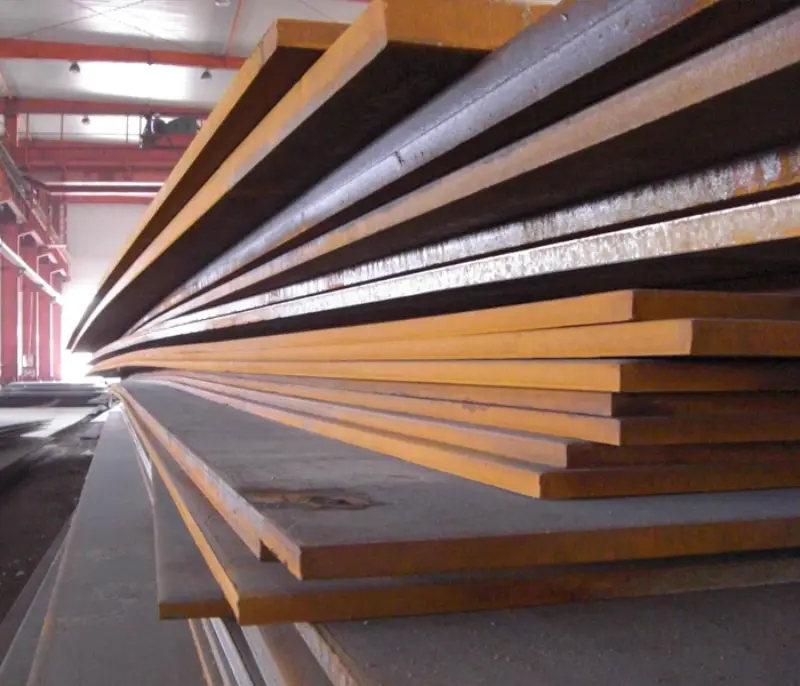
API Spec 5L PSL2 X46 (L320) Pipeline Steel Plate
API Spec 5L PSL2 X46 (L320) Pipeline Steel Plate - Properties & Equivalents
Comprehensive technical profile of API 5L PSL2 X46 (L320) pipeline steel plate, including chemical composition, mechanical and physical properties, international equivalents, and application guidelines.
Thermo‑mechanical controlled rolling (TMCP), welding (SAW, ERW), cold forming, machining
- Phone : +8618037372205
- Email : [email protected]
- WhatsApp: Contact via Whtsapp
- WeChat: +8618037372205
API Spec 5L PSL2 X46 Pipeline Steel Plate Introduction
API Spec 5L PSL2 X46 (L320) is a high-strength low-alloy (HSLA) steel plate specifically designed for welded line pipe in oil and gas transportation systems. The designation 'X46' indicates a minimum specified yield strength of 46 ksi (approximately 320 MPa), while 'L320' is the corresponding metric grade. As a Product Specification Level 2 (PSL2) material, it is subject to stricter requirements on chemical composition, notch toughness, and non‑destructive inspection compared to PSL1. This grade offers an excellent balance of strength, weldability, and fracture toughness, making it suitable for onshore and offshore pipelines operating under moderate to high pressures. The steel is typically supplied in the as‑rolled or thermo‑mechanically rolled condition, capable of being formed into longitudinal or spiral welded pipes.
API Spec 5L PSL2 X46 Pipeline Steel Plate Chemical Composition
The chemical composition complies with API Spec 5L Table 4 (PSL2, X46 grade). Limits are for heat analysis of the steel plate. For thicknesses ≤25 mm, the maximum carbon content is further restricted when carbon exceeds 0.12% to meet carbon equivalent requirements. Micro‑alloying elements such as niobium, vanadium, and titanium are commonly added to achieve the required strength and toughness.
| Element | Standard Value (max, unless range) | Remarks |
|---|---|---|
| C | 0.22% (for t ≤ 25 mm); 0.23% (t > 25 mm) | Lower Ceq required for PSL2 |
| Mn | 1.40% | Maximum for PSL2; typical 1.00–1.35% |
| Si | 0.45% | Usually 0.15–0.40% |
| P | 0.025% | Phosphorus limit for PSL2 |
| S | 0.015% | Sulphur limit for PSL2 |
| V, Nb, Ti | Sum ≤ 0.15% | Nb+V+Ti, unless otherwise agreed |
| Ni | 0.30% | Residual maximum |
| Cr | 0.30% | Residual maximum |
| Mo | 0.15% | Residual maximum |
| Cu | 0.35% | Residual maximum |
| Al (total) | 0.015–0.060% | If added; grain refinement |
| N | 0.012% | Maximum for PSL2 |
API Spec 5L PSL2 X46 Pipeline Steel Plate Thermal and Electrical Physical Properties
Physical properties are typical for low‑alloy pipeline steels and are not part of the mandatory certification. Values are valid at room temperature unless otherwise noted. The data are provided for engineering calculations such as heat transfer, stress analysis, and cathodic protection design.
| Property | Typical Value | Unit | Test Condition |
|---|---|---|---|
| Density (ρ) | 7850 | kg/m³ | 20°C |
| Elastic Modulus (E) | 205 | GPa | 20°C, tension |
| Shear Modulus (G) | 80 | GPa | 20°C |
| Poisson's Ratio (ν) | 0.30 | – | 20°C |
| Thermal Expansion Coefficient (α) | 11.7 × 10⁻⁶ | K⁻¹ | 20–200°C |
| Thermal Conductivity (λ) | 48 | W/(m·K) | 20°C |
| Specific Heat Capacity (c) | 480 | J/(kg·K) | 20°C |
| Electrical Resistivity (ρ_e) | 0.20 × 10⁻⁶ | Ω·m | 20°C |
API Spec 5L PSL2 X46 Pipeline Steel Plate Mechanical Properties
Mechanical properties are specified in API Spec 5L Table 5 for the pipe body, and these requirements are reflected in the plate. The yield strength (ReH) and tensile strength (Rm) apply to the transverse direction. Elongation (A) is measured on a rectangular specimen with a gauge length of 50.8 mm (2 in) using the formula in API 5L. Charpy V‑notch impact tests are mandatory for PSL2; values shown are for transverse specimens at 0°C (unless a lower temperature is agreed). Bend tests are not normally required for plate alone but may be performed for weld procedure qualification.
| Property | Required Value | Unit | Test Condition |
|---|---|---|---|
| Yield Strength (ReH) | 320–525 | MPa | Transverse, 0.5% total extension |
| Tensile Strength (Rm) | 435–655 | MPa | Transverse |
| Yield‑to‑Tensile Ratio (ReH/Rm) | ≤ 0.93 (for L320 PSL2) | – | When Sr ≤ 0.93 requirements apply |
| Elongation after Fracture (A) | ≥ 22% (typical for 10 mm wall) | % | 50.8 mm gauge, full‑wall strip specimen |
| Charpy Impact Energy (KV) | Average ≥ 40 J; individual min 27 J | J | Transverse, 0°C (or as agreed) |
| Bend Test (guideline) | No cracks after 180° bending | – | Mandrel diameter 3t typical (for pipe weld qualification) |
API Spec 5L PSL2 X46 Pipeline Steel Plate Complete Equivalent Material Standards and Replaceable Grades
| Country / Region | Standard | Grade | Remarks |
|---|---|---|---|
| International (ISO) | ISO 3183:2019 | L320 | PSL2 requirements identical to API 5L X46 |
| Europe | EN 10208‑2:2009 | L320GA | Welded line pipe; equivalent to X46 PSL2 |
| China | GB/T 9711‑2017 | L320 | Part 2 (PSL2) harmonized with ISO 3183 |
| Russia / CIS | GOST 20295‑85 | 17GS (approximate) | Closest equivalent, verify carbon equivalent |
| DNV | DNV‑OS‑F101 (2013) | Class 320 | Offshore pipeline standard; full PSL2 equivalence |
API Spec 5L PSL2 X46 Pipeline Steel Plate Application Introduction
API 5L X46 (L320) PSL2 steel plate is primarily used for manufacturing welded line pipes. Its good weldability and toughness allow fabrication of pipe using high‑productivity processes such as submerged arc welding (SAW) and electric resistance welding (ERW). The PSL2 grade often incorporates additional testing to guarantee resistance against hydrogen‑induced cracking (HIC) and sulfide stress cracking (SSC) when specified for sour environments.
Product Applications: Longitudinally submerged arc welded (LSAW) pipes, Spiral submerged arc welded (SSAW) pipes, Electric resistance welded (ERW) pipes, Pipe fittings and flanges (when formed from plate), Pressure vessel shells and end plates
Processed into products: Onshore gas transmission pipelines, Offshore riser and flowline components, Plant interconnecting pipe spools, Piling and structural tubulars in marine environments, High‑pressure water mains
Application industries: Oil and gas upstream, midstream, and downstream transportation, Water transmission and distribution (high‑pressure), Structural applications in offshore platforms and jackets, Chemical and petrochemical plant piping, Slurry and mineral transport pipelines
API Spec 5L PSL2 X46 Pipeline Steel Plate Similar / Near‑Equivalent Alternative Materials
| Country / Region | Standard | Grade | Remarks |
|---|---|---|---|
| USA | API Spec 5L PSL2 | X52 / L360 | Higher strength (360 MPa min. yield); may substitute for X46 after stress analysis |
| Europe | EN 10028‑3 | P355N | Pressure vessel steel with similar yield (355 MPa); check toughness requirements |
| International | ISO 3183 | L290 / X42 | Lower strength grade; suitable for less demanding pressure conditions |
| USA | ASTM A572 / A709 | Grade 50 | Structural steel with 345 MPa yield; only for non‑pipeline applications |
| China | GB/T 1591 | Q345 | General structural Low‑alloy steel; equivalent in strength but not certified for sour service |
Notes:
Additional Notes:
- For sour service applications (H₂S containing), supplementary requirements such as HIC and SSC testing per NACE MR0175/ISO 15156 may be specified.
- Carbon equivalent (CEIIW) is normally limited to ≤ 0.43% for PSL2 plates to ensure good field weldability.
- The minimum design temperature for ductile‑to‑brittle transition is assessed by the Charpy test temperature; -20°C or colder can be achieved by agreement.
- All data are based on the API 5L 46th Edition and verified against typical mill certificates. For exact values, refer to the specific material test report.
- Share



