
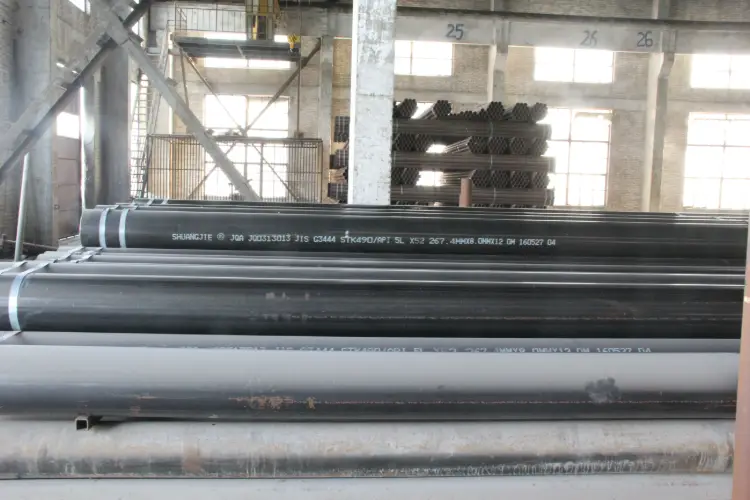
API 5L X52 PSL2 Pipeline Steel Plate
API 5L X52 PSL2 Pipeline Steel Plate - High-Strength & Toughness for Critical Energy Transport
Comprehensive technical data for API 5L PSL2 X52 (L360) pipeline steel plate, including chemical composition, mechanical properties, thermal and electrical properties, equivalent grades, and application guidance for oil and gas transmission pipelines.
Hot rolling, controlled rolling (TMCP), normalizing, or as agreed; suitable for welding (LSAW, SSAW)
- Phone : +8618037372205
- Email : [email protected]
- WhatsApp: Contact via Whtsapp
- WeChat: +8618037372205
API 5L X52 PSL2 Pipeline Steel Plate Introduction
API 5L X52 PSL2 steel plate is a high-strength, low-alloy (HSLA) structural steel specifically designed for welded line pipe in the oil, gas, and water transportation industries. Conforming to the American Petroleum Institute (API) specification 5L, Product Specification Level 2 (PSL2), this grade offers enhanced notch toughness and stricter chemical and mechanical requirements compared to PSL1. With a minimum yield strength of 360 MPa (L360 in ISO 3183), X52 provides an excellent balance of strength, weldability, and resistance to crack propagation. It is available in various delivery conditions including as-rolled, normalized, or thermo-mechanically controlled rolled (TMCP). The plate form is the primary raw material for manufacturing longitudinally welded (LSAW) or spiral welded (SSAW) pipe, and can also be used directly in structural applications requiring reliable low-temperature performance. Typical applications include long-distance oil and gas transmission systems, subsea risers, and critical structural components in harsh environments.
API 5L X52 PSL2 Pipeline Steel Plate Chemical Composition
The chemical composition of API 5L X52 PSL2 is strictly controlled to achieve the required strength and toughness while maintaining excellent weldability. Limits are based on heat analysis. Microalloying elements such as Nb, V, and Ti are often added individually or in combination to refine grain size and provide precipitation strengthening. Maximum carbon equivalent values (CEpcm or CEIIW) may be specified by the purchaser to ensure good field weldability.
- PSL2 imposes lower maximums for phosphorus and sulfur compared to PSL1, enhancing toughness and corrosion resistance.
- Sums of Nb+V and Nb+V+Ti may be restricted when combinations are used.
- All values are maximum unless a range is given.
| Element | Standard Value | Remarks |
|---|---|---|
| Carbon (C) | 0.22 | Max, heat analysis |
| Manganese (Mn) | 1.40 | Max |
| Phosphorus (P) | 0.025 | Max, PSL2 limit |
| Sulfur (S) | 0.015 | Max, PSL2 limit |
| Silicon (Si) | 0.45 | Max |
| Vanadium (V) | 0.05 | Max |
| Niobium (Nb) | 0.05 | Max |
| Titanium (Ti) | 0.04 | Max |
| Niobium + Vanadium + Titanium | 0.15 | Max, when all three are intentionally added |
| Boron (B) | 0.0005 | Max, unless otherwise agreed; residual |
| Aluminum (Al) | 0.060 | Max, total aluminum, if specified |
| Nitrogen (N) | 0.012 | Max |
| Copper (Cu), Nickel (Ni), Chromium (Cr) | Each 0.50 max (residual) | Unless specifically added; sum of residual Cu+Ni+Cr+Mo ≤ 1.0 |
| Molybdenum (Mo) | 0.50 | Max, if added or residual |
API 5L X52 PSL2 Pipeline Steel Plate Thermal and Electrical Physical Properties
The following physical properties are typical for API 5L X52 pipeline steel at room temperature and ambient pressure. These values are representative of low-carbon, low-alloy carbon-manganese steels and are suitable for engineering calculations such as heat transfer, thermal stress, and induction heating design.
- Thermal properties can vary slightly with actual processing (e.g., TMCP versus normalized), but remain within the ranges given below.
- Electrical resistivity is for reference in non-destructive testing and welding applications.
- Values are not part of API 5L mandatory requirements and are provided for guidance only.
| Property | Typical Value | Unit | Test Conditions |
|---|---|---|---|
| Density (ρ) | 7.85 | g/cm³ | Room temperature |
| Modulus of Elasticity (E) | 205 | GPa | Ambient temperature |
| Shear Modulus (G) | 79.3 | GPa | Calculated |
| Poisson's Ratio (ν) | 0.29 | — | Ambient temperature |
| Coefficient of Thermal Expansion (α) | 11.7 × 10⁻⁶ | K⁻¹ | 20°C to 100°C |
| Thermal Conductivity (λ) | 50 | W/(m·K) | At 20°C |
| Specific Heat Capacity (cp) | 460 | J/(kg·K) | At 20°C |
| Electrical Resistivity (ρe) | 0.18 | μΩ·m | At 20°C |
API 5L X52 PSL2 Pipeline Steel Plate Mechanical Properties
Mechanical properties for PSL2 X52 plate intended for pipe manufacturing are determined on transverse test specimens unless otherwise agreed. Requirements include tensile, elongation, and Charpy V-notch impact toughness at a specified test temperature, typically 0°C or lower as per supplementary requirements. The yield strength is the 0.5% total extension (Rt0.5) under load. Elongation formulas are based on gauge length and specimen width.
- All tensile tests are carried out at room temperature.
- Impact energy values are minimum average for full-size (10x10 mm) specimens; sub-size specimens require adjustment factors.
- Bend tests can be substituted or required per the product standard for plates used in pipe conversion.
| Property | Standard Requirement | Unit | Test Conditions |
|---|---|---|---|
| Yield Strength (Rt0.5) | 360 - 530 | MPa | Minimum 360 MPa; maximum 530 MPa; transverse specimen |
| Tensile Strength (Rm) | 460 - 760 | MPa | Transverse specimen, room temperature |
| Yield to Tensile Ratio (Rt0.5/Rm) | ≤ 0.93 | — | Maximum if specified for PSL2 (optional requirement) |
| Elongation (A) | Min. 23% | % | On 50 mm gauge length, transverse strip specimen (typical for plate thickness ≤ 12.5 mm); see standard for exact formula based on area |
| Charpy V-Notch Impact Energy (KV) | Min. 27 J (average), 20 J (individual) | J | Full-size specimen, transverse, test temperature 0°C or -20°C as per order (e.g., SR5A or SR5B); PSL2 mandatory |
| Bend Test (Guided Bend) | No cracks or opening in weld and HAZ | — | Bend angle 180°, bend diameter 3T (T = specimen thickness); applied to test welds in plate converted to pipe |
API 5L X52 PSL2 Pipeline Steel Plate Fully Equivalent Material Standards & Substitutable Grades
| Country/Region | Standard | Grade | Remarks |
|---|---|---|---|
| International | ISO 3183 | L360 | Identical technical delivery conditions; PSL2 equivalent to ISO 3183 Annex requirements |
| European Union | EN 10208-2 | L360MB | Steel pipes for combustible fluids; comparable chemistry and mechanical properties |
| China | GB/T 9711 | L360 | Petroleum and natural gas industry pipeline transportation systems; adopts ISO 3183 |
| Russia / CIS | GOST R ISO 3183 | L360 | Direct adoption of ISO 3183 within Russian national standards |
| India | IS 15663-2 (based on ISO 3183) | L360 | Equivalent grade for line pipe; PSL2 requirements included |
| Brazil | NBR 15386 (similar to ISO 3183) | L360/API 5L X52 | Petroleum and gas pipe; equivalent properties |
| Canada | CSA Z245.1 | Grade 359 (typically matched to X52) | Pipe grade with minimum yield 52 ksi (359 MPa), often interchangeable |
API 5L X52 PSL2 Pipeline Steel Plate Application Introduction
API 5L X52 PSL2 steel plate is the backbone material for constructing pipelines that operate under high pressure and in demanding environments. Its combination of strength, weldability, and toughness makes it suitable for a wide range of products from large-diameter transmission lines to small-diameter distribution networks.
- The plate is primarily used for fabricating longitudinally submerged arc welded (LSAW) and spiral submerged arc welded (SSAW) pipes.
- It is also employed in manufacturing pipe fittings such as bends, tees, and reducers through hot forming or welding.
- Beyond line pipe, the steel can be used for structural parts and pressure vessels when additional certifications are obtained.
Product Applications: Longitudinally welded (LSAW) line pipe, Spiral welded (SSAW) line pipe, Seamless line pipe (by converting billets), Pipe fittings (elbows, tees, end caps, flanges), Pressure vessel shells and heads, Piling and structural pipe, Offshore platform members and bridge components
Processed into products: Mainline pipe segments for cross-country oil and gas networks, Riser pipes for subsea tie-backs, Flowlines connecting wells to processing facilities, Station piping within compressor and pump stations, Hot induction bends, Flanges (weld neck, slip-on), Manifold headers and spools, Storage tank shell plates (when dual certified)
Application industries: Oil and gas upstream (exploration & production), Midstream transportation (long-distance pipelines), Downstream refining and petrochemical plants, Water and wastewater infrastructure, Mining and slurry handling systems, Offshore and marine engineering (risers, conductors)
API 5L X52 PSL2 Pipeline Steel Plate Similar / Alternative Material Recommendations
| Country/Region | Standard | Grade | Remarks |
|---|---|---|---|
| USA / International | API 5L PSL2 | X50 / L345 | Lower strength grade, min yield 345 MPa; suitable for less demanding pressure service |
| USA / International | API 5L PSL2 | X56 / L390 | Higher strength grade, min yield 390 MPa; increased load capacity but requires attention to weldability |
| USA | ASTM A572 / A709 | Grade 50 (Grade 345) | General structural steel with similar yield but not specifically designed for sour service or extensive toughness requirements |
| European Union | EN 10025-3 | S355N/NL | Normalized fine-grain structural steel with comparable yield; often used in non-pipeline structural applications where toughness at low temperature is required |
| China | GB/T 1591 | Q345D/E | Low alloy structural steel with good low-temperature toughness; not a direct pipeline grade but sometimes used for general pipe structures |
| Japan | JIS G 3128 | SHY 685N (similar strength level) | High yield strength steel plate for pressure vessels; may serve as an alternative for specific heavy-wall applications |
Notes:
Additional requirements for PSL2 X52 plate:
- Mandatory Charpy V-notch impact testing with minimum average 27 J at a temperature specified by the purchase order (common SR5A: 0°C, SR5B: -20°C).
- Non-destructive testing (NDT) of the plate may be required per supplementary requirements (e.g., ultrasonic testing per SR9).
- Surface condition and dimensional tolerances shall comply with API 5L Section 9.
- Welding repairs of plate are allowed only with the approval of the purchaser, following a qualified welding procedure.
- For sour service applications, additional HIC/SSC tests per NACE MR0175/ISO 15156 may be specified by the purchaser.
- Dual certification to EN 10208-2 or ISO 3183 is common to meet European project requirements.
- Share



