
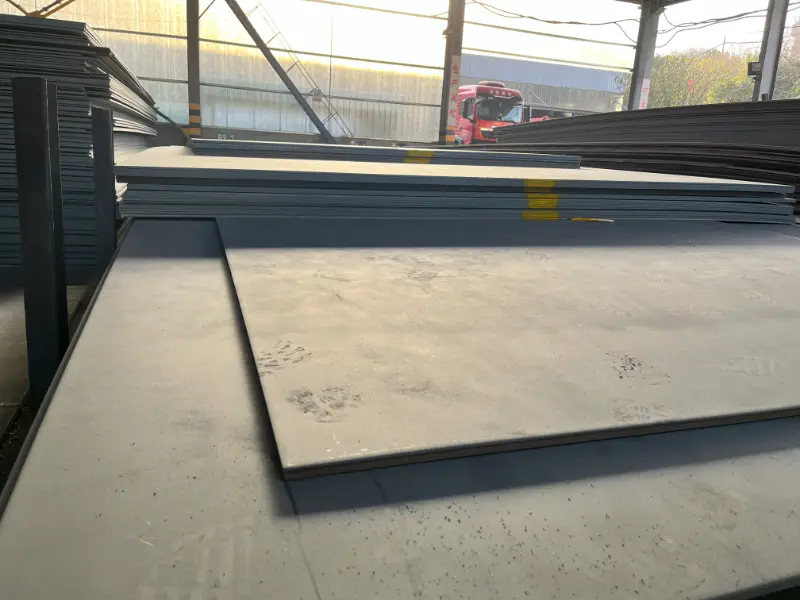
API Spec 5L PSL2 X56 (L390) Pipeline Steel Plate
API Spec 5L PSL2 X56 (L390) Pipeline Steel Plate - High-Strength Sour Service Grade
API 5L PSL2 X56 (L390) is a high-strength low-alloy (HSLA) steel for pipeline transportation systems in the petroleum and natural gas industries. It offers excellent weldability, improved toughness, and resistance to hydrogen-induced cracking for sour service environments.
Hot rolling, controlled rolling, thermo-mechanical controlled processing (TMCP), normalizing, welding (SAWL, SAWH, ERW), cold forming (limited)
- Phone : +8618037372205
- Email : [email protected]
- WhatsApp: Contact via Whtsapp
- WeChat: +8618037372205
API Spec 5L PSL2 X56 Pipeline Steel Plate Introduction
API Spec 5L PSL2 X56 (also designated L390 under ISO 3183) is a high-strength low-alloy steel designed for use in welded and seamless steel pipes for conveying gas, water, and oil in the petroleum and natural gas industries. The PSL2 designation (Product Specification Level 2) imposes stricter requirements on chemical composition, mechanical properties, and mandatory notch toughness testing compared to PSL1, making it suitable for more demanding applications, including sour service and offshore environments. The steel typically exhibits a fine-grained ferritic-pearlitic microstructure and achieves its strength through controlled rolling or thermo-mechanical controlled processing (TMCP) with microalloying elements such as niobium, vanadium, and titanium. Key characteristics include minimum yield strength of 390 MPa, good weldability, and excellent resistance to brittle fracture and hydrogen-induced cracking when ordered with supplementary sour service requirements. It is commonly supplied as hot-rolled plate or strip for manufacturing longitudinal submerged arc welded (SAWL) or spiral submerged arc welded (SAWH) pipes.
API Spec 5L PSL2 X56 Pipeline Steel Plate Chemical Composition
Chemical requirements for API 5L PSL2 X56 (L390) steel plate according to Table 4 of the standard. The composition is designed to provide adequate strength, weldability, and toughness. For sour service (HIC/SSC resistance), stricter control on sulfur and inclusion shape is applied. Microalloying elements (Nb, V, Ti) are commonly added for grain refinement and precipitation strengthening.
- Carbon equivalent (CEIIW) max 0.43% for typical deliveries.
- For sour service, maximum sulfur is typically ≤0.002% and phosphorus ≤0.015%.
| Chemical Element | Standard Value (max % unless range) | Remarks |
|---|---|---|
| Carbon (C) | 0.22 | Heat analysis; 0.24 for product analysis |
| Manganese (Mn) | 1.40 | Heat analysis; 1.50 for product analysis |
| Phosphorus (P) | 0.025 | Maximum |
| Sulfur (S) | 0.015 | Maximum (sour service typically ≤0.002) |
| Silicon (Si) | 0.45 | May be added for deoxidation |
| Niobium (Nb) | ≤0.05 | Microalloy; sum Nb+V+Ti ≤0.15% per standard limits |
| Vanadium (V) | ≤0.10 | Often used for strength |
| Titanium (Ti) | ≤0.04 | For grain refinement and sulfide shape control |
| Copper (Cu) | ≤0.35 | Residual or added for atmospheric corrosion resistance |
| Nickel (Ni) | ≤0.30 | Residual |
| Chromium (Cr) | ≤0.30 | Residual |
| Molybdenum (Mo) | ≤0.15 | Residual |
| Aluminum (Al) | ≤0.060 | Total Al; typically 0.015–0.060 for deoxidation |
| Nitrogen (N) | ≤0.012 | Unless Al treated |
| Boron (B) | ≤0.0005 | Not intentionally added |
API Spec 5L PSL2 X56 Pipeline Steel Plate Physical Properties
Typical physical properties for X56/L390 pipeline steel in the as-rolled or TMCP condition. These values are representative for low-alloy carbon steels and are provided for engineering design purposes. Actual values may vary slightly depending on exact chemical composition and processing. Density is approximately 7.85 g/cm³, and thermal expansion coefficient is around 12.0 ×10⁻⁶/K at room temperature. Electrical resistivity is typical for low-alloy steel.
| Property | Standard Typical Value | Unit | Test Condition |
|---|---|---|---|
| Density (ρ) | 7.85 | g/cm³ | At 20°C |
| Modulus of Elasticity (E) | 205 | GPa | At 20°C |
| Shear Modulus (G) | 80 | GPa | At 20°C |
| Poisson's Ratio (ν) | 0.29 | — | Ambient temperature |
| Thermal Expansion Coefficient (α) 20–100°C | 12.0 | 10⁻⁶/K | Mean coefficient |
| Thermal Expansion Coefficient (α) 20–200°C | 12.5 | 10⁻⁶/K | Mean coefficient |
| Thermal Conductivity (λ) | 45 | W/m·K | At 20°C |
| Specific Heat Capacity | 0.49 | kJ/kg·K | At 20°C |
| Electrical Resistivity (ρe) | 0.22 | µΩ·m | At 20°C |
API Spec 5L PSL2 X56 Pipeline Steel Plate Mechanical Properties
Tensile and toughness requirements for API 5L PSL2 X56 (L390) steel plate according to Table 7 of the standard. Testing is performed on transverse specimens unless otherwise agreed. Impact tests are mandatory for PSL2 with a minimum average absorbed energy of 27 J at specified temperature. Yield strength must fall within the range 390–545 MPa, and the Y/T ratio is typically limited to 0.93 for strain-based design applications. Charpy V-notch impact values depend on pipe diameter and wall thickness; for plates, standard requirement is at least 27 J at 0°C unless specified lower test temperature for sour or offshore service.
| Property | Standard Required Value | Unit | Test Condition |
|---|---|---|---|
| Yield Strength (Rt0.5) | 390–545 | MPa | Transverse specimens, 0.5% total extension under load |
| Tensile Strength (Rm) | 490–760 | MPa | Transverse specimens |
| Yield to Tensile Ratio (Rt0.5/Rm) | ≤0.93 (if required) | — | For strain-based design applications; optional requirement |
| Elongation (A50mm) | ≥22 (typical min) | % | 50 mm gauge length, transverse |
| Elongation (A5.65√S0) | ≥24 (typical min) | % | Proportional gauge length |
| Charpy V-Notch Impact Energy | ≥27 (average); ≥20 (individual) | J | Transverse, at 0°C (standard PSL2) or lower temperature per order |
| Bend Test (Mandrel Diameter) | No cracks or ruptures; 180° bend | — | Mandrel diameter = 3x thickness (t ≤ 12.7 mm) or 4x thickness (t > 12.7 mm); as per Table 11 |
| Hardness | ≤250 HV10 (for sour service) | HV | Usually agreed for HIC-resistant grades |
API Spec 5L PSL2 X56 Pipeline Steel Plate Fully Equivalent Material Standards and Replaceable Grades
| Country/Region | Standard | Grade | Remarks |
|---|---|---|---|
| International | ISO 3183:2019 | L390 PSL2 | Identical to API 5L X56; letter 'L' denotes minimum yield strength in MPa |
| European Union | EN 10208-2:2009 | L390MB | Steel pipes for pipelines for combustible fluids; M = TMCP delivery, B = option suffix |
| China | GB/T 9711-2017 | L390 PSL2 | Petroleum and natural gas industries – Steel pipe for pipelines – Technical delivery conditions |
| Canada | CSA Z245.1-18 | Grade 386 (Category II) | Yield strength 386 MPa minimum, equivalent mechanical properties; PSL2 corresponds to Category II |
| Russia/CIS | GOST R 52079-2003 | K52 (X56) | Approximate, depending on addition of alloying elements |
API Spec 5L PSL2 X56 Pipeline Steel Plate Application Introduction
API 5L PSL2 X56 (L390) steel plate is extensively used in the pipeline industry for transporting hydrocarbons and other fluids. Its balanced strength, toughness, and weldability make it a versatile choice for both onshore and offshore projects. For sour service applications, additional quality requirements (e.g., HIC testing per NACE TM0284, SSC testing per NACE TM0177) are often specified. The plate can be formed into SAWL (longitudinal submerged arc welded) or SAWH (spiral submerged arc welded) pipes using three-roll bending or UOE process. Typical wall thicknesses range from 6 mm to 40 mm, depending on design pressure and diameter.
Product Applications: Long-distance oil and gas trunk lines, Subsea flowlines and risers (with supplementary requirements), Gas gathering and distribution networks, Water injection and produced water lines, Process piping in refineries (non-corrosive service), Spiral and longitudinal welded large-diameter pipes
Processed into products: Line pipe sections (SAWL and SAWH), Pipe fittings (elbows, tees, reducers) manufactured from plate, Flanges and custom flange adapters, Pressure vessel shells (when code allows), Structural caissons and jacket legs (offshore wind or oil platforms), Storage tank walls and roofs (for low-temperature service)
Application industries: Oil & Gas Exploration and Production, Pipeline Transmission (Onshore and Offshore), Petrochemical and Refinery Plants, Water Transmission and Distribution, Structural Engineering in Energy Projects, Mining Slurry Transportation
API Spec 5L PSL2 X56 Pipeline Steel Plate Recommendation of Similar / Alternative Material Grades
| Country/Region | Standard | Grade | Remarks |
|---|---|---|---|
| USA/International | API Spec 5L | X52 (L360) | Lower strength grade (360 MPa YS); often used where lower pressure or thinner wall is acceptable; similar weldability |
| USA/International | API Spec 5L | X60 (L415) | Higher strength grade (415 MPa YS); may require adjusted welding procedures; slightly lower toughness at same thickness |
| European Union | EN 10028-3 | P355NL2 | Pressure vessel steel with comparable strength and good low-temperature toughness; not intended for line pipe but can be considered in static equipment |
| China | GB/T 1591 | Q390D | High-strength low-alloy structural steel; similar yield strength but not designed for sour service or pipe forming; may substitute in structural uses |
| Japan | JIS G 3125 | SPA-H | High weather resistance; not equivalent in strength but offers atmospheric corrosion resistance; considered in non-pressurized structural alternatives |
Notes:
Supplementary Requirements: When ordering PSL2 X56 for sour service, specify HIC/SSC resistance with additional testing per NACE standards. Maximum hardness of 250 HV10 is often enforced. For low-temperature toughness, Charpy tests may be conducted at temperatures as low as -46°C. The steel is fully deoxidized and typically made to fine grain practice. Weldability: Carbon equivalent (CE) should be controlled; typical CE(IIW) ≤0.43% for thicknesses up to 25 mm to avoid cold cracking. Preheating may be required for thick sections. The plate can be hot formed provided controlled re-normalizing is performed. Avoid prolonged exposure above 600°C to maintain mechanical properties. All data are based on API Spec 5L 46th Edition (2018).
- Share



