
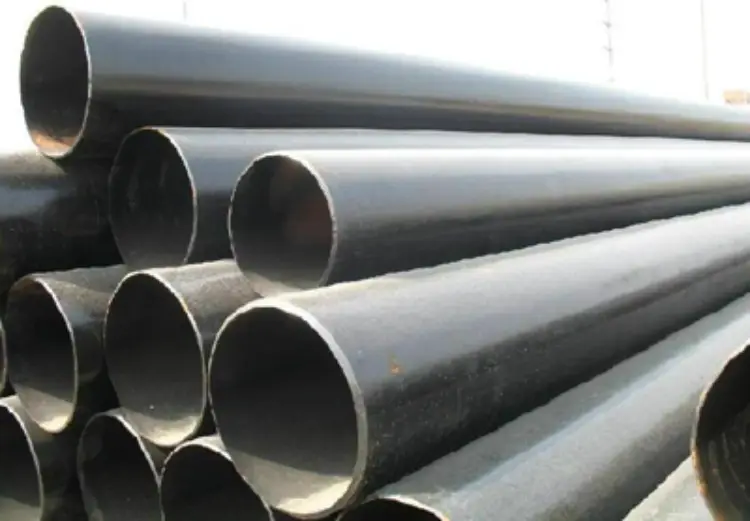
API 5L PSL2 X60 (L415) Pipeline Steel
API 5L PSL2 X60 (L415) Pipeline Steel: High-Strength, Sour-Service Ready Line Pipe Material
Comprehensive material profile of API 5L PSL2 X60 (L415) pipeline steel including chemical composition, mechanical and physical properties, international equivalents, and application guidance.
Thermomechanical Rolling (TMCP), Normalizing Rolling, Quenching & Tempering (Q&T), Welding, Bending, Cold Forming
- Phone : +8618037372205
- Email : [email protected]
- WhatsApp: Contact via Whtsapp
- WeChat: +8618037372205
API 5L PSL2 X60 Pipeline Steel Introduction
API Spec 5L PSL2 X60, also designated L415 under ISO 3183, is a high-strength low-alloy (HSLA) steel developed for line pipe in oil, gas, and water transmission. It offers a minimum yield strength of 415 MPa (60 ksi) with enhanced toughness and weldability. PSL2 classification imposes stricter chemical composition, superior notch toughness, and mandatory non-destructive testing compared to PSL1. The steel is engineered for reliable performance in demanding environments, including mildly sour service, and is widely adopted in pipeline projects worldwide.
API 5L PSL2 X60 Pipeline Steel Chemical Composition
Chemical composition per API 5L PSL2 requirements for grade X60. Values represent maximum limits unless a range is given. Carbon equivalent (CEIIW) maximum is 0.43% for PSL2. Elements like Nb, V, Ti are added for grain refinement and strengthening. Phosphorus and sulfur are strictly controlled to ensure toughness and weldability.
| Element | Maximum Value (%) | Remarks |
|---|---|---|
| Carbon (C) | 0.22 | Max; lower values improve weldability |
| Manganese (Mn) | 1.40 | Max; up to 1.65% may be agreed for certain products |
| Silicon (Si) | 0.45 | Max |
| Phosphorus (P) | 0.025 | Max; PSL2 limit |
| Sulfur (S) | 0.015 | Max; PSL2 limit |
| Niobium (Nb) | 0.05 | Max |
| Vanadium (V) | 0.06 | Max |
| Titanium (Ti) | 0.04 | Max |
| Copper (Cu) | 0.50 | Max; residual or intentional |
| Nickel (Ni) | 0.50 | Max |
| Chromium (Cr) | 0.50 | Max |
| Molybdenum (Mo) | 0.50 | Max |
| Nitrogen (N) | 0.012 | Max |
| Carbon Equivalent CE(IIW) | 0.43 | Max; c = C+Mn/6+(Cr+Mo+V)/5+(Ni+Cu)/15 |
API 5L PSL2 X60 Pipeline Steel Physical, Thermal and Electrical Properties
The following physical properties are typical for API X60 pipeline steel and similar low-alloy grades. Values are approximate and can vary slightly with composition, heat treatment, and manufacturing process. These data serve as reference for design and thermal analysis.
| Property | Typical Value | Unit | Test Condition / Remarks |
|---|---|---|---|
| Density (ρ) | 7850 | kg/m³ | Ambient temperature |
| Modulus of Elasticity (E) | 205 – 210 | GPa | Tensile modulus, 20°C |
| Shear Modulus (G) | 79 – 82 | GPa | Calculated |
| Poisson's Ratio (ν) | 0.29 – 0.30 | – | Elastic range |
| Thermal Expansion Coefficient (α) | 11.7 – 12.3 | ×10⁻⁶/K | 20–100°C range |
| Thermal Expansion Coefficient (α) | 12.5 – 13.0 | ×10⁻⁶/K | 20–200°C range |
| Thermal Conductivity (λ) | 48 – 52 | W/(m·K) | At 20°C |
| Specific Heat Capacity (cp) | 460 – 500 | J/(kg·K) | At 20°C |
| Electrical Resistivity (ρe) | 0.20 – 0.25 | μΩ·m | At 20°C |
API 5L PSL2 X60 Pipeline Steel Mechanical Properties
Mechanical properties for API Spec 5L PSL2 X60 (L415) line pipe. Tensile testing transverse to the pipe axis for welded pipe and longitudinal for seamless. Charpy V-notch impact tests are mandatory for PSL2, typically at 0°C or lower depending on service conditions. The yield-to-tensile ratio (Y/T) ≤ 0.93 is required for certain applications to ensure ductile fracture behavior.
| Property | Requirement | Unit | Test Condition / Remarks |
|---|---|---|---|
| Yield Strength (ReH / Rt0.5) | 415 – 565 | MPa | Minimum 60.2 ksi; upper limit for PSL2 |
| Tensile Strength (Rm) | 520 – 760 | MPa | Minimum 75.4 ksi |
| Yield to Tensile Ratio (ReH/Rm) | ≤ 0.93 | – | Applicable for sour service and certain other orders |
| Elongation (A) | ≥ 21 | % | 200 mm gauge length (8 in.); or per API 5L formula for other specimens |
| Charpy Impact Energy (KV) | ≥ 27 (avg) / ≥ 20 (single) | J | Transverse sample at 0°C, full-size specimen (10×10 mm²) |
| Charpy Impact Energy (KV) | ≥ 40 (avg) / ≥ 30 (single) | J | Optional: test at -10°C for lower temperature service |
| Guided Bend Test | No cracks exceeding 3 mm in any direction | – | 180° bend, diameter = 2.5x wall thickness, after welding or base metal depending on specification |
API 5L PSL2 X60 Pipeline Steel Exact International Equivalent Standards and Grades
| Country/Region | Standard | Grade | Remarks |
|---|---|---|---|
| International | ISO 3183 | L415 PSL2 | Identical to API 5L X60 PSL2 |
| European Union | EN 10208-2 | L415MB | PSL2 equivalent (M = thermomechanically rolled or normalized rolled) |
| Canada | CAN/CSA Z245.1 | Grade 415 | Matched to L415/X60 PSL2 |
| China | GB/T 9711 | L415 | Corresponds to ISO 3183; PSL2 specified by supplementary requirements |
| Russia | GOST R 51164 | K60 | Approximately equivalent; yield strength 412 MPa, similar chemical limits |
| India | IS 1239 or IS 8062 | X60 | Adopts API 5L or ISO 3183 directly |
API 5L PSL2 X60 Pipeline Steel Application Introduction
API 5L PSL2 X60 (L415) is a versatile line pipe steel designed for safe, long-distance transmission of hydrocarbons and other fluids. Its balanced chemistry ensures good field weldability with standard procedures, and the PSL2 level guarantees reliable notch toughness and resistance to brittle fracture. The steel is compatible with standard lining and coating systems (FBE, 3LPE, etc.) for corrosion protection. Typical applications include:
Product Applications: Longitudinal Submerged Arc Welded (LSAW) pipes, Spiral Submerged Arc Welded (SSAW) pipes, Seamless (SMLS) line pipes, Electric Resistance Welded (ERW/HFI) pipes, Hot-rolled steel plates for fabrication, Induction bends and fittings
Processed into products: Transmission pipeline sections (straight pipe lengths), Tees, reducers, elbows, and flanges, Offshore risers and jumper spools, Pump station and compressor manifold piping, Valve bodies and connectors (subject to forging capability), Casings and conductors for wells, Steel bends manufactured from pipe or plate
Application industries: Oil and Gas (Upstream, Midstream, Downstream), Petrochemical and Refining, Water Distribution and Wastewater Treatment, Mining and Slurry Transport, Power Generation (Cooling Water Lines), Construction and Civil Engineering (Structural Piling, Conduits)
API 5L PSL2 X60 Pipeline Steel Similar or Substitute Materials with Close Properties
| Country/Region | Standard | Grade | Remarks |
|---|---|---|---|
| USA / International | API 5L PSL1 | X60 (L415) | PSL1 has relaxer requirements; not a direct substitute for PSL2 due to lower toughness and testing requirements |
| USA / International | API 5L PSL2 | X65 (L450) | Higher strength grade (450 MPa min YS); can be used if increased strength is acceptable, but may require re-engineering |
| USA / International | API 5L PSL2 | X52 (L360) | Lower strength grade (360 MPa min YS); suitable where reduced strength is permissible and toughness is similar |
| European | EN 10028-3 | P355NL1/NL2 | Structural steel for pressure equipment; comparable yield strength (355 MPa) with excellent toughness; not pipeline-specific |
| USA | ASTM A572 | Gr. 60 (Type 1/2) | Structural steel with similar yield (415 MPa) but different chemistry and no PSL2 toughness requirements |
Notes:
PSL2 imposes mandatory Charpy V-notch testing, non-destructive inspection (ultrasonic or radiographic), and certification. Supplementary requirements for sour service (HIC/SWC), low temperature, or specific carbon equivalent may apply. Always refer to the project specification and the latest edition of API Spec 5L for exact requirements. PSL2 grades are not recommended for services requiring prolonged exposure to wet H₂S without qualification to NACE MR0175/ISO 15156. The typical maximum hardness for sour service is 250 HV10. Plates and coils are often delivered with mill test certificates (MTC) per EN 10204 3.1 or 3.2.
- Share



