
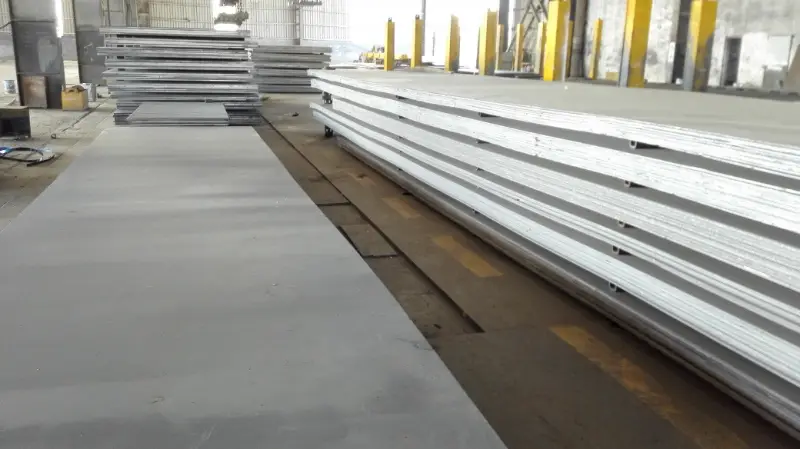
API 5L PSL2 X65 (L450) Pipeline Steel Plate
API 5L PSL2 X65 (L450) Pipeline Steel Plate: High-Strength for Oil & Gas Transport
Comprehensive data sheet for API 5L PSL2 X65 (L450) pipeline steel plate, including chemical composition, mechanical and thermal properties, international equivalents, and industrial applications.
Hot rolling, controlled rolling, thermomechanical control processing (TMCP), submerged arc welding (SAW), gas metal arc welding (GMAW), bending, forming
- Phone : +8618037372205
- Email : [email protected]
- WhatsApp: Contact via Whtsapp
- WeChat: +8618037372205
API 5L PSL2 X65 Pipeline Steel Plate Introduction
API 5L PSL2 X65 (L450) pipeline steel plate is a high-strength, low-alloy (HSLA) steel designed for the fabrication of welded line pipes used in oil, gas, and water transportation under high pressure. It is governed by the American Petroleum Institute (API) Specification 5L, 46th edition. The designation X65 indicates a minimum yield strength of 65 ksi (450 MPa), with L450 being the metric equivalent. PSL2 (Product Specification Level 2) imposes stringent controls on chemical composition, mechanical properties, and non-destructive testing, ensuring superior toughness and resistance to brittle fracture. The steel achieves a fine-grained microstructure through thermomechanical control processing (TMCP), delivering an excellent combination of strength, ductility, and weldability. Typical alloying includes a carbon-manganese base with additions of niobium, vanadium, and titanium for grain refinement and precipitation strengthening. The plate is usually supplied in the thermomechanically rolled (M) condition for optimal toughness, but can also be ordered in normalized or as-rolled conditions. Strict Charpy V-notch impact requirements at low temperatures (down to -20 °C or lower) are mandatory for PSL2. For sour service, supplementary testing such as HIC (Hydrogen-Induced Cracking) and SSC (Sulfide Stress Cracking) can be performed upon agreement. Widely used to produce LSAW and spiral welded pipes of large diameter (up to 120 inches) and wall thickness up to 40 mm, the steel’s high yield ratio and good elongation facilitate forming and fabrication, making it also suitable for structural applications like offshore platforms and pressure vessels.
API 5L PSL2 X65 Pipeline Steel Plate Chemical Composition of API 5L PSL2 X65 Pipeline Steel Plate
The chemical composition of API 5L PSL2 X65 steel plate is strictly regulated to meet the mechanical and weldability requirements. The limits shown are for product analysis on plates intended for welded pipe manufacture. Microalloying elements such as Nb, V, and Ti are added individually or in combination to refine grain size and enhance strength. The carbon equivalent (CE) is typically controlled to 0.43% or lower to ensure good field weldability.
| Chemical Element | Standard Value (max unless noted) | Remarks |
|---|---|---|
| C | ≤0.22 | For welded pipe |
| Si | ≤0.45 | Typical |
| Mn | ≤1.50 | For welded pipe |
| P | ≤0.030 | |
| S | ≤0.030 | |
| Nb | ≤0.05 | Microalloy |
| V | ≤0.10 | Microalloy |
| Ti | ≤0.06 | Microalloy |
| Nb+V+Ti | ≤0.15 | Sum of microalloys |
| Cu | ≤0.30 | Residual (may be intentionally added) |
| Ni | ≤0.30 | Residual |
| Cr | ≤0.30 | Residual |
| Mo | ≤0.30 | Residual |
| CE (IIW) | ≤0.43 | Carbon Equivalent typically agreed |
API 5L PSL2 X65 Pipeline Steel Plate Thermal and Electrical Physical Properties of API 5L X65 Steel
The physical properties listed are typical for low-alloy carbon-manganese steel at room temperature and provide guidance for engineering design. Actual values may vary depending on the specific processing route and microstructure. Density, modulus of elasticity, and thermal expansion are essential for stress analysis and thermal cycling calculations.
| Property | Typical Value | Unit | Test Condition |
|---|---|---|---|
| Density (ρ) | 7.85 | g/cm³ | At 20 °C |
| Modulus of Elasticity (E) | 210 | GPa | At 20 °C |
| Shear Modulus (G) | 80 | GPa | At 20 °C |
| Poisson's Ratio (ν) | 0.3 | ||
| Coefficient of Thermal Expansion (α) | 11.7 | 10−⁶/°C | 20 – 100 °C |
| Thermal Conductivity (λ) | 50 | W/m·K | At 20 °C |
| Specific Heat Capacity (cp) | 480 | J/kg·K | At 20 °C |
| Electrical Resistivity (ρe) | 0.22 | μΩ·m | At 20 °C |
API 5L PSL2 X65 Pipeline Steel Plate Mechanical Properties of X65 Steel Plate
Mechanical properties are tested on transverse specimens removed from the pipe body or skelp (plate). PSL2 requirements mandate tensile and Charpy V-notch tests. Yield strength (Rt0.5) and tensile strength values are given for wall thickness ranges; elongation is measured on a 2 in. (50.8 mm) gauge length. Impact tests are conducted on full-size specimens at 0 °C unless another temperature is specified.
| Property | Requirement | Unit | Test Condition |
|---|---|---|---|
| Yield Strength (ReH) | ≥450 | MPa | Transverse, wall thickness ≤25 mm |
| Yield Strength (ReH) | ≥435 | MPa | Transverse, wall thickness >25 mm |
| Tensile Strength (Rm) | 535 – 760 | MPa | Transverse |
| Elongation (A) | ≥23 | % | In 2 in. gauge length, transverse |
| Charpy V-notch impact (KV) at 0 °C | ≥27 (average) ≥20 (individual) | J | Full-size, transverse |
| Bend test (180 °) | No cracks | - | Mandrel dia. = 2t (t ≤19 mm) |
API 5L PSL2 X65 Pipeline Steel Plate Full Equivalent Material Standards and Substitutable Grades for API 5L PSL2 X65
| Country/Region | Standard | Grade | Remarks |
|---|---|---|---|
| International | API Spec 5L | X65 (L450) PSL2 | Base standard |
| Europe | EN 10208-2 | L450MB | Steel pipes for pipelines, comparable requirements |
| International | ISO 3183 | L450 | Metric designation identical |
| Canada | CSA Z245.1 | Grade 448 | Minimum yield 448 MPa, similar strength level |
| Brazil | ABNT NBR 15073 | L450 | Line pipe equivalent |
API 5L PSL2 X65 Pipeline Steel Plate Application Introduction
API 5L PSL2 X65 (L450) steel plate is a critical material for the energy sector. It is engineered for high-pressure, large-diameter pipelines but also serves in structures where strength, toughness, and weldability are paramount. The plate can be fabricated into finished products using conventional welding, bending, and forming processes. Typical applications are listed below.
Product Applications: Longitudinally Submerged Arc Welded (LSAW) pipes, Spiral Submerged Arc Welded (SSAW) pipes, High-pressure gas transmission pipelines, Oil flowlines and gathering networks, Offshore platform structural beams and columns, Pressure vessel shells and heads
Processed into products: Pipe body (base metal), Induction bends and cold bends, Reducing tees and elbows, Welded-on flanges and connectors, Valve bodies and components, Riser pipes and tie-in spools, Casing and conductor pipes, Piling pipes for marine foundations
Application industries: Oil & Gas (onshore / offshore pipelines), Petrochemical process plants, Water transmission and distribution, Construction & Infrastructure (structural parts), Shipbuilding (jack-up rig legs, offshore modules)
API 5L PSL2 X65 Pipeline Steel Plate Similar / Nearest Alternative Materials to API 5L PSL2 X65
| Country/Region | Standard | Grade | Remarks |
|---|---|---|---|
| International | API Spec 5L | X60 (L415) PSL2 | Lower minimum yield (415 MPa), similar toughness and weldability, suitable for less demanding pressure |
| International | API Spec 5L | X70 (L485) PSL2 | Higher strength (485 MPa min yield), used when higher operating pressures are required |
| USA | ASTM A572/A572M | Grade 65 [450] | Structural HSLA steel with equal yield strength, not specifically for pipelines; may require additional testing for pipe applications |
| Europe | EN 10025-4 | S460M/ML | Thermomechanically rolled structural steel, comparable strength and good weldability, suitable for structural parts |
Notes:
Sour service: For environments containing H2S, additional tests for HIC (Hydrogen Induced Cracking) and SSC (Sulfide Stress Cracking) must be agreed. Welding: Preheating (typically 100-150 °C) is recommended for thicknesses above 20 mm; PWHT may be required for certain service conditions. Carbon equivalent limits should be strictly observed to avoid cold cracking. Material certificates to EN 10204 3.1 or 3.2 can be provided. Supplementary testing: Ultrasonic testing (UT) per EN 10160 or ASTM A435 is often specified to guarantee internal soundness of the plate.
- Share



