
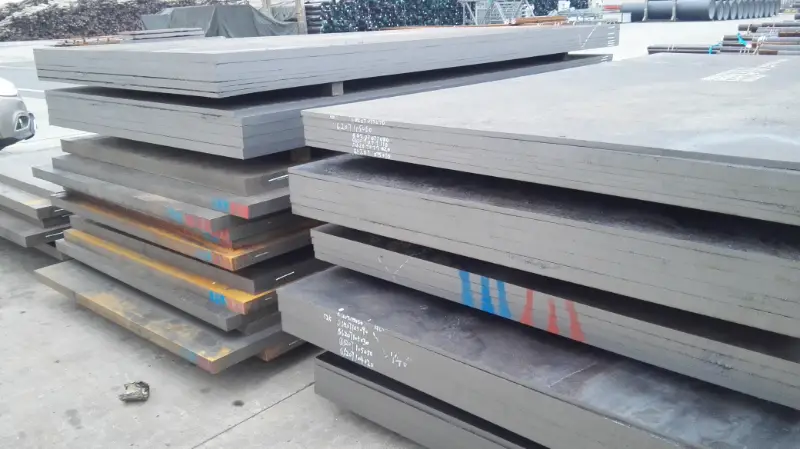
API 5L PSL2 X70 (L485) Pipeline Steel Plate
API 5L PSL2 X70 (L485) Pipeline Steel Plate: Properties, Equivalents & Applications
Comprehensive material data for API 5L PSL2 X70 (L485) pipeline steel plate including chemical composition, mechanical properties, thermal/electrical characteristics, and international equivalents.
Thermo-mechanical control process (TMCP), normalizing, quenching and tempering (Q&T)
- Phone : +8618037372205
- Email : [email protected]
- WhatsApp: Contact via Whtsapp
- WeChat: +8618037372205
API 5L PSL2 X70 Pipeline Steel Plate Introduction
API 5L PSL2 X70 (L485) is a high-strength low-alloy (HSLA) pipeline steel plate designed for demanding oil and gas transportation. Key features include high yield strength (min 485 MPa), excellent weldability, good low-temperature toughness, and compliance with PSL2 stricter requirements such as controlled chemistry and guaranteed impact values. It is typically supplied in thermomechanical controlled process (TMCP) condition, which refines grain structure for superior strength-toughness balance. X70 is widely used in large-diameter, high-pressure pipelines and is available in thicknesses up to several tens of millimeters, often with additional sour service testing (HIC/SSC) as required. Its maximum yield-to-tensile ratio of 0.93 ensures adequate plastic deformation capacity for strain-based design.
API 5L PSL2 X70 Pipeline Steel Plate Chemical Composition
The chemical composition of API 5L PSL2 X70 steel plates is tightly controlled to ensure weldability and toughness. Maximum limits are specified for impurity elements, and carbon equivalent (CEV) is limited to avoid cold cracking.
- CEV (Ceq) formula: C + Mn/6 + (Cr+Mo+V)/5 + (Ni+Cu)/15.
- For X70 with C ≤0.12%, CEV max is typically 0.42%.
- Microalloying elements (Nb, V, Ti) are used for grain refinement and precipitation hardening.
Values are typical ladle analysis from standard.
| Element | Standard Value (wt%) | Remarks |
|---|---|---|
| C | ≤0.12 | max |
| Si | ≤0.45 | max |
| Mn | ≤1.70 | max |
| P | ≤0.025 | max |
| S | ≤0.015 | max |
| V | ≤0.05 | max; commonly 0.03-0.05 |
| Nb | ≤0.05 | max; commonly 0.02-0.05 |
| Ti | ≤0.04 | max; often 0.005-0.02 |
| Al (total) | 0.015-0.060 | typical range for grain refinement |
| N | ≤0.012 | max; some specs ≤0.009 |
| Cu | ≤0.50 | residual element max |
| Ni | ≤0.50 | residual element max |
| Cr | ≤0.50 | residual element max |
| Mo | ≤0.50 | residual element max |
| CEV (Ceq) | ≤0.42 (when C≤0.12%) | PSL2 requirement; project may specify lower |
API 5L PSL2 X70 Pipeline Steel Plate Thermal & Electrical Physical Properties
Physical properties representative of low-carbon HSLA steel at ambient temperature and up to 200°C. These values are not part of API 5L specification but are commonly accepted for engineering calculations.
- Values may vary slightly with specific heat treatment and chemical composition.
- Thermal conductivity decreases with increasing temperature.
- Electrical resistivity is given for direct current at room temperature.
| Property | Typical Value | Unit | Test Condition |
|---|---|---|---|
| Density (ρ) | 7.85 | g/cm³ | Room temperature |
| Elastic Modulus (E) | 207 | GPa | Room temperature, tension |
| Shear Modulus (G) | 80 | GPa | Calculated from E and ν |
| Poisson's Ratio (ν) | 0.30 | - | Room temperature |
| Thermal Expansion Coefficient (α) | 12.2 | 10⁻⁶/K | 20-100°C mean coefficient |
| Thermal Conductivity (λ) | 50 | W/m·K | At 20°C |
| Specific Heat Capacity (Cp) | 480 | J/kg·K | At 20°C |
| Electrical Resistivity (ρe) | 0.20 | µΩ·m | At 20°C |
API 5L PSL2 X70 Pipeline Steel Plate Mechanical Properties
Mechanical properties are determined on test pieces taken transverse to the rolling direction unless otherwise noted. PSL2 requirements include a maximum yield-to-tensile ratio of 0.93 and mandatory Charpy V-notch impact testing at 0°C (or other agreed temperature).
- Elongation values depend on specimen dimensions; calculator per API 5L Table 7 formula.
- Bend test: no cracks or other defects after 180° bending.
- Material is often subject to additional testing such as drop-weight tear test (DWTT) for line pipe applications.
| Property | Standard Requirement | Unit | Test Condition |
|---|---|---|---|
| Yield Strength (ReH) | 485 - 635 (min-max) | MPa | Transverse, 0.5% total extension (under load) |
| Tensile Strength (Rm) | 570 - 760 | MPa | Transverse test |
| Yield-to-Tensile Ratio (Rp0.5/Rm) | ≤0.93 | - | Transverse, PSL2 limit |
| Elongation (A) - longitudinal | ≥ 22 (typical for 12.7 mm plate) | % | Longitudinal, rectangular specimen 50 mm (2 in) gauge length; value calculated per API 5L Table 7 for given area and UTS |
| Elongation (A) - transverse | ≥ 18 (typical for 12.7 mm plate) | % | Transverse, rectangular specimen; lower limit than longitudinal |
| Charpy Impact Energy (KV2) | ≥ 27 average / ≥ 20 single (full-size specimen) | J | Transverse, at 0°C (default PSL2); often tested at lower temperature for specific projects |
| Bend Test (Guided Bend, 180°) | No cracks or defects | - | Mandrel diameter: 3T for thickness ≤12.7 mm; 4T for thickness >12.7 mm (pipeline plate) |
| Hardness (optional) | ≤ 250 HV10 (typical) | HV | For sour service or customer specification |
API 5L PSL2 X70 Pipeline Steel Plate Fully Equivalent Material Standards & Substitute Grades
| Country/Region | Standard | Grade | Remarks |
|---|---|---|---|
| International (ISO) | ISO 3183 | L485M or L485Q | PSL2 equivalent; M = TMCP delivery, Q = quenched & tempered |
| Europe | EN 10208-2 | L485MB | Thermo-mechanical rolled; intended for small/medium diameter pipes but also applies to plate |
| China | GB/T 9711 | L485M (PSL2) | Equivalent to API 5L X70 PSL2, with M suffix |
| Russia / CIS | GOST R 52079 | K60 (X70) | Category K60 corresponds to X70 grade |
| Brazil | ABNT NBR 14842 | X70M (PSL2) | Adopts ISO 3183 system |
API 5L PSL2 X70 Pipeline Steel Plate Application Introduction
X70 pipeline steel is a workhorse material in the energy sector due to its combination of high strength, toughness, and excellent weldability. Typical applications include long-distance transmission pipelines for natural gas, crude oil, and refined products.
- It is suitable for sour service when specified with HIC/SSC resistance.
- Plate is fabricated into large-diameter longitudinal (SAW) and spiral-welded (HSAW) pipes.
- Also employed in offshore platforms, risers, and high-pressure vessel shells.
Product Applications: Large-diameter welded line pipes (Longitudinal SAW, Spiral HSAW), Pipeline fittings (induction bends, tees, reducers), High-pressure pressure vessels and separators, Offshore riser pipes and flowlines, Storage tank shells (for top courses)
Processed into products: Line pipe segments (12m or 24m lengths), Hot induction bends (3D, 5D, etc.), Flanges and blind flanges, Valve bodies, Concentric and eccentric reducers, Manifold piping and pig launcher/receiver barrels
Application industries: Oil & Gas Transmission, Petrochemical Industry, Offshore Engineering, Water Transport Systems, Structural and Construction (for pipe-shaped components)
API 5L PSL2 X70 Pipeline Steel Plate Similar Alternative Materials
| Country/Region | Standard | Grade | Remarks |
|---|---|---|---|
| International | API 5L PSL2 | X65 (L450) | Lower yield strength (450 MPa), often interchangeable for lower pressure conditions |
| International | API 5L PSL2 | X80 (L555) | Higher strength (555 MPa), requires more stringent welding procedure and may reduce wall thickness |
| Europe | EN 10208-2 | L450MB | Equivalent to X65; similar weldability and toughness |
| China | GB/T 9711 | L450M | Lower grade alternative; may be used if design pressure allows |
| Japan | JIS G 3128 | SHY 685N | High strength structural plate; not designed for pipelines but can be used in some pressure equipment with careful evaluation |
Notes:
The data above is based on API Spec 5L 46th edition (and later) for PSL2 X70 plate. Exact values may vary with product thickness and mill practice; always refer to the specific material test certificate. Weldability: Carbon equivalent (CEV) and Pcm should be evaluated per project specification. For sour service (NACE MR0175/ISO 15156), additional testing for HIC and SSC resistance is mandatory. Dimensional tolerance of plate follows API 5L or customer specification (e.g., thickness tolerance class). Surface condition can be supplied with primer or temporary corrosion protection if required. Material can be re-certified according to EN 10204 3.1 or 3.2.
- Share



