
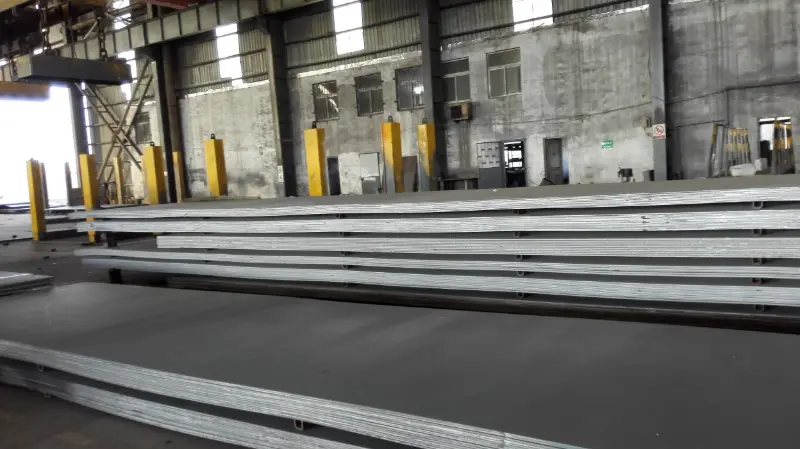
API Spec 5L PSL2 X80 (L555) Pipeline Steel Plate
API Spec 5L PSL2 X80 (L555) Pipeline Steel Plate: Chemical, Mechanical & Physical Properties
Complete material data for API 5L PSL2 X80 (L555) pipeline steel plate including chemical composition, mechanical properties, thermal & electrical data, equivalent grades, and application guide.
TMCP (Thermo-Mechanical Controlled Process), Normalized, Quenched & Tempered (Q&T), as per agreement
- Phone : +8618037372205
- Email : [email protected]
- WhatsApp: Contact via Whtsapp
- WeChat: +8618037372205
API Spec 5L PSL2 X80 Pipeline Steel Plate Introduction
API Spec 5L PSL2 X80 (L555) is a high-strength, low-alloy steel plate primarily used in the manufacture of large-diameter line pipes for long-distance oil and gas transmission. Under API 5L 46th edition, PSL2 denotes stricter requirements for chemical composition, carbon equivalent, notch toughness, and non-destructive testing compared to PSL1. The designation X80 corresponds to a minimum yield strength of 80 ksi (555 MPa). Typical delivery condition is thermo-mechanically controlled processed (TMCP) or quenched and tempered (Q&T), achieving an excellent balance of strength, toughness, and weldability. It is widely applied in onshore and offshore pipelines, high-pressure gas transmission, and sour service environments with appropriate chemistry control.
API Spec 5L PSL2 X80 Pipeline Steel Plate Chemical Composition
Chemical composition limits for API 5L PSL2 X80 plate in accordance with API Spec 5L Table 2B (PSL 2). Values are maximum unless a range is indicated. The final chemistry is adjusted by the steelmaker to meet mechanical property and carbon equivalent requirements. Typical microalloying additions of Nb, V, and Ti are used for grain refinement and precipitation strengthening. CEIIW and CEPcm limits are applied for weldability control.
| Element | Standard Value (max %) | Remarks |
|---|---|---|
| Carbon (C) | 0.12 | For t ≤ 25 mm (0.984 in); varies with thickness |
| Silicon (Si) | 0.45 | Typical range 0.15–0.40 |
| Manganese (Mn) | 1.85 | May be adjusted for required strength |
| Phosphorus (P) | 0.025 | PSL2 limit |
| Sulfur (S) | 0.015 | PSL2 limit |
| Vanadium (V) | 0.06 | Microalloying element |
| Niobium (Nb) | 0.06 | Also known as Columbium (Cb) |
| Titanium (Ti) | 0.04 | For grain refinement and nitrogen fixation |
| Copper (Cu) | 0.50 | Residual or intentional addition |
| Nickel (Ni) | 0.50 | Residual or intentional addition |
| Chromium (Cr) | 0.50 | Residual or intentional addition |
| Molybdenum (Mo) | 0.50 | Residual or intentional addition |
| Aluminum (Al) | 0.060 (total) | Typically 0.015–0.050 acid soluble |
| Nitrogen (N) | 0.012 | Unless otherwise agreed |
| Boron (B) | 0.0005 | Trace element, unless intentionally added |
| CEIIW | 0.43 max | Carbon equivalent (IIW formula) at CEPcm ≤0.22 (typical) |
| CEPcm | 0.22 max (typical) | Pcm = C+Si/30+Mn/20+Cu/20+Ni/60+Cr/20+Mo/15+V/10+5B |
API Spec 5L PSL2 X80 Pipeline Steel Plate Thermal and Electrical Physical Properties
The following physical properties are typical for low-alloy, high-strength pipeline steel (similar to C-Mn-Nb-V-Ti microalloyed grades). Actual values may vary slightly with chemical composition and heat treatment condition. Data are applicable at room temperature and pressure unless noted. They are not specified requirements of API 5L but are useful for design calculations.
| Property | Typical Value | Unit | Condition / Reference |
|---|---|---|---|
| Density (ρ) | 7.85 | g/cm³ | 20°C |
| Elastic Modulus (E) | 205 – 210 | GPa | 20°C |
| Shear Modulus (G) | 79 – 81 | GPa | Calculated from E and ν |
| Poisson's Ratio (ν) | 0.29 – 0.30 | – | 20°C |
| Thermal Expansion Coefficient (α) | 11.5 – 13.0 | 10⁻⁶/K | 20–100°C; typical 12.5 |
| Thermal Conductivity (λ) | 45 – 55 | W/(m·K) | 20°C; decreases with temperature |
| Specific Heat Capacity | 460 – 480 | J/(kg·K) | 20°C |
| Electrical Resistivity (ρₑ) | 0.22 – 0.28 | μΩ·m | 20°C |
API Spec 5L PSL2 X80 Pipeline Steel Plate Mechanical Properties
Mechanical test requirements for API 5L PSL2 X80 line pipe (from plate). Values correspond to the pipe body transverse direction unless noted. Specimens are taken from welded pipe produced from the plate. Charpy impact test temperature is typically 0°C, but may be specified lower (e.g., -20°C) depending on design. The yield-to-tensile ratio is controlled to ensure strain capacity. Hardness is limited for sour service applications.
| Property | Requirement | Unit | Test conditions |
|---|---|---|---|
| Yield Strength (ReH) | 555 – 705 | MPa | Transverse, 0.5% total extension under load |
| Tensile Strength (Rm) | 625 – 825 | MPa | Transverse |
| Yield/Tensile Ratio (ReH/Rm) | ≤ 0.93 | – | For pipe body (agreed limit) |
| Elongation after fracture (A) | ≥ 18 (min.) | % | Transverse, gauge length 2 in. (50.8 mm); calculated per API formula |
| Charpy V-notch impact (KV) | ≥ 27 (average) | J | Transverse, specimen 10x10 mm, 0°C; individual min 20 J |
| Charpy V-notch impact (KV) at lower temp. | ≥ 40 (average) | J | Optional: longitudinal, -20°C; individual min 30 J |
| Guided bend test | No cracks or other defects | – | 180° bend, diameter as per standard |
| Hardness (HV10 or HRC) | ≤ 250 HV10 | – | Optional; required for sour service; across weld and HAZ |
API Spec 5L PSL2 X80 Pipeline Steel Plate Full International Equivalents / Direct Substitutions
| Country/Region | Standard | Grade | Remarks |
|---|---|---|---|
| International | ISO 3183:2012 | L555Q or L555M (PSL2) | Identical mechanical/chemical requirements to API X80 PSL2 |
| Europe | EN 10208-2:2009 | L555MB | Comparable to TMCP delivered plate; slight differences in CE limits |
| China | GB/T 9711-2017 | L555 / X80M (PSL2) | Equivalent to API 5L X80 PSL2; widely used in Chinese projects |
| Russia | GOST R 52079-2003 | K80 (К80) | Strength grade corresponds to X80; chemical adjustments may apply |
| Brazil | NBR 15273 | X80M | Based on API 5L; PSL2 with same yield range |
API Spec 5L PSL2 X80 Pipeline Steel Plate Application Introduction
API 5L PSL2 X80 (L555) plate is purpose-designed for manufacturing high-pressure transmission pipes. Its combination of high strength, excellent low-temperature toughness, and good weldability makes it the material of choice for long-distance pipelines through challenging terrain and offshore environments. The grade can be tailored for sour service (H₂S-containing fluids) by controlling hardness and chemistry (e.g., compliance with NACE MR0175/ISO 15156). Typical end products are welded pipes (LSAW, SSAW), fittings, flanges, and risers. The steel is readily welded with low-hydrogen procedures; preheating and ECA (engineering critical assessment) may be required for the highest wall thicknesses.
Product Applications: Longitudinal Submerged-Arc Welded (LSAW) pipes, Spiral Submerged-Arc Welded (SSAW) pipes, High-Frequency Welded (HFW/ERW) pipes (limited thickness), Induction bends and hot-formed fittings, Pressure vessel shells for gas storage
Processed into products: Line pipe segments (transporting natural gas, crude oil, refined products), Pipe fittings: elbows, reducers, tees, caps, Flanges and forged connectors, Pig launchers/receivers, Valve bodies and structural supports, Offshore risers and J-tubes
Application industries: Oil & Gas (upstream & midstream), Pipeline Infrastructure (gas transit systems), Offshore Engineering (subsea flowlines, risers), Water Transmission (large diameter mains), Energy and Utilities (CO₂ transport lines)
API Spec 5L PSL2 X80 Pipeline Steel Plate Similar / Alternative Pipeline Steel Grades
| Country/Region | Standard | Grade | Remarks |
|---|---|---|---|
| USA / International | API 5L PSL2 | X70 / L485 | Lower strength grade; improved weldability and toughness |
| USA / International | API 5L PSL2 | X90 / L625 | Higher strength; requires more careful processing and welding consumables |
| Europe | EN 10208-2 | L485MB | X70 equivalent; less strength but excellent fracture toughness |
| International | ISO 3183 | L625Q/M | X90 equivalent; used for extremely high-pressure gas transmission |
| USA | ASTM A1066 | HMS 80 | High-strength microalloyed plate for structural applications (not pipeline) |
Notes:
PSL2 Additional Requirements: Charpy impact tests are mandatory for PSL2; supplementary fracture toughness tests (CTOD) may be specified if required for strain-based design. Hydrogen Induced Cracking (HIC) resistance can be ordered according to NACE TM0284 for sour service. Weldability: CEIIW ≤0.43 and CEPcm ≤0.22 minimize cold cracking susceptibility. Coating compatibility: Standard 3-layer PE/PP or fusion-bonded epoxy (FBE) coatings are widely applied. All data compiled from API Spec 5L (46th Ed.) and typical industry references. Actual values are subject to manufacturer's certification and purchase agreement.
- Share



