
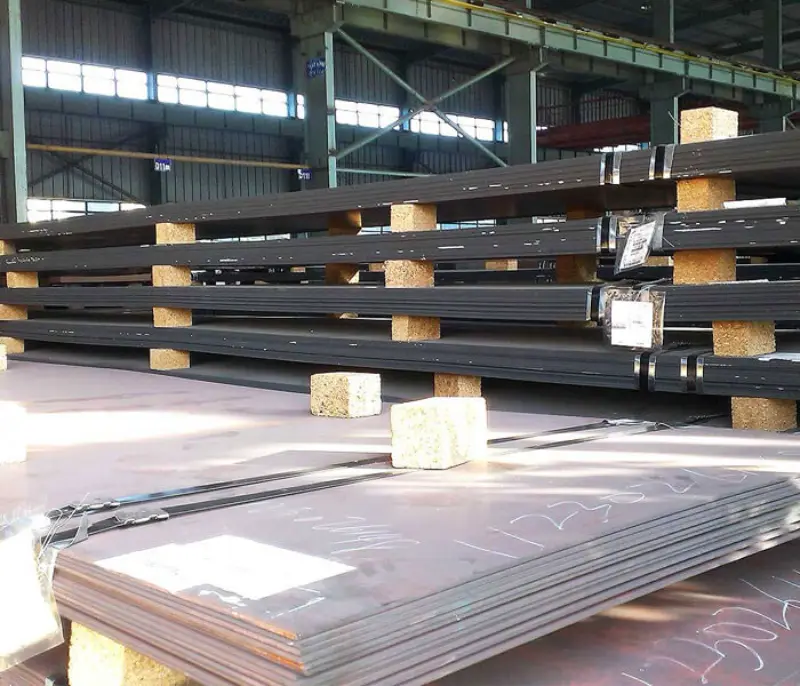
EN 10083-3 38Cr2 High Alloy Steel Plate
EN 10083-3 38Cr2 High Alloy Steel Plate - Quenched & Tempered Engineering Steel
Technical data for 38Cr2 (1.7003) alloy steel plate per EN 10083-3: chemical composition, mechanical properties, physical properties, equivalent grades, and application guide.
Hot forming, forging, machining, welding (with precautions), heat treatment (quenching and tempering, soft annealing, normalizing)
- Phone : +8618037372205
- Email : [email protected]
- WhatsApp: Contact via Whtsapp
- WeChat: +8618037372205
EN 10083-3 38Cr2 High Alloy Steel Plate Introduction
38Cr2 is an alloy special steel for quenching and tempering specified in European standard EN 10083-3. It is a chromium low-alloy steel with good hardenability, moderate strength and toughness, typically used in the quenched and tempered condition. The steel offers a balanced combination of high tensile strength and good ductility, making it suitable for medium-stressed components. Compared to plain carbon steels, 38Cr2 provides better wear resistance and fatigue strength after heat treatment. It is commonly supplied as round bars, flat bars, and plates, and can be further processed by forging, machining, and welding under controlled conditions. Its delivery condition is usually quenched and tempered (+QT) or soft annealed (+A), allowing direct use or subsequent heat treatment tailored to the final application.
EN 10083-3 38Cr2 High Alloy Steel Plate Chemical Composition
The chemical composition of 38Cr2 conforms to EN 10083-3:2006. The steel is a chromium low-alloy grade with controlled contents to ensure uniform hardenability and mechanical properties after heat treatment. Phosphorus and sulfur contents are kept low to improve toughness and cold formability.
| Chemical Element | Standard Value | Remarks |
|---|---|---|
| Carbon (C) | 0.35 – 0.42 | Key element for strength and hardness after quenching |
| Silicon (Si) | ≤ 0.40 | Deoxidizer, improves strength slightly |
| Manganese (Mn) | 0.50 – 0.80 | Enhances hardenability and tensile strength |
| Phosphorus (P) | ≤ 0.025 | Maximum limit for improved toughness |
| Sulfur (S) | ≤ 0.035 | Maximum limit for improved machinability |
| Chromium (Cr) | 0.40 – 0.60 | Primary alloying element for hardenability and wear resistance |
EN 10083-3 38Cr2 High Alloy Steel Plate Thermal and Electrical Physical Properties
Physical properties of 38Cr2 are typical for low-alloy chromium steels at room temperature. Thermal expansion coefficients and thermal conductivity vary with temperature; the values below are approximate and serve as engineering reference. Electrical resistivity is suitable for magnetically soft applications after annealing.
| Property | Standard Requirement Value | Unit | Test Condition |
|---|---|---|---|
| Density (ρ) | 7.83 | g/cm³ | 20 °C |
| Modulus of elasticity (E) | 210 | GPa | 20 °C |
| Shear modulus (G) | 81 | GPa | 20 °C (calculated from E) |
| Poisson's ratio (ν) | 0.30 | - | 20 °C |
| Thermal expansion coefficient (α) | 11.5 × 10⁻⁶ | K⁻¹ | 20 – 100 °C |
| Thermal expansion coefficient (α) | 12.5 × 10⁻⁶ | K⁻¹ | 20 – 200 °C |
| Thermal expansion coefficient (α) | 13.5 × 10⁻⁶ | K⁻¹ | 20 – 300 °C |
| Thermal conductivity (λ) | 42.0 | W/(m·K) | 20 °C |
| Specific heat capacity | 460 | J/(kg·K) | 20 °C |
| Electrical resistivity (ρ_e) | 0.22 × 10⁻⁶ | Ω·m | 20 °C |
EN 10083-3 38Cr2 High Alloy Steel Plate Mechanical Properties
Mechanical properties for 38Cr2 in the quenched and tempered condition (testing on samples taken from the surface of bars with diameters ≤100 mm, tempering temperature at least 540 °C). The values depend on ruling section size. For larger dimensions, properties are agreed at the time of enquiry and order. Impact energy is measured on ISO-V specimens at room temperature (+20 °C).
| Property | Standard Requirement Value | Unit | Test Condition |
|---|---|---|---|
| Yield strength (ReH) | ≥ 550 | MPa | d ≤ 16 mm, +QT |
| Yield strength (ReH) | ≥ 500 | MPa | 16 < d ≤ 40 mm, +QT |
| Yield strength (ReH) | ≥ 450 | MPa | 40 < d ≤ 100 mm, +QT |
| Tensile strength (Rm) | 800 – 950 | MPa | d ≤ 16 mm, +QT |
| Tensile strength (Rm) | 750 – 900 | MPa | 16 < d ≤ 40 mm, +QT |
| Tensile strength (Rm) | 700 – 850 | MPa | 40 < d ≤ 100 mm, +QT |
| Elongation after fracture (A) | ≥ 14 | % | d ≤ 16 mm, proportional test piece L0=5.65√S0 |
| Elongation after fracture (A) | ≥ 15 | % | 16 < d ≤ 40 mm |
| Elongation after fracture (A) | ≥ 16 | % | 40 < d ≤ 100 mm |
| Reduction of area (Z) | ≥ 35 | % | Applicable for d ≤ 100 mm (typical) |
| Impact energy (KV2) | ≥ 35 | J | +20 °C, ISO-V, +QT |
| Hardness | 250 – 300 | HBW | Quenched and tempered (for reference) |
EN 10083-3 38Cr2 High Alloy Steel Plate Fully Equivalent Material Standards and Substitute Grade Recommendations
| Country/Region | Standard | Grade | Remarks |
|---|---|---|---|
| Germany | DIN 17200 (withdrawn), DIN EN 10083-3 | 38Cr2 (1.7003) | Identical chemical and mechanical requirements |
| France | NF EN 10083-3 | 38Cr2 | Direct adoption of European standard |
| Italy | UNI EN 10083-3 | 38Cr2 | Direct adoption |
| United Kingdom | BS 970-1 (historical) | 530A32 / 530A36 | Approximate only; check Cr content |
| International | ISO 683-2 (if reference) | 38Cr2 | Possible future inclusion |
EN 10083-3 38Cr2 High Alloy Steel Plate Application Introduction
38Cr2 is widely employed in general mechanical engineering for components that require moderate wear resistance and strength. It can be machined after softening annealing and achieves its final properties through quenching and tempering. The steel is suitable for induction hardening and can be welded with low-hydrogen electrodes. Typical uses include:
- Automotive powertrain parts (axles, steering knuckles, shafts)
- Fasteners (studs, bolts of strength class 8.8–10.9)
- Machine tool components (spindles, levers, connecting rods)
- Construction machinery (pins, bushes, forged parts)
Product Applications: Axle shafts, Connecting rods, Steering knuckles, Gear blanks (before case hardening), High-strength bolts and studs, Propeller shafts, Crankshafts (medium duty), Hydraulic cylinder rods
Processed into products: Transmission shafts, Spindles, Levers, Pins and bushes, Flanges, Forged mechanical parts, Clutch plates (after Q&T), Industrial rollers
Application industries: Automotive manufacturing, General mechanical engineering, Construction and agricultural machinery, Power transmission, Tool and die making (for support parts)
EN 10083-3 38Cr2 High Alloy Steel Plate Similar / Alternative Material Recommendations
| Country/Region | Standard | Grade | Remarks |
|---|---|---|---|
| Germany / EU | EN 10083-3 | 41Cr4 (1.7035) | Higher Cr (0.90-1.20%) gives higher hardenability and strength |
| USA | ASTM A29 / SAE J404 | 5135 / 5140 (UNS G51350 / G51400) | Slightly higher Cr (0.80-1.10%); similar carbon range; can be used with adjustment of heat treatment |
| China | GB/T 3077 | 35Cr or 40Cr | 35Cr has C 0.32-0.39, Cr 0.80-1.10; 40Cr C 0.37-0.44, Cr 0.80-1.10; these have higher Cr, may affect hardenability |
| Japan | JIS G4104 | SCr440H | C 0.38-0.43, Cr 0.90-1.20; considered as an upgrade in Cr content |
| International | ISO 683-17 | 35Cr4 or 41Cr4 | When Cr requirement is relaxed or enhanced |
Notes:
For large cross-sections (>100 mm) the mechanical properties must be agreed between supplier and purchaser. The steel can be welded only under controlled preheat and post-weld heat treatment conditions. When replacing 38Cr2 with similar grades containing higher chromium (e.g. 41Cr4 or 40Cr), hardenability and strength levels may change; revalidation of heat treatment parameters is recommended.
- Share



