
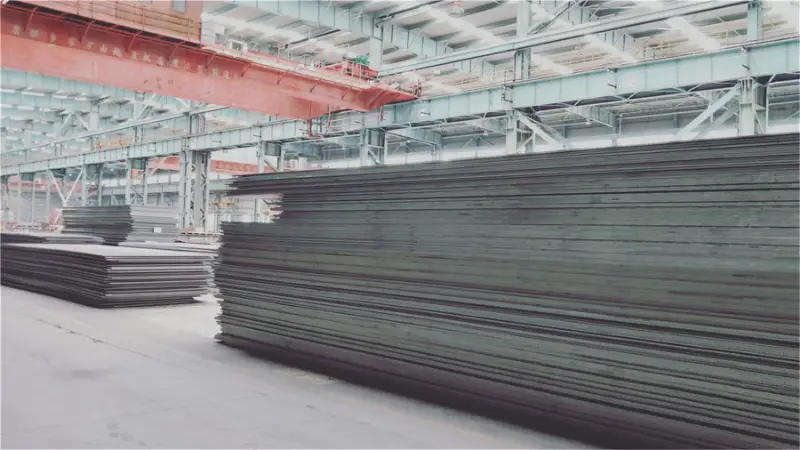
EN 10083-3 46Cr2 High Alloy Steel
46Cr2 Alloy Steel (EN 10083-3) - Composition, Properties & Equivalents
Detailed chemical composition, mechanical and physical properties, international equivalents, and application guide for 46Cr2 alloy steel in accordance with EN 10083-3 standard.
Hot rolling, forging, quenching and tempering, induction hardening, welding (with precautions)
- Phone : +8618037372205
- Email : [email protected]
- WhatsApp: Contact via Whtsapp
- WeChat: +8618037372205
EN 10083-3 46Cr2 High Alloy Steel Introduction
46Cr2 is a medium carbon chromium alloy steel for quenching and tempering, specified in EN 10083-3:2006. It offers
- Good hardenability and uniform through-hardening in sections up to ~40 mm
- High strength and toughness after quench and temper treatment
- Excellent combination of wear resistance and ductility
- Reliable performance under dynamic loads
Widely used for medium-stressed machine components, this grade is typically delivered in +QT (quenched and tempered) condition with guaranteed mechanical properties. The designation follows EN naming: 46 = 0.46% C, Cr2 = chromium alloyed with ~0.5% Cr. It is not a high-alloy steel but a fine-grained quality alloy steel for heat treatment.
EN 10083-3 46Cr2 High Alloy Steel Chemical Composition
Ladle analysis according to EN 10083-3:2006. 46Cr2 is a fine-grained alloy steel with controlled chromium content for improved hardenability. Maximum limits apply for phosphorus and sulfur to ensure clean steel and good mechanical properties.
| Element | Content (mass %) | Notes |
|---|---|---|
| Carbon (C) | 0.42 – 0.50 | |
| Silicon (Si) | ≤ 0.40 | |
| Manganese (Mn) | 0.50 – 0.80 | |
| Phosphorus (P) | ≤ 0.025 | |
| Sulfur (S) | ≤ 0.035 | |
| Chromium (Cr) | 0.40 – 0.60 | |
| Copper (Cu) | ≤ 0.40 | Residual, if not agreed otherwise |
| Chromium + Molybdenum + Nickel (Cr+Mo+Ni) | ≤ 0.63 | Unless specified |
| Others | - | Fine grain practice: Al ≥ 0.020% total or Nb/V/Ti |
EN 10083-3 46Cr2 High Alloy Steel Thermal and Electrical Properties
Data given are typical for 46Cr2 in quenched and tempered condition and are not mandatory testing parameters per the standard. They serve as design guidance and may vary with heat treatment and test methodology.
| Property | Typical Value | Unit | Test Condition / Remarks |
|---|---|---|---|
| Density (ρ) | 7.85 | g/cm³ | At 20 °C |
| Modulus of elasticity (E) | 210 | GPa | At 20 °C |
| Shear modulus (G) | 80 | GPa | At 20 °C |
| Poisson's ratio (ν) | 0.30 | - | At 20 °C |
| Thermal expansion coefficient (α) | 11.5 | 10⁻⁶/K | 20 – 100 °C |
| Thermal expansion coefficient (α) | 12.5 | 10⁻⁶/K | 20 – 200 °C |
| Thermal expansion coefficient (α) | 13.5 | 10⁻⁶/K | 20 – 400 °C |
| Thermal conductivity (λ) | 50 | W/(m·K) | At 20 °C |
| Specific heat capacity (Cp) | 460 | J/(kg·K) | At 20 – 100 °C |
| Electrical resistivity (ρ_e) | 0.20 | 10⁻⁶ Ω·m | At 20 °C |
EN 10083-3 46Cr2 High Alloy Steel Mechanical Properties
Minimum properties in longitudinal direction for ruling section thicknesses according to EN 10083-3. 46Cr2 steel achieves high strength with adequate ductility and impact toughness in the quenched and tempered condition. Soft annealed state (+A) shows lower strength but improved machinability.
| Property | Value | Unit | Test Condition / Section Thickness |
|---|---|---|---|
| Yield strength (ReH) | ≥ 685 | MPa | d ≤ 16 mm |
| Tensile strength (Rm) | 850 – 1000 | MPa | d ≤ 16 mm |
| Elongation (A) | ≥ 12 | % | d ≤ 16 mm |
| Impact energy (KV, +20°C) | ≥ 25 | J | d ≤ 16 mm |
| Yield strength (ReH) | ≥ 620 | MPa | 16 < d ≤ 40 mm |
| Tensile strength (Rm) | 800 – 950 | MPa | 16 < d ≤ 40 mm |
| Elongation (A) | ≥ 14 | % | 16 < d ≤ 40 mm |
| Impact energy (KV, +20°C) | ≥ 30 | J | 16 < d ≤ 40 mm |
| Yield strength (ReH) | ≥ 540 | MPa | 40 < d ≤ 100 mm |
| Tensile strength (Rm) | 750 – 900 | MPa | 40 < d ≤ 100 mm |
| Elongation (A) | ≥ 16 | % | 40 < d ≤ 100 mm |
| Impact energy (KV, +20°C) | ≥ 35 | J | 40 < d ≤ 100 mm |
| Yield strength (ReH) | ≥ 490 | MPa | 100 < d ≤ 160 mm |
| Tensile strength (Rm) | 700 – 850 | MPa | 100 < d ≤ 160 mm |
| Elongation (A) | ≥ 17 | % | 100 < d ≤ 160 mm |
| Impact energy (KV, +20°C) | ≥ 35 | J | 100 < d ≤ 160 mm |
| Yield strength (ReH) | ≥ 440 | MPa | 160 < d ≤ 250 mm |
| Tensile strength (Rm) | 650 – 800 | MPa | 160 < d ≤ 250 mm |
| Elongation (A) | ≥ 18 | % | 160 < d ≤ 250 mm |
| Impact energy (KV, +20°C) | ≥ 35 | J | 160 < d ≤ 250 mm |
EN 10083-3 46Cr2 High Alloy Steel Fully Equivalent Standards and Substitutable Grades
These standards and designations are direct equivalents to EN 10083-3 46Cr2. They share identical or near-identical chemical composition and mechanical property requirements.
| Country / Region | Standard | Grade | Remarks |
|---|---|---|---|
| International | ISO 683-2 | 46Cr2 | Identical composition and properties |
| Germany | DIN EN 10083-3 | 46Cr2 (1.7003) | |
| France | NF EN 10083-3 | 46Cr2 | |
| United Kingdom | BS EN 10083-3 | 46Cr2 | |
| Italy | UNI EN 10083-3 | 46Cr2 | |
| Sweden | SS-EN 10083-3 | 46Cr2 |
EN 10083-3 46Cr2 High Alloy Steel Application Introduction
46Cr2 is suitable for moderately stressed parts requiring defined hardness and strength after quenching and tempering. It is weldable under controlled conditions (preheating and post-weld heat treatment recommended). Typical hardness in +QT is 25-34 HRC depending on thickness.
Product Applications: Shafts and axles, Gears and pinions, Connecting rods, Crankshafts (medium size), High-strength bolts and studs, Piston rods, King pins
Processed into products: Transmission shafts, Drive pinions, Steering knuckles, Camshafts, Crankshafts for small engines, Connecting rods for diesel engines, Headed bolts for structural connections, Spindles and arbors, Hydraulic cylinder rods
Application industries: Automotive engineering, General mechanical engineering, Agricultural machinery, Construction equipment, Power transmission
EN 10083-3 46Cr2 High Alloy Steel Similar / Alternative Materials with Comparable Performance
The following grades are not direct substitutes but offer similar tensile strength, hardenability, or application range. Differences in alloying (e.g., higher Cr or addition of Mo) may require adjustment of heat treatment or design.
| Country / Region | Standard | Grade | Remarks |
|---|---|---|---|
| China | GB/T 3077 | 40Cr | Higher Cr (0.80-1.10%), similar C; slightly higher hardenability |
| USA | ASTM A29 / SAE J404 | 5140 | Cr 0.70-0.90%; comparable strength range |
| Japan | JIS G4053 | SCr440 | Cr 0.80-1.10%; widely used in machinery |
| Germany | EN 10083-3 | 42CrMo4 | Mo addition for better toughness and through-hardening |
| France | NF EN 10083-3 | 45C2 | Similar C and Cr; sometimes used for leaf springs |
| Italy | UNI EN 10083-3 | 40Cr4 | Cr 0.80-1.10%; close in intended applications |
Notes:
- Heat treatment: normalising at 850–880°C, quenching in oil or water from 830–860°C, tempering at 540–680°C depending on required strength.
- Hardness ranges can be tailored by selecting appropriate tempering temperature (e.g., 850–1000 MPa → tempering ~580°C).
- For welded structures, use low-hydrogen electrodes and stress-relieve after welding.
- Soft annealing: 650–700°C, slow cooling, for improved machinability.
- Fine grain practice (Al-killed) is default for better toughness; grain size ≤ 5 ASTM per EN 10308 is typical.
- Share



