
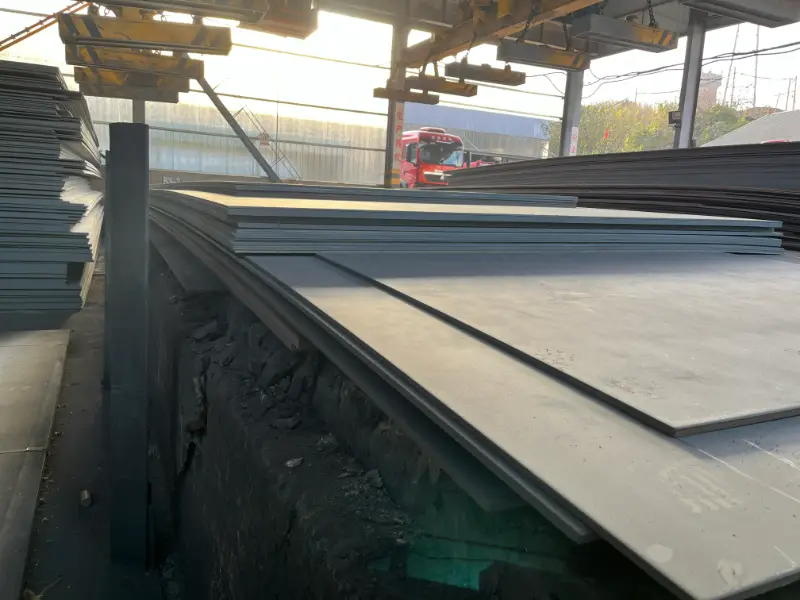
EN10083-3 34Cr4 Alloy Steel
EN10083-3 34Cr4 Alloy Steel: Complete Material Data, Properties & Equivalent Grades
In-depth technical profile of 34Cr4 steel under EN 10083-3, covering chemical composition, mechanical properties at various section sizes, physical and thermal constants, global equivalent grades, and typical applications in automotive and machinery sectors.
Hot forging, cold drawing, machining (preferably in annealed or quenched‑and‑tempered condition), heat treatment (normalizing, quenching and tempering, induction hardening, nitriding)
- Phone : +8618037372205
- Email : [email protected]
- WhatsApp: Contact via Whtsapp
- WeChat: +8618037372205
EN10083-3 34Cr4 Alloy Steel Introduction
34Cr4 is a chromium alloy steel defined in EN 10083-3 for quenching and tempering. It delivers a balanced combination of high strength, good toughness, and moderate hardenability, making it suitable for medium-stressed components in automotive and general mechanical engineering. The steel is typically supplied in the quenched and tempered (+QT) condition with tensile strengths from 900 MPa in thin sections to 630 MPa in heavy sections. Key properties include reliable yield strength, adequate impact energy at room temperature, and good machinability in the annealed state. Its chromium content (0.90–1.20%) provides sufficient hardenability for oil quenching of parts up to approximately 40 mm thickness. 34Cr4 is widely used for
- Transmission gears and shafts
- Steering knuckles and ball joints
- High-strength bolts and studs of property class 10.9/12.9
- Connecting rods and hydraulic piston rods
It can be induction hardened for local wear resistance. As an economic alternative to high‑alloy Cr‑Mo grades like 42CrMo4, 34Cr4 occupies a well‑established position in the European automotive supply chain.
EN10083-3 34Cr4 Alloy Steel Chemical Composition
Chemical requirements as specified in EN 10083‑3 for alloy steel grade 34Cr4. The chromium and carbon contents are controlled to ensure adequate hardenability and strength after quenching and tempering. Residual elements are limited to avoid brittleness.
- Product analysis tolerances apply per the standard.
- Combined nickel, copper, and molybdenum may be present as residuals but are not intentionally added.
| Chemical Element | Standard Value (wt%) | Remarks |
|---|---|---|
| Carbon (C) | 0.30 – 0.37 | Essential for hardenability and strength |
| Silicon (Si) | ≤ 0.40 | Deoxidizer; higher levels can increase strength slightly |
| Manganese (Mn) | 0.60 – 0.90 | Improves hardenability and counteracts sulfur brittleness |
| Phosphorus (P) | ≤ 0.025 | Restricted to maintain toughness |
| Sulfur (S) | ≤ 0.035 | Controlled to avoid hot shortness; slightly higher may improve machinability |
| Chromium (Cr) | 0.90 – 1.20 | Primary alloying element for hardenability and wear resistance |
EN10083-3 34Cr4 Alloy Steel Physical, Thermal and Electrical Properties
Characteristic physical constants for 34Cr4 alloy steel under ambient and elevated temperature. These values are indicative of the chromium‑alloyed quenched‑and‑tempered steel family and are suitable for engineering design calculations.
- Density, moduli, and resistivity are largely insensitive to heat treatment condition.
- Thermal expansion and conductivity vary with temperature; linear interpolation between given values is acceptable for initial design.
- Specific heat capacity increases with temperature due to lattice vibrations.
| Property | Typical Value | Unit | Test Condition |
|---|---|---|---|
| Density (ρ) | 7.85 | g/cm³ | 20 °C |
| Modulus of Elasticity (E) | 210 | GPa | 20 °C |
| Shear Modulus (G) | 80 | GPa | 20 °C |
| Poisson's Ratio (ν) | 0.3 | — | 20 °C |
| Thermal Expansion Coefficient (α) | 11.1 | ×10⁻⁶/K | 20 – 100 °C |
| Thermal Expansion Coefficient (α) | 12.2 | ×10⁻⁶/K | 20 – 200 °C |
| Thermal Expansion Coefficient (α) | 12.9 | ×10⁻⁶/K | 20 – 300 °C |
| Thermal Expansion Coefficient (α) | 13.5 | ×10⁻⁶/K | 20 – 400 °C |
| Thermal Conductivity (λ) | 42 | W/(m·K) | 20 °C |
| Thermal Conductivity (λ) | 43 | W/(m·K) | 100 °C |
| Thermal Conductivity (λ) | 41 | W/(m·K) | 200 °C |
| Thermal Conductivity (λ) | 36 | W/(m·K) | 400 °C |
| Specific Heat Capacity (cp) | 460 | J/(kg·K) | 20 °C |
| Specific Heat Capacity (cp) | 540 | J/(kg·K) | 200 °C |
| Electrical Resistivity (ρe) | 0.22 | μΩ·m | 20 °C |
EN10083-3 34Cr4 Alloy Steel Mechanical Properties in Quenched and Tempered Condition
Minimum mechanical properties according to EN 10083‑3 for 34Cr4 in the quenched and tempered state at room temperature. Values are valid for longitudinal specimens taken from the indicated thickness range.
- Yield strength is the upper yield strength (ReH) or 0.2% proof strength (Rp0.2).
- Impact energy is determined on ISO‑V notch specimens at 20 °C.
- Properties for thicknesses above 250 mm are subject to agreement.
The steel exhibits a gradual decrease in strength with increasing section size while ductility improves.
| Property | Standard Required Value | Unit | Test Condition (Thickness, t) |
|---|---|---|---|
| Yield Strength (ReH) | 700 | MPa | t ≤ 16 mm |
| Tensile Strength (Rm) | 900 – 1100 | MPa | t ≤ 16 mm |
| Elongation (A) | 12 | % | t ≤ 16 mm (L₀ = 5.65√S₀) |
| Reduction of Area (Z) | 45 | % | t ≤ 16 mm |
| Impact Energy (KV, longitudinal) | 35 | J | t ≤ 16 mm, 20 °C |
| Yield Strength (ReH) | 590 | MPa | 16 < t ≤ 40 mm |
| Tensile Strength (Rm) | 800 – 950 | MPa | 16 < t ≤ 40 mm |
| Elongation (A) | 14 | % | 16 < t ≤ 40 mm |
| Reduction of Area (Z) | 50 | % | 16 < t ≤ 40 mm |
| Impact Energy (KV, longitudinal) | 35 | J | 16 < t ≤ 40 mm, 20 °C |
| Yield Strength (ReH) | 460 | MPa | 40 < t ≤ 100 mm |
| Tensile Strength (Rm) | 700 – 850 | MPa | 40 < t ≤ 100 mm |
| Elongation (A) | 15 | % | 40 < t ≤ 100 mm |
| Reduction of Area (Z) | 55 | % | 40 < t ≤ 100 mm |
| Impact Energy (KV, longitudinal) | 35 | J | 40 < t ≤ 100 mm, 20 °C |
| Yield Strength (ReH) | 400 | MPa | 100 < t ≤ 160 mm |
| Tensile Strength (Rm) | 650 – 800 | MPa | 100 < t ≤ 160 mm |
| Elongation (A) | 16 | % | 100 < t ≤ 160 mm |
| Reduction of Area (Z) | 60 | % | 100 < t ≤ 160 mm |
| Impact Energy (KV, longitudinal) | 35 | J | 100 < t ≤ 160 mm, 20 °C |
| Yield Strength (ReH) | 360 | MPa | 160 < t ≤ 250 mm |
| Tensile Strength (Rm) | 630 – 780 | MPa | 160 < t ≤ 250 mm |
| Elongation (A) | 16 | % | 160 < t ≤ 250 mm |
| Reduction of Area (Z) | 60 | % | 160 < t ≤ 250 mm |
| Impact Energy (KV, longitudinal) | 35 | J | 160 < t ≤ 250 mm, 20 °C |
EN10083-3 34Cr4 Alloy Steel Identical/Equivalent Grade Cross‑Reference
| Country / Region | Standard | Grade | Remarks |
|---|---|---|---|
| Europe | EN 10083‑3 | 34Cr4 (1.7033) | Base standard |
| International | ISO 683‑2 | 34Cr4 | Chemically and mechanically identical |
| Germany | DIN 17200 | 34Cr4 | Historically equivalent |
| China | GB/T 3077 | 35Cr | Very close; Mn 0.50–0.80, Cr 0.80–1.10; verify properties |
| Japan | JIS G4105 | SCr435 | Cr 0.90–1.20, C 0.33–0.38; minor S/P differences |
| USA | ASTM A29/A29M | 5135 (UNS G51350) | Cr 0.80–1.05, Mn 0.60–0.80; design adjustment possible |
EN10083-3 34Cr4 Alloy Steel Application Introduction
34Cr4 steel is employed where a favourable strength‑to‑cost ratio and reliable heat‑treatment response are required. Its moderate hardenability suits oil‑quenched components up to 40 mm, and it can be surface hardened by induction for wear‑resistant surfaces.
- In the automotive industry it is a workhorse for gears and shafts that are carburized or induction hardened.
- In mechanical engineering it serves for bolts and fasteners of high property classes after tempering at low temperature.
- Delivery in the +QT condition allows straightforward machining with carbide tools, while field heat treatment can be applied for repair or alteration.
Product Applications: Transmission gears and pinions, Input and output shafts, Steering knuckles and ball joints, Connecting rods (medium‑speed engines), Wheel hub spindles, High‑strength bolts and studs (class 10.9/12.9), Hydraulic cylinder rods, Axle shafts
Processed into products: Synchronizer hubs and sleeves, Differential side gears, Power take‑off shafts, Track link pins, High‑tensile threaded fasteners with controlled ductility, Crankshafts for light‑duty applications, Press‑fit mandrels and spindles
Application industries: Automotive (passenger cars, commercial vehicles), Mechanical and plant engineering, Hydraulics and pneumatics, Fastener manufacturing, Agricultural machinery
EN10083-3 34Cr4 Alloy Steel Closely Related Alternative Steels
| Country / Region | Standard | Grade | Remarks |
|---|---|---|---|
| Europe | EN 10083‑3 | 34CrS4 | Higher sulfur for improved machinability; same base chemistry |
| Europe | EN 10083‑3 | 37Cr4 | C 0.34–0.41; slightly higher tensile strength |
| Europe | EN 10083‑3 | 41Cr4 | C 0.38–0.45; higher strength, reduced ductility |
| Japan | JIS G4105 | SCr430 | C 0.28–0.33; lower strength, better toughness |
| USA | ASTM A304 | 5132H (UNS H51320) | Cr 0.70–1.00; lower hardenability, economical option |
Notes:
- Heat treatment recommendations: Austenitize at 830–860 °C, oil or polymer quench, temper at 540–680 °C depending on desired strength. For induction hardening, pre‑condition (+QT) and surface harden to 56–62 HRC.
- Weldability: Limited; preheating to 200–300 °C and post‑weld stress relief is necessary. Suitable only for non‑critical repairs.
- Hardenability band: Jominy data available in EN 10083‑3; typical HRC values at 1.5 mm from quenched end are 54–58 in the as‑quenched condition.
- All data are based on the official EN 10083‑3 standard and recognised reference sources; no unverified values have been included.
- Share



