
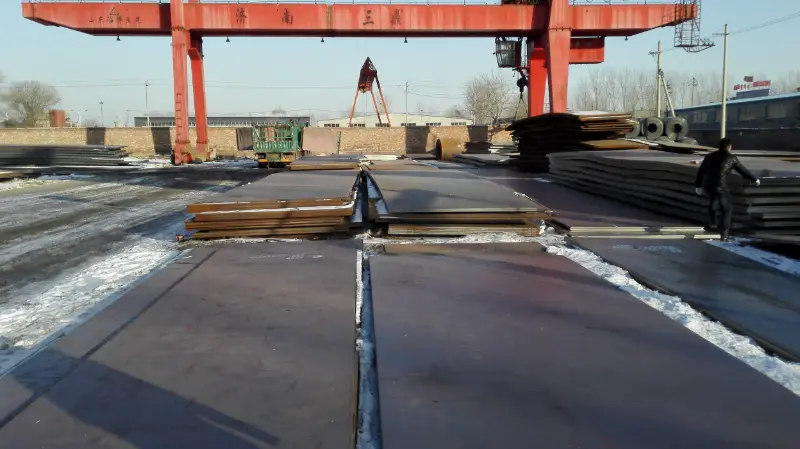
EN10083-3 34CrS4 Alloy Steel
EN10083-3 34CrS4 Alloy Steel - Sulfur-Containing Quenched & Tempered Grade for Auto Parts
Detailed material data for 34CrS4 to EN10083-3: chemical composition, mechanical properties, thermal & electrical properties, international equivalents, and application guidance.
Hot forming, forging, machining, quenching and tempering, surface hardening (induction, nitriding)
- Phone : +8618037372205
- Email : [email protected]
- WhatsApp: Contact via Whtsapp
- WeChat: +8618037372205
EN10083-3 34CrS4 Alloy Steel Introduction
34CrS4 is a chromium-alloyed quenched and tempered steel with controlled sulfur content (0.020–0.040%) for improved machinability, classified under EN 10083-3. It offers a good combination of strength, toughness, and wear resistance after heat treatment, typically supplied in the quenched and tempered (+QT) condition.
The controlled sulfur promotes chip breaking during machining, making it suitable for high-volume production of automotive and mechanical components. The steel is commonly used for parts such as
- connecting rods
- bolts and studs
- gears and shafts
- steering components
where medium tensile strength (up to 1100 MPa) and good ductility are required.
EN10083-3 34CrS4 Alloy Steel Chemical Composition
Ladle analysis according to EN 10083-3:2006 for grade 34CrS4. The controlled sulfur range guarantees consistent machinability. All values in percent by mass.
| Element | Value (min - max) | Remarks |
|---|---|---|
| Carbon (C) | 0.30 – 0.37 | |
| Silicon (Si) | ≤ 0.40 | |
| Manganese (Mn) | 0.60 – 0.90 | |
| Phosphorus (P) | ≤ 0.025 | |
| Sulfur (S) | 0.020 – 0.040 | Controlled for improved machinability |
| Chromium (Cr) | 0.90 – 1.20 |
EN10083-3 34CrS4 Alloy Steel Thermal & Electrical Physical Properties
Typical physical properties for quenched and tempered 34CrS4 at room temperature unless otherwise stated. These values are indicative and may vary depending on heat treatment condition.
| Property | Value | Unit | Condition / Remarks |
|---|---|---|---|
| Density (ρ) | 7.85 | g/cm³ | Room temperature |
| Elastic modulus (E) | 210 | GPa | Room temperature |
| Shear modulus (G) | 81 | GPa | Calculated from E and ν |
| Poisson's ratio (ν) | 0.30 | – | |
| Thermal expansion coefficient (α) | 11.5 | 10⁻⁶/K | 20 – 100 °C |
| Thermal expansion coefficient (α) | 12.5 | 10⁻⁶/K | 20 – 300 °C |
| Thermal conductivity (λ) | 42 | W/(m·K) | Room temperature |
| Specific heat capacity (c) | 460 | J/(kg·K) | Room temperature |
| Electrical resistivity (ρₑ) | 0.20 | 10⁻⁶ Ω·m | Room temperature |
EN10083-3 34CrS4 Alloy Steel Mechanical Properties
Minimum mechanical properties for 34CrS4 in the quenched and tempered condition according to EN 10083-3:2006, Table 6. Values are valid for longitudinal test pieces taken from a specified diameter range. Charpy-V impact energy values guaranteed at +20 °C.
| Property | Value | Unit | Testing condition / Diameter (d) mm |
|---|---|---|---|
| Yield strength (ReH) | ≥ 700 | MPa | d ≤ 16 |
| Tensile strength (Rm) | 900 – 1100 | MPa | d ≤ 16 |
| Elongation (A) | ≥ 12 | % | d ≤ 16 |
| Reduction of area (Z) | ≥ 50 | % | d ≤ 16 |
| Charpy-V impact energy (KV₂) | ≥ 25 | J | +20 °C, d ≤ 16 |
| Yield strength (ReH) | ≥ 590 | MPa | 16 < d ≤ 40 |
| Tensile strength (Rm) | 800 – 950 | MPa | 16 < d ≤ 40 |
| Elongation (A) | ≥ 14 | % | 16 < d ≤ 40 |
| Reduction of area (Z) | ≥ 55 | % | 16 < d ≤ 40 |
| Charpy-V impact energy (KV₂) | ≥ 30 | J | +20 °C, 16 < d ≤ 40 |
| Yield strength (ReH) | ≥ 460 | MPa | 40 < d ≤ 100 |
| Tensile strength (Rm) | 750 – 900 | MPa | 40 < d ≤ 100 |
| Elongation (A) | ≥ 15 | % | 40 < d ≤ 100 |
| Reduction of area (Z) | ≥ 60 | % | 40 < d ≤ 100 |
| Charpy-V impact energy (KV₂) | ≥ 30 | J | +20 °C, 40 < d ≤ 100 |
EN10083-3 34CrS4 Alloy Steel Directly Equivalent Standards & Substitution Grades
| Country / Region | Standard | Designation | Remarks |
|---|---|---|---|
| European Union | EN 10083-3 | 34CrS4 (1.7037) | Identical base standard |
| Germany | DIN EN 10083-3 | 34CrS4 (1.7037) | Identical |
| France | NF EN 10083-3 | 34CrS4 | Identical |
| United Kingdom | BS EN 10083-3 | 34CrS4 | Identical |
| International | ISO 683-2:2016 | 34CrS4 | Chemical and mechanical compatibility |
EN10083-3 34CrS4 Alloy Steel Application Introduction
34CrS4 is a versatile engineering steel for medium to high-strength components that also demand good machinability. The controlled sulfur addition significantly reduces tool wear and improves chip formation, making it ideal for automated mass production. Typical applications span the automotive, mechanical, and hydraulic industries.
Product Applications: Connecting rods, Crankshaft gears, Steering knuckles, High-strength bolts (class 10.9/12.9), Shafts and spindles, Hydraulic piston rods
Processed into products: CNC-machined transmission shafts, Forged steering arms, Induction-hardened gearbox pinions, Threaded fasteners for engines, Cold-headed and heat-treated studs
Application industries: Automotive (powertrain, chassis), Mechanical engineering, Hydraulic & pneumatic systems, Fastener manufacturing, General machine building
EN10083-3 34CrS4 Alloy Steel Comparable / Similar Material Recommendations
| Country / Region | Standard | Designation | Remarks |
|---|---|---|---|
| Germany | DIN EN 10083-3 | 34Cr4 (1.7033) | Lower sulfur (≤0.035%), similar base properties, less free‑machining |
| Germany | DIN EN 10083-3 | 37CrS4 (1.7038) | Higher carbon, slightly higher strength, comparable machinability |
| USA | AISI / SAE | SAE 5132 | Similar Cr content (0.80–1.10%), C range 0.30–0.35, no controlled S for machining |
| China | GB/T 3077 | 35Cr | Similar alloy base, S content typically lower; may require consideration for machinability |
Notes:
34CrS4 can be surface hardened by induction or nitriding to improve wear resistance. The sulfur content may slightly reduce fatigue strength compared to low‑sulfur variants; this should be considered in highly dynamic applications. Welding is possible with preheating and suitable filler metals, but is not recommended for fully hardened condition.
When specifying the material, the desired delivery condition (+QT, +S) must be clearly stated per EN 10083-3.
- Share



